


On a Saturday morning at the MAX POWER aerospace expo at NASA’s Kennedy Space Center, the agency handed out the paperwork for a supply chain. Almost none of what NASA announced was about a spacecraft that flies soon. Eight companies were put on a list to fly cargo to the lunar south pole. Six task orders were awarded for launches and orbital transfer vehicles, and one company took home $94 million to deliver a nuclear-powered rover that will drill into the Moon (NASA, November 2026). That rover is PROMISE, the Polar Rover for Observation, Mapping, and In-Situ Exploration. Everything else that day was about how that box gets there, and what happens to the power and spare parts after it lands.
The program itself is young. In March 2026, at an event NASA called Ignition, administrator Jared Isaacman laid out a Moon Base: humanity’s first outpost, assembled one mission at a time rather than in a single leap. “The moon base will not appear overnight,” he said at the time (CNN, March 2026). Eight months later the program is issuing contracts, and the shape of those contracts says what NASA thinks a base is. Not a habitat first. A logistics chain first, with the habitat waiting at the far end of it. NASA’s phased plan is blunt about it: Phase One, through 2029, is titled “Gain Reliable Access, Experiment, and Learn,” and every asset listed under it flies without a crew aboard.
Getting to the south pole is not mainly a distance problem. It is a problem of arriving with power and staying alive. The sun never climbs high there, so sunlight is weak and arrives at a grazing angle. Shadowed craters near Shackleton reach roughly -242 degrees Celsius, cold enough to freeze tanks and kill batteries. A lunar night lasts about 14 Earth days. And the polar ice that would make a base self-sufficient sits under meters of dust, findable only by drilling or by watching neutrons scatter off hydrogen. The hard part is not the pressure vessel. It is landing repeatedly at a named spot on a world with no roads and no rescue, using hardware somebody else owns.
That is where the November 7 announcements land. NASA’s new CLPS 2 on-ramp admits eight companies: Blue Origin, Firefly Aerospace, Intuitive Machines, ispace-US, Lockheed Martin Space, Northrop Grumman Space Systems, SpaceX and Voyager Technologies. They compete for lunar delivery missions under a ten-year multiple-award contract with a ceiling of $10 billion. NASA also raised the value of the original CLPS 1.0 vehicle from $2.6 billion to $4.2 billion for Phase One, while deliveries already awarded must finish by November 2033. The trade has changed: the company builds the lander, operates it and flies it, and NASA arrives with a payload and a delivery ticket.
The legs in between are covered by a second contract. NASA’s Venture-Class Acquisition of Dedicated and Rideshare vehicle is a ten-year indefinite-delivery contract with a $5 billion ceiling. Six task orders worth roughly $1.3 billion went to Arrow Science and Technology, Blue Origin and Impulse Space, in three shapes (NASA, November 2026). One carries CAPSTONE 02, a pair of small spacecraft, into deep space to rehearse rendezvous and navigation around the Moon. One sends JPL’s MoonFall drones to scout terrain before astronauts arrive. One tests commercial orbital transfer vehicles in cislunar orbits. Launches will ride New Glenn, Relativity’s Terran R and Falcon 9, with transfer vehicles from Blue Origin, Firefly, Impulse Space and Quantum Space. SpaceX, separately, won a cislunar communications demonstration that will put satellites on a Starship in 2028, and NASA will buy parts for miniCAST towers: solar arrays, batteries and wireless power transfer, assembled at Marshall.
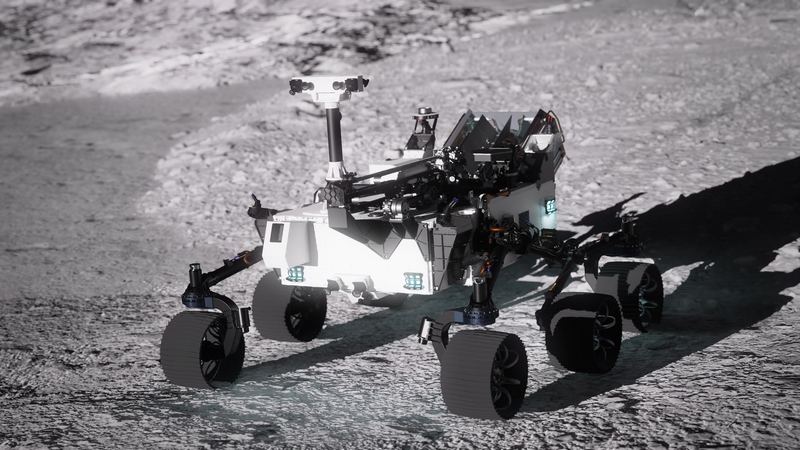
And then there is the rover, where the engineering gets specific. Blue Origin will fly PROMISE to the surface on its Blue Moon Mark 1 lander, under the $94 million award and $140 million in options. The rover is six wheels on a Curiosity-derived chassis. JPL is building it from the electronics, body structure and mobility system of the duplicate Curiosity vehicle used as a test bed for the Mars mission, supplementing that with flight spares and test models left over from Curiosity and Perseverance. That shortens the path from a parts bin to a landing site. Power comes from a flight-spare Multi-Mission Radioisotope Thermoelectric Generator, a unit that supplies about 110 watts of electricity at the start of a mission (NASA Radioisotope Power Systems). A hundred watts looks trivial next to a solar array, but it does not stop at sunset, and at the pole there is always a sunset.
The payload surveys everything the base will need to know. A rotary percussive drill called TRIDENT, designed by Honeybee Robotics, a Blue Origin subsidiary, pulls regolith up from a meter down in 10-centimeter increments while measuring how strong and how warm the material is. A mass spectrometer at Kennedy and a near-infrared spectrometer at Ames read its chemistry. A Lockheed Martin neutron spectrometer looks for hydrogen. A radiometer built at Johns Hopkins, using technology from the Lunar Reconnaissance Orbiter’s Diviner instrument, measures temperatures down toward -242 degrees Celsius inside permanently shadowed terrain. Everything runs on NASA’s High Performance Spaceflight Computing, which NASA says delivers more than 100 times the capability of current space processors. With light taking about 1.3 seconds to cross the Earth-Moon distance each way, the rover has to decide things on its own.
That chain is worth the arithmetic, because NASA has split the old lunar lander into three or four separately purchased pieces. From low Earth orbit to the lunar surface is roughly 5.6 kilometers per second of delta-v: about 3.1 for translunar injection, 0.9 for lunar orbit insertion and 1.7 for the powered descent. Tsiolkovsky’s rocket equation, Δv = v_e * ln(m_0 / m_f), explains why nobody flies that whole profile as one vehicle. A chemical stage with an exhaust velocity near 3.5 kilometers per second needs a mass ratio above two just for the departure burn. A Hall thruster needs far less propellant, but it thrusts too low to sprint, and solar flux at the Moon is a twenty-third of Earth’s. Electric transfers pay off when the cargo can carry a huge array, which is why the chain is layered. Impulse Space’s two awards show the logic: Helios, a chemical kick stage, takes the expensive first leg, while Mira and a throttleable lander handle the maneuvers and the descent. Blue Origin’s Blue Moon Mark 1 is scheduled to attempt a landing at the Shackleton Connecting Ridge, with SCALPSS cameras watching how engine plumes scour the ground. A second lander is booked to carry NASA’s VIPER rover in late 2027.
What to watch is not any single mission but the order they arrive in. Blue Moon’s Endurance landing attempt and CAPSTONE 02 both fly in 2027, followed by VIPER’s delivery, then the MoonFall drones, then PROMISE in late 2028 with its eighteen-month campaign. Every one of those dates assumes commercial hardware shows up on a schedule NASA does not control, at a place NASA does not own. The contracts do not make that harder. They make it financeable. An indefinite-delivery vehicle with a $10 billion ceiling turns a program of bespoke government spacecraft into a market where a lander operator has to show up repeatedly, not once, and where a failed delivery is somebody else’s problem. Whether the Moon Base ends up a settlement or a very expensive parking lot will be settled by how those eight companies perform over the next three years, long before anyone has to live there.
 Subscribe to our RSS feed









There are no comments.
Add A Comment