


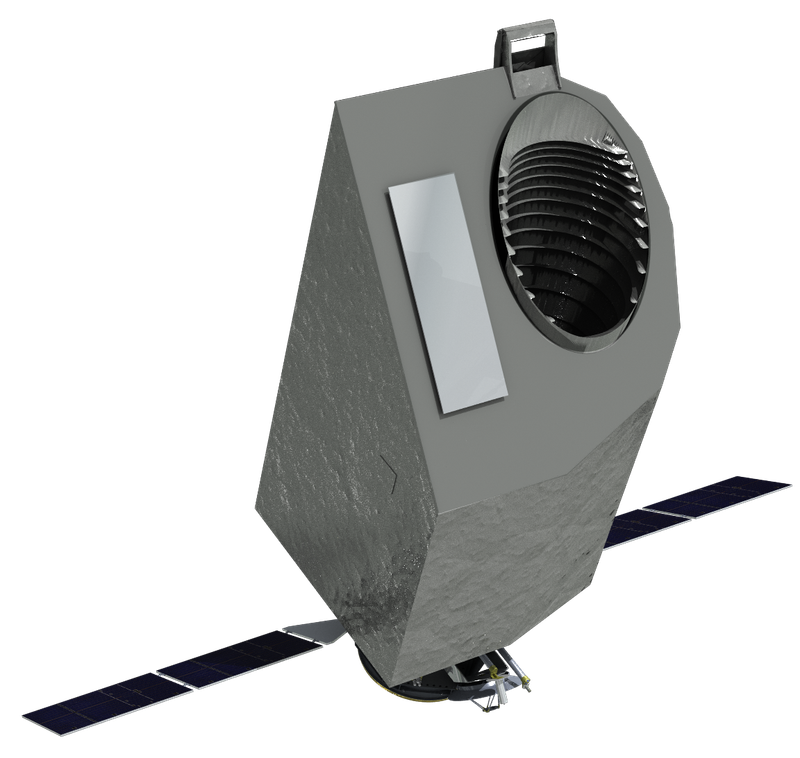
On October 27, 2026, NASA confirmed the Ultraviolet Explorer, or UVEX, after it cleared Key Decision Point C, a formal technical and programmatic review, committing the agency to a launch by January 2031 at a total lifecycle cost of $590 million (NASA, October 2026). Nothing has been built yet. The mirrors are still drawings and the detectors are still wafers. But a program that clears KDP-C has a budget, a schedule and an obligation to deliver.
What NASA has committed to is the first major ultraviolet space mission in two decades (SRI International, October 2026) and the first deep map of the entire sky in ultraviolet light, built from repeated visits over a two-year prime mission and reaching fifty to a hundred times deeper than the survey it inherits (Kulkarni et al., arXiv:2111.15608).
The ultraviolet is not a wavelength anyone misses until they try to work without it. Earth’s atmosphere is opaque below roughly 300 nanometres, so seeing it at all requires a space telescope, and the roster of great ultraviolet observatories is short. The last of them was GALEX, the Galaxy Evolution Explorer, launched on a Pegasus XL in April 2003 and decommissioned in June 2013 (NASA/JPL). It paired a 50-centimetre modified Ritchey-Chrétien telescope with a circular field 1.24 degrees across, splitting the beam through a dichroic into near and far ultraviolet channels read by microchannel plate detectors (Morrissey et al., 2004), one of which failed in 2009 and never came back.
What followed was not ultraviolet. Rubin, Euclid, Roman and SPHEREx map the sky in visible and infrared light, and every one of them leaves the ultraviolet gap sitting where GALEX left it. Filling that gap is harder than it looks, because ultraviolet astronomy runs into three difficulties with nothing to do with each other: the photons are scarce, the mirrors cannot be made of glass, and the detectors age.
UVEX is a Caltech mission with a NASA budget. Fiona Harrison, the Harold A. Rosen Professor of Physics at Caltech, is principal investigator; UC Berkeley’s Space Sciences Laboratory manages the project; Northrop Grumman builds the spacecraft; and the ultraviolet detectors come from NASA’s Jet Propulsion Laboratory and SRI International (Caltech, October 2026). The observatory was selected in February 2024 as a Medium-Class Explorer mission with a two-year lifetime, at about $300 million excluding launch and a 2030 launch (NASA, February 2024).
Two numbers moved since then. The price is now $590 million, close to double, and the launch deadline shifted to January 2031. NASA published no line-item account of the increase, so the fair reading is that the hardware grew more expensive faster than the schedule grew long. The ambition did not shrink, which is presumably why the review passed.
The science programme rests on three pillars. The first is low-mass, low-metallicity galaxies, which hold about half the mass in the local universe and are the closest analogues available to the first galaxies (Kulkarni et al., arXiv:2111.15608). The second is time-domain astronomy: the imagers will watch for change, and the long-slit spectrograph will swing toward new transients within hours, chasing supernovae and the kilonovae that follow neutron-star mergers. “With UVEX, we will now be able to follow up on gravitational-wave events in ultraviolet light,” says Mansi Kasliwal, who directs Caltech’s Palomar Observatory and sits on the UVEX team (Caltech, October 2026).
The third pillar is a particular kind of star. Blue stripped stars are massive stars whose hydrogen-rich outer layers have been torn away by an orbiting companion, exposing the interior, and they are hard to find because the giveaway is a slow change in their ultraviolet light. “We will be able to see what’s inside the stars,” says UVEX team member Kareem El-Badry (Caltech, October 2026). Scanning the sky over and over should turn up hundreds.
The hardware is where the difficulty sits. UVEX carries one instrument: a 75-centimetre effective aperture in an all-reflective three-mirror anastigmat feeding an ultraviolet instrument module (Kulkarni et al., arXiv:2111.15608). No glass anywhere, since ordinary optical glass absorbs ultraviolet hard, so the coatings on every mirror decide whether you get a working telescope or an expensive tube. The optical design is fast, at f/2.7, which sounds reckless until you work out the numbers: at 200 nanometres the diffraction limit of a 75-centimetre aperture is θ = 1.22 * λ / D, about 0.07 arcseconds, while the point-spread function runs around 2 arcseconds and the pixels are 2.25 arcseconds across (uvex.caltech.edu). UVEX is therefore sampling-limited rather than diffraction-limited, on purpose: each pixel holds roughly thirty resolution elements, and that is what buys sky coverage.
At the instrument module entrance, a dichroic splits the beam into far-ultraviolet and near-ultraviolet channels imaged simultaneously, 1390 to 1900 angstroms and 2030 to 2700 angstroms, each focal plane a three-by-three array of 4k by 4k CMOS detectors (Kulkarni et al., arXiv:2111.15608). The science case targets a two-year survey depth fainter than AB 25.8 in both bands, reached by stacking repeated visits to the same sky (uvex.caltech.edu). Multiply collecting area by solid angle, the quantity that sets how much sky a survey covers per second of exposure, and the gain shows up immediately. UVEX’s 0.44 square metres across 12 square degrees gives roughly 1.6 times 10 to the minus 3 square metre steradians; GALEX’s 0.20 square metres across 1.2 square degrees gives about 7 times 10 to the minus 5. The étendue is some twenty-two times larger, before the detector gains.
The detectors are the part that has taken longest. GALEX read photons with microchannel plates, which amplify electrons down a channel wall and carry that amplification’s noise with them. UVEX’s detectors are silicon: back-illuminated CMOS made sensitive to ultraviolet light by a thin implant just beneath the illuminated surface that suppresses the recombination which would otherwise destroy charge before it reaches the pixel, and by metal-dielectric bandpass filters deposited on the sensor window to reject out-of-band light (Hennessy et al., SPIE 2023). Delta-doped sensors with antireflective coatings are two to three times more efficient than the far- and near-ultraviolet detectors on GALEX (Nikzad, February 2026). JPL and SRI build the parts, the same lineage that put CMOS imagers on the Parker Solar Probe (SRI International, October 2026).
Why silicon works in this band comes down to energy bookkeeping. A 150-nanometre photon carries about 8.3 electronvolts, E = hc / λ, against a silicon band gap of 1.12 electronvolts, so one ultraviolet photon can liberate roughly seven electron-hole pairs. Below about 150 nanometres the Earth scatters essentially no light into the beam, which is why that band is called solar blind; the residual background comes from zodiacal light and geocoronal emission that the bandpass filters exist to cut. Even so, the spacecraft will not fly in low Earth orbit. UVEX goes into a 13.7-day lunar resonance orbit, the kind NASA called a “Goldilocks orbit” when it chose the same path for TESS, swinging from about 104,000 kilometres to about 396,000 kilometres (NASA Goddard, 2013; Kulkarni et al., arXiv:2111.15608). Staying clear of the Van Allen belts matters for a silicon detector, because energetic protons displace atoms in the lattice and dark current climbs for the rest of the mission.
None of this is guaranteed by a review. KDP-C commits NASA to build; the price has already moved once and Explorer schedules have slipped before. But the direction is set. When UVEX starts returning data in the 2030s, the ultraviolet sky stops being a set of targeted observations of objects somebody already knew about and becomes a systematic map, far deeper than anything preceding it, alongside Rubin, Euclid and Roman in the optical and infrared. The team argues that the archive is worth more than any single target: a deep ultraviolet map of the whole sky keeps paying out for decades after the people who built it have moved on. The prime mission is two years. The stars it will find and the explosions it will catch in the act will take the rest of the century to work through.
 Subscribe to our RSS feed









There are no comments.
Add A Comment