


A comet is a bad neighbour for a telescope built to stare at distant galaxies. Fixed light holds still inside an exposure. Comets do not. They smear a short streak across the detector, drag stray light into frames that were supposed to be empty, and complicate somebody’s photometry. Euclid was built to do the opposite. ESA’s dark Universe mapper sits at the second Sun-Earth Lagrange point and spends its nights holding position on patches of sky far beyond the Milky Way, measuring the shapes of galaxies with a precision the atmosphere never allows from the ground.
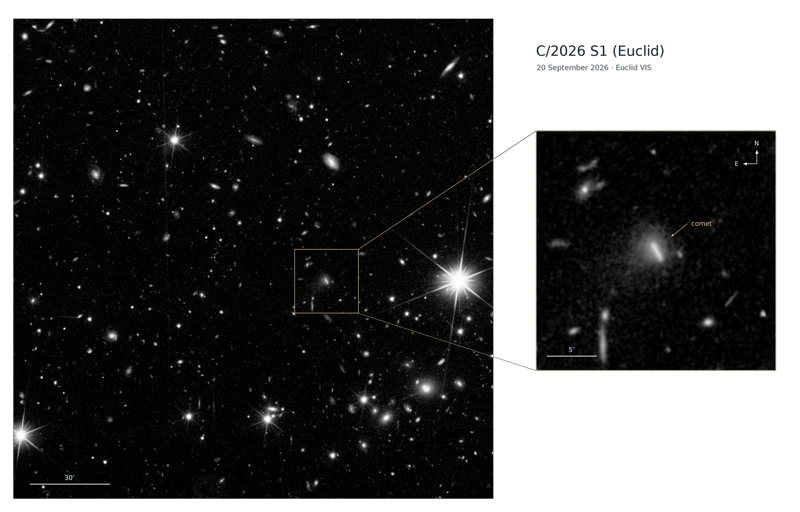
On 8 October 2026, the Minor Planet Center confirmed an object nobody had reported before, found by that telescope. C/2026 S1 (Euclid) is the first new comet Euclid has ever discovered, according to the agency’s announcement of the discovery.
There is a practical reason to care that a Solar System object turned up in a deep-space survey. Euclid’s science case rests on cleanly separating fixed sources from everything else. A comet trail crossing a galaxy image is a contaminating streak that has to be identified and masked, and a mask applied carelessly biases the weak lensing measurement the entire mission is built around. Every moving thing in the field gets accounted for, whether the team set out to look for it or not. There is also an older reason. Comets are leftovers from the Solar System’s formation, around 4.6 billion years old, arriving from the Kuiper Belt and the distant Oort Cloud. They have been altered very little since they formed, so the ices and dust they carry are a sample of the raw material that built the planets, including much of the water that ended up on Earth.
The detections came out of Euclid’s Deep Field North, in the constellation Draco, across a run of images taken between 16 and 24 September 2026. That field was chosen partly because it overlaps a region the now-retired Spitzer Space Telescope surveyed in infrared, a detail Universe Today reported on the discovery. Euclid caught the object in five separate fields of view, two to four exposures each, for 16 exposures in total.
Mikko Pöntinen, a PhD student at the University of Helsinki, wrote the software that caught it. He developed a moving-object detection tool to search Euclid images for small Solar System bodies, and it flagged a streak smeared across several frames. Predicting where the object ought to turn up next, he located it again in other image sets. Closer inspection turned up a fuzzy envelope around the point source, the signature of something actively shedding dust and gas rather than a solid rock. Pöntinen and the Solar System Objects Science Working Group of the Euclid Consortium checked the position against catalogues of known comets and asteroids. No match. He reported the observations to the Minor Planet Center, the global clearing house that collects reports from observers, confirms discoveries, computes orbits and assigns designations. Ground-based astronomers picked up the alert and contributed follow-up, and on 8 October the centre confirmed it as a comet. The designation C/2026 S1 follows standard convention, with the S marking a September discovery and the comet named for the telescope that found it.
At roughly 1.3 billion kilometres from Earth, the comet sits about where the Sun would be if you placed it halfway between the orbits of Jupiter and Saturn. Its orbit is the odd part. Most small bodies travel close to the plane the planets occupy. This one does not. It approaches from high above, and ESA describes the path as one that will take thousands of years to complete. The orbital period will be refined once more data has been collected. That geometry explains how the discovery happened at all, and it happened partly by luck. Euclid deliberately avoids the band of sky lying along the Solar System plane, where dust scatters sunlight into the optics and wrecks deep exposures. Finding new Solar System objects is harder for this telescope than for almost any other in service. Archive Scientist Bruno Altieri said very few comets are expected to turn up in Euclid data, and called the capture a happy coincidence of the comet’s orbit and the telescope’s scanning pattern across those particular days. Project Scientist Valeria Pettorino added that while this comet is not a suitable target for ESA’s planned Comet Interceptor mission, the discovery and the alert that followed give the two mission teams a real case study in how they would coordinate.
Two design decisions shaped what was possible. The first is Euclid’s observing strategy. It works step-and-stare: settle on a target, take the exposures, slew to the next position, do not come back. Each piece of sky gets visited once. For a fixed galaxy that is fine. For a moving comet it means a discovery has to be stitched together from unrelated snapshots taken at different points in the orbit, and confirmed by prediction rather than by simply looking again at the same spot. The five-field, 16-exposure recovery is a reconstruction from fragments. The second is scale. The visible imager is a mosaic of 36 CCDs, each with more than 4000 pixels a side, giving roughly 600 megapixels total, and it covers about half a square degree at a time, the area of two and a half full moons, across wavelengths from 550 to 900 nanometres, as ESA describes the instrument. The consortium specifies the field of view as 0.57 square degrees sampled at 0.1 arcseconds across a 609-megapixel array. Those numbers matter for the detection, because a comet at that distance is not a bright object. It registered as a faint smudge in a frame built to see galaxies looking back close to ten billion years. There is a third reason the find matters beyond curiosity. Comets and asteroids crossing Euclid’s fields are contaminating data as well as discoveries. The team’s job is to identify every moving object, work out where it should have been, and subtract it. Doing that well enough to also notice a fuzzy envelope around one of them is the same detection pipeline doing two different jobs at once.
Euclid has been working at L2 since 2023, partway through a planned six-year survey of roughly a third of the sky, and it is expected to measure more than a billion galaxies. It found a comet anyway. Not because it was hunting one, and not because dark Universe observatories are good comet hunters, but because a PhD student’s software was watching for streaks in the data as routine housekeeping. More finds like it are plausible. The consortium team already had to detect known comets in Euclid frames before this one turned up, and every streak lifted out of a galaxy image is a streak somebody examined closely. The orbital period of C/2026 S1 is still open pending more measurements, and there is a fair chance the follow-up community revises the initial description before the numbers settle.
The discovery will be archived under a name that will not change: C/2026 S1, the first comet Euclid found, in a survey pointed deliberately away from it.
Image: Comet C/2026 S1 (Euclid) in Euclid VIS data, 20 September 2026. Credit: ESA/Euclid/Euclid Consortium.
 Subscribe to our RSS feed









There are no comments.
Add A Comment