


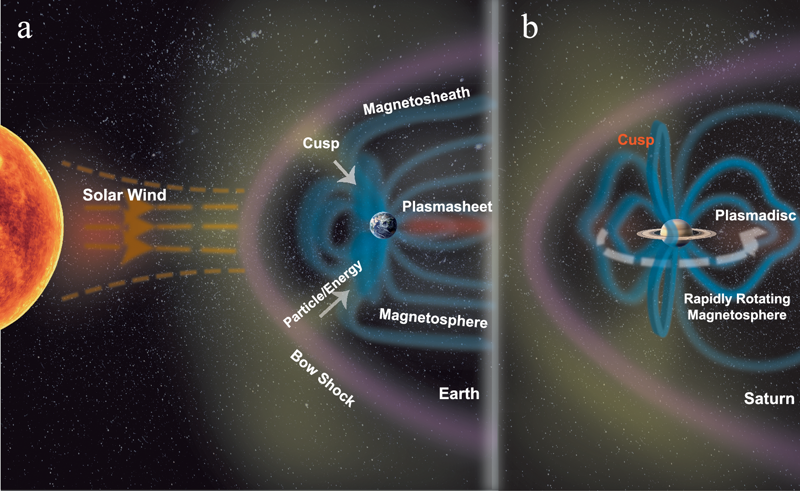
Earth’s magnetosphere is, by planetary standards, a tidy thing. The solar wind blows outward from the Sun, the planet’s magnetic field pushes back, and the funnel-shaped openings near the north and south poles, called cusps, sit almost directly under the Sun at local noon. That is the place where the incoming stream of charged particles most cleanly slips through the magnetic shield and into the atmosphere. Saturn does nothing of the kind. A team led by Dr. Yan Xu of the Southern University of Science and Technology has now mapped the kronian cusp using six years of archival Cassini magnetometer and plasma data, and found that the opening is dragged well into the afternoon. On average it sits between 13:00 and 15:00 local Saturn time, and in some events it extends toward 20:00, three to eight hours from where Earth’s equivalent sits. The culprit, the team argues, is not the solar wind at all. It is Saturn’s 10.7-hour rotation and the heavy load of ionized water vapor that the moon Enceladus pumps into the magnetosphere from its south-polar plumes.
The paper, published on 1 April 2026 in Nature Communications by Xu, Zhonghua Yao, Andrew Coates, Licia Ray, Sarah Badman, Chris Arridge and nine co-authors, is more than a curiosity about a single planet. The result is direct observational evidence for a long-standing theoretical claim: that on rapidly spinning gas giants with active moons, the planet’s own rotation can become the dominant force shaping its magnetosphere, more important than the Sun. If that is true at Saturn, it almost certainly extends to Jupiter, where the same physics plays out at larger scale, and to the growing catalog of exoplanets whose magnetic environments astronomers are now trying to characterize from a distance. “This study provides critical evidence for a long-held theory, that the rapid spin of massive planets like Saturn with active moons replaces the solar wind as the dominant force shaping magnetospheres,” Coates, a professor at University College London’s Mullard Space Science Laboratory, said in the UCL release.
There is a more practical reason the result matters. Saturn’s auroras are unusually bright and unusually variable, and one of the open questions in kronian physics has been why the most energetic emissions appear in the afternoon sector rather than at noon as on Earth (Lancaster University press release, August 10, 2026). A cusp that lives in the afternoon is also where magnetic reconnection, the explosive snapping and reconnecting of magnetic field lines that accelerates particles to keV energies and beyond, is most likely to fire. Knowing where the cusp sits helps the community locate the engine room of Saturn’s auroras, and the figure and full discussion have been widely covered in the planetary-science press (Sci.News writeup).
The analysis uses data from two of Cassini’s instruments, the magnetometer (MAG) and the Cassini Plasma Spectrometer (CAPS), collected between 2004 and 2010. Cassini spent thirteen years orbiting Saturn before its deliberate plunge into the planet’s cloud tops on 15 September 2017, and its archive is still turning up new science more than eight years after end of mission. For this study, the team pulled 67 discrete cusp crossings from the MAG and electron spectrometer data, then used a magnetic-field-line tracing model to localize each event in kronian local time. The result, summarized in the paper’s Figure 4, is a statistical map that looks nothing like Earth’s: instead of a single peak at noon, the kronian cusp occurrence rate is broadly distributed across the afternoon and early evening, with the centroid shifted several hours past local noon.
Two ingredients go into the explanation. The first is rotation. Saturn’s day is about 10.7 hours long, roughly 2.25 times shorter than Earth’s, and the planet’s deep interior is thought to rotate almost as a solid body. That fast spin drags the magnetic field, and everything locked to it, around the planet. The second is internal plasma loading. Enceladus, a small icy moon orbiting deep inside Saturn’s magnetosphere, vents water vapor from fractures near its south pole at a rate that turns out to be significant for the planet’s space environment. Cassini first imaged those plumes in 2005, and the ionized water they produce loads Saturn’s magnetosphere with heavy ions, including O+, OH+ and water-group species. Once ionized, this material is picked up by Saturn’s rotating magnetic field and pulled around the planet, where it contributes pressure that competes with the solar wind.
A 2019 paper in the Journal of Geophysical Research: Space Physics had already shown that Saturn’s equatorial current sheet oscillates with a period tied to the planet’s rotation rate, and that the sheet’s position depends on the balance between the solar wind pushing from outside and the internal plasma pushing from inside. The Xu et al. result extends that picture to the polar cusp, and shows that the imbalance is large enough to move the cusp by hours of local time.
The magnetosphere is the cavity carved out of the solar wind by a planet’s magnetic field. Its outer boundary, called the magnetopause, is the surface where the pressure of the planet’s field balances the pressure of the incoming solar wind. On Earth, the magnetopause is roughly ten Earth radii upstream, and the cusps are narrow funnel-shaped regions near the magnetic poles where field lines converge and dip back into the atmosphere. Charged particles from the solar wind can ride these open field lines directly into the upper atmosphere, which is why the cusps are preferred sites for auroral precipitation and direct solar wind entry into the magnetosphere.
The picture changes when a planet rotates fast and carries a lot of plasma around with it. At Saturn, the magnetosphere is enormous, more than ten times wider than the planet itself, and the heavy load of Enceladus-derived ions gives the internal plasma pressure enough weight to push the magnetopause outward on the night side and compress it on the day side. The fast rotation then drags the whole asymmetric structure around the planet. In the team’s high-resolution simulations, the net result is that the cusps are no longer located near local noon but are pushed several hours toward dusk.
That matters because of magnetic reconnection, the process by which oppositely directed magnetic field lines snap and reconnect across the magnetopause, releasing stored magnetic energy and accelerating particles to high energies. The location of the cusp sets the stage for where reconnection is most likely to occur, and where reconnection occurs is where the most energetic charged particles enter the magnetosphere. A cusp that sits in the afternoon sector therefore predicts afternoon-loaded energetic particles and auroral emissions concentrated on the afternoon and evening side of the polar cap.
The team also addressed a secondary question. Saturn’s magnetic field is famously hard to measure, because the planet’s radio emissions, the usual proxy for rotation rate, are unusually weak compared to Jupiter’s. The kronian rotation period has been a long-running puzzle. The Xu et al. result does not solve it, but it constrains one variable that goes into rotation-period models: the spatial distribution of plasma inside the magnetosphere.
Saturn’s magnetosphere is not a scaled-up Earth. The kronian cusp, the place where the solar wind enters the atmosphere most easily, is shifted into the afternoon because of two things the Earth does not have in any meaningful amount: a 10.7-hour rotation that drags magnetic field lines around the planet, and an active icy moon that loads the magnetosphere with water-group plasma. The Xu et al. 2026 paper compiles 67 such events from Cassini’s first six years at Saturn, and the statistical map of cusp occurrence has its centroid at 13:00 to 15:00 local time, with some events reaching 20:00.
The next test is at Jupiter, where Juno is still returning magnetometer data and where the same physics should produce a similarly skewed cusp distribution at larger scale. Looking further out, the framework should help astronomers reading magnetic signatures of hot Jupiters around other stars, where rapid rotation and intense plasma loading are the rule.
 Subscribe to our RSS feed









There are no comments.
Add A Comment