


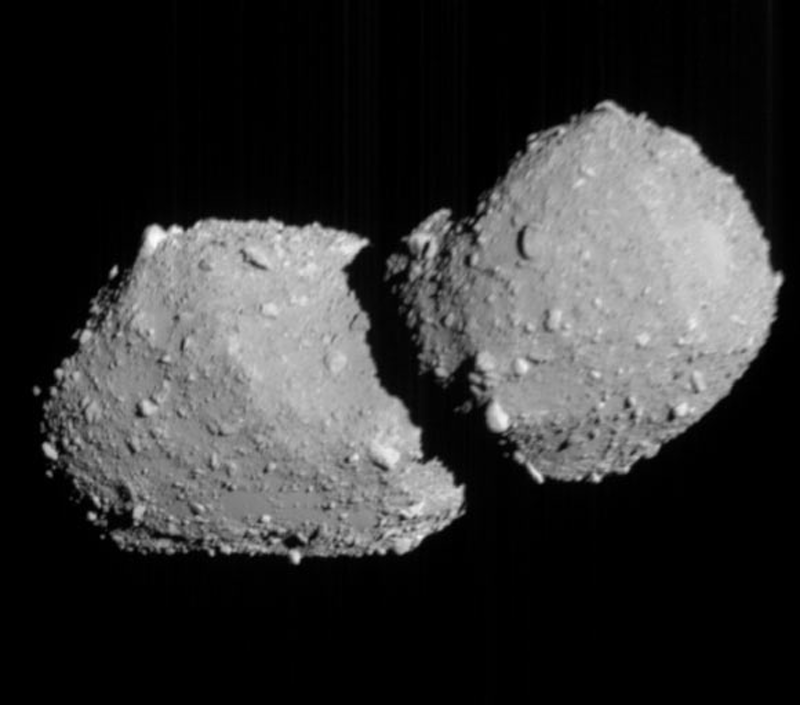
On the evening of July 5, 2026, a 600-kilogram box of solar panels and instruments zipped past a peanut-shaped rock 450 meters across at roughly five kilometers per second. The flyby lasted about as long as the time it took you to read this sentence. The spacecraft was JAXA’s Hayabusa2, on a deliberate dash past near-Earth asteroid 98943 Torifune, also known by its provisional designation 2001 CC21. By the time anyone on Earth saw a single pixel of the encounter, the spacecraft was already several thousand kilometers beyond the asteroid, never to swing back (JAXA, July 6, 2026).
That brevity is the point. Torifune is the first of three asteroid encounters the extended Hayabusa2 mission is supposed to make before the probe reaches its true final target, the tiny 11-meter asteroid 1998 KY26, in 2031. The spacecraft is a sample-return craft that has already done its main job. Every extra maneuver now is rehearsal for an encounter that will be the most technically punishing of the mission (The Planetary Society, July 7, 2026).
Two reasons. First, Torifune is a contact binary, a body made of two lobes stuck together like a snowman, and those shapes are common in the small-body population but hard to study up close. Ground-based radar and adaptive-optics images suggested it was elongated; until last week no spacecraft had ever confirmed the structure with its own camera.
Second, the flyby is a deliberate dress rehearsal for planetary defense. JAXA wanted to demonstrate the kind of precision terminal guidance a kinetic impactor mission like NASA’s DART would need, where the spacecraft picks a small, faint, irregularly shaped target and threads a narrow approach corridor without hitting it. Torifune is the right kind of object: small, dim, and only clearly resolved a few days before closest approach. The mission team could not plot the final approach trajectory until the very end, because Torifune is faint enough that its exact orbit was uncertain until then (The Planetary Society, July 7, 2026).
If you are trying to design a spacecraft that bumps a city-block-sized rock off course, this is the kind of practice you want.
Hayabusa2 launched in December 2014 on an H-IIA rocket and arrived at asteroid Ryugu in mid-2018. Over the next eighteen months it dropped a pair of tiny hopping rovers, lowered the German-French MASCOT lander onto the surface, fired a 2-kilogram copper projectile into Ryugu to expose fresh sub-surface material, and scooped up samples. The return capsule landed at Woomera, Australia, in December 2020. Inside, scientists found water-bearing minerals, organic molecules, and grains that had escaped billions of years of space weathering. The samples are still being analyzed and are among the cleanest primitive materials anyone has yet returned from a carbon-rich near-Earth asteroid (Sci.News, July 8, 2026).
Most sample-return missions end there. Hayabusa2 did not. After releasing its sample capsule, the main spacecraft fired its ion engines and began a new trajectory. The extended mission has two goals: a high-speed flyby of Torifune in 2026, two Earth gravity assists in 2027 and 2028, and a final rendezvous with 1998 KY26 in 2031 (ISAS, mission page).
The Torifune encounter happened on July 5 at 18:30 JST, give or take one second. The spacecraft passed about 800 meters from the asteroid’s center, well outside the body but close enough that its three imaging instruments could resolve surface detail. ONC-T, the visible-light Optical Navigation Camera, started tracking Torifune on June 20 and continued to use the asteroid as an optical navigation reference right up to closest approach. About an hour before the flyby, the spacecraft also switched on NIRS3, a near-infrared spectrometer that hunts for water and hydroxyl signatures; TIR, a thermal infrared imager; and LIDAR, which bounces a laser off the surface to measure distance (JAXA, July 6, 2026).
Closest approach came and went. Hayabusa2 could not look back. JAXA confirmed the spacecraft was healthy at 18:35 JST, five minutes after the flyby, and the first images and thermal maps arrived within a day (Sky & Telescope, July 6, 2026).
The visible-light image showed what ground-based observers had suspected. Torifune is two distinct lobes joined at a narrow neck, the textbook shape of a contact binary formed when two smaller asteroids collided gently and stuck rather than bouncing apart. At about 450 meters across, it is in the same size class as the near-Earth asteroid Apophis and roughly an order of magnitude larger than the object that exploded over Chelyabinsk in 2013 (The Planetary Society, July 7, 2026).
The naming fits. JAXA chose “Torifune” through a public contest; it is short for Ame-no-Torifune, a Japanese deity associated with safe, steady, high-speed travel. You can see why the mission team liked it.
A flyby at five kilometers per second does not leave much margin for error. A small miscalculation in the closest-approach distance translates into several hundred meters of horizontal miss, easily enough to fly by the wrong side of the asteroid. There is no second chance. Hayabusa2 had to arrive at a precise point in space at a precise time, then keep going.
The spacecraft used a hybrid optical and radio navigation scheme. ONC-T took repeated images of Torifune against the background star field, and the team on the ground measured the asteroid’s apparent position to refine the predicted encounter point. Combined with deep-space network Doppler and ranging data, this let mission control update the trajectory within the last few days before closest approach. JAXA has not published the final navigation error budget, but the fact that ONC-T returned sharply focused images from 800 meters suggests the geometry worked (JAXA, July 6, 2026).
The thermal imager, TIR, observed Torifune in the 8 to 12 micrometer band, the thermal infrared where a sunlit asteroid radiates most of its heat. The brightness temperature, divided by the solar illumination, lets you back out the surface’s thermal inertia, a property set by regolith grain size, packing, and whether the surface is bare rock or blanketed in dust. For a small contact binary, the thermal data is the only way to learn what the surface is made of, because visible and near-infrared spectroscopy during a flyby captures too little reflected sunlight to break out mineral absorption signatures cleanly.
LIDAR is simpler but just as important. It rangefinds the surface with a 1.064-micrometer pulsed YAG laser, accurate from 30 meters out to 25 kilometers. During the Torifune encounter it produced a continuous altitude profile in the final minutes before closest approach, doubling as both a navigation input and a shape model. Combined with the ONC-T silhouette from a known viewing angle, the LIDAR track pins down the asteroid’s three-dimensional shape far better than the optical images alone (JAXA, July 6, 2026).
The instrument suite is what the spacecraft will carry into the 1998 KY26 encounter in 2031. KY26 is a different problem. At roughly 11 meters across, it is small enough that Hayabusa2 will not simply fly past; the extended mission plan calls for an actual orbit insertion and an attempted landing. The asteroid’s rapid rotation period, on the order of a few minutes, will make that landing extremely difficult, and the extended mission team is using Torifune to validate the optical and thermal mapping pipeline they will need for the harder job.
Hayabusa2 has now visited three asteroids across two missions. The first primary mission gave the world its best sample of a carbon-rich near-Earth asteroid. The extended mission is a chain of progressively harder technical demonstrations, and the Torifune flyby is the one with the lowest stakes but the cleanest test of the navigation approach JAXA wants to use in 2031. More data will downlink over the coming weeks.
Two years from now, the spacecraft will swing past Earth for a gravity assist. Three years after that, in 2031, it will arrive at a rock smaller than a house and try to land on it. Last week’s flyby is the first of the milestones the extended mission still owes the public. JAXA hit the geometry and returned a clean, recognizable image. The data will inform how we eventually deflect a real asteroid.
 Subscribe to our RSS feed









There are no comments.
Add A Comment