


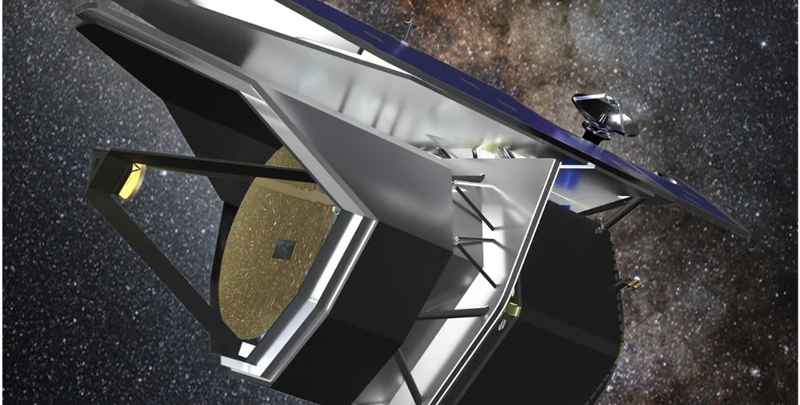
NASA announced on Wednesday, September 23, 2026 that its next great space observatory will be PRIMA, the PRobe far-Infrared Mission for Astrophysics, and that the $1.2 billion project has been advanced into Phase B development on a path toward a 2033 launch (NASA news release). PRIMA is the first in a new mission line NASA is calling Probe Explorers, a billion-dollar class that sits between the agency’s smaller Explorer-class satellites (such as SPHEREx and NICER) and its flagship observatories like the newly launched Nancy Grace Roman Space Telescope (SpaceNews). The observatory’s job is to do something neither Roman nor the James Webb Space Telescope was designed to do well: stare through the cold, dusty universe at wavelengths from 24 to 235 micrometers, the far-infrared window where most of the radiant energy from planet birth, black hole accretion, and interstellar dust actually emerges (Caltech announcement).
The reason far-infrared astronomy needs its own flagship is straightforward and a little humbling. Roughly half the energy released since the Big Bang has been absorbed by interstellar dust and re-radiated in the far-infrared, a band that is essentially opaque from the ground and that earlier infrared telescopes have only been able to nibble at. ESA’s Herschel Space Observatory, the last major far-infrared mission, ended in 2013. NASA’s Spitzer, the predecessor JPL ran for Caltech, ran from 2003 to 2020. SPHEREx, launched in March 2025, maps the whole sky in near-infrared colors but is not optimized for the deep, narrow surveys a 1.8-meter cryogenic far-infrared telescope can deliver (IPAC project page). JWST, for its part, runs from 0.6 to 28 micrometers and is fundamentally a near-and-mid-infrared observatory, leaving the long-wavelength half of the infrared spectrum to PRIMA (Live Science). The Astro 2020 Decadal Survey, led by Caltech physicist Fiona Harrison, asked NASA to fill that gap, and the question of how Earth’s water arrived is one of the targets the survey explicitly named as ripe for a far-infrared answer (NASA news release).
PRIMA is being designed to be, in Caltech President Ray Jayawardhana’s words, “orders of magnitude more sensitive than previous far-infrared space missions” (Caltech announcement). The trick is the same one Herschel and Spitzer used, but pushed harder: a 1.8-meter primary mirror and a detector array cooled to about 4.5 kelvin, so that thermal noise from the telescope itself stops drowning out the faint signals from distant galaxies and cold dust. At the back of the optics sit two science instruments. FIRESS, the Far-Infrared Enhanced Survey Spectrometer, is a four-band grating spectrometer covering the full 24 to 235 micrometer range, with a Fourier Transform Module that can be inserted to push spectral resolution as high as 20,000 (PRIMA instrument page). PRIMAger, the imager, splits into two sub-instruments: the Hyperspectral Imager (PHI), which scans 24 to 84 micrometers at a spectral resolution of about 8, and the Polarimetric Imager (PPI), which uses four filters from 92 to 235 micrometers to measure the I, Q, and U Stokes parameters of incoming light, the first dedicated far-infrared polarimeter ever flown on a NASA mission. Both instruments read out through superconducting kinetic inductance detectors (KIDs), a technology Jonas Zmuidzinas at Caltech and Rick LeDuc at JPL first sketched out in 1999 over coffee near campus and that has spent the intervening decades maturing in ground-based and balloon-borne instruments (Caltech announcement).
What those instruments let PRIMA actually do falls into three themes the 2020 Decadal Survey highlighted. First, the chemistry of planet formation. Far-infrared spectroscopy captures the cold molecular fingerprints (HD rotational lines, water vapor bands, OH, neutral carbon, nitrogen, oxygen, neon) that trace the disk midplanes where gas giants and ice giants are still accreting, the wavelengths JWST’s mid-infrared instruments struggle to reach from inside dust cocoons (NTRS PRIMA concept paper). Second, the co-evolution of galaxies and their central supermassive black holes. Far-infrared dust continuum tracks the obscured side of accretion that X-ray and optical surveys miss, and the new PRIMA Hyperspectral Imager is built to map dust temperature and star-formation rate across cosmic time in single pointed observations. Third, the build-up of dust and heavy elements from the first galaxies to today, the link between stellar nucleosynthesis and the cold universe that JWST and ALMA have been hinting at but cannot survey with the same speed (NASA news release). Twenty-five percent of the five-year prime mission goes to the PI-led science program; the remaining seventy-five percent is open to the broader community through a General Observer call, modeled on the same time-allocation structure Hubble and JWST use today (IPAC project page). The engineering challenges are also unusual for a Probe-class mission: holding a 1.8-meter telescope and two large instruments near 4.5 K for five years, in a Sun-Earth L2 halo orbit similar to Roman’s and JWST’s, requires a multi-stage mechanical cooler chain with no flight-qualified NASA heritage at that scale. The mission also leans on international partners more heavily than most Probe-class concepts typically do: CNES (France) is co-leading PRIMAger with the Laboratoire d’Astrophysique de Marseille and CEA, SRON (Netherlands) is co-developing both instruments, the Max-Planck Institute in Heidelberg built the beam-steering mirrors, and the Canadian Space Agency, DLR, ASI, KASI and KASA, JAXA, and the UK Space Agency all contributed to the Phase A studies (NASA news release). NASA has not yet chosen a launch vehicle, and the $1.2 billion cost cap explicitly excludes launch and other non-project costs, which is why the total mission price tag will be higher than the headline number.
PRIMA’s two-year Phase B is now the gating step. The team has to lock the optical design, demonstrate the cryocooler chain to NASA review board standards, and pass the confirmation review that lets the project enter Phase C implementation, with the same kind of cost-and-schedule scrutiny that pushed the Roman mission through development (SpaceNews). If everything lines up, a 2033 launch puts PRIMA into operation in the mid-2030s, after Roman’s prime five-year survey ends and as JWST enters its second decade of fuel-limited life. The selection also marks the formal opening of the Probe Explorer line, with the next call for proposals expected within the next two NASA budget cycles (NASA news release). In the words of Astrophysics Division director Shawn Domagal-Goldman, the goal is “a pipeline that will consistently have missions of this caliber ready to go,” one Probe Explorer per decade, each opening a wavelength band the current fleet cannot reach. The choice to start that pipeline with the far-infrared is not accidental. Roughly half the photons the universe has ever produced live in that band, and PRIMA is the first NASA mission in more than a decade built specifically to count them.
 Subscribe to our RSS feed









There are no comments.
Add A Comment