


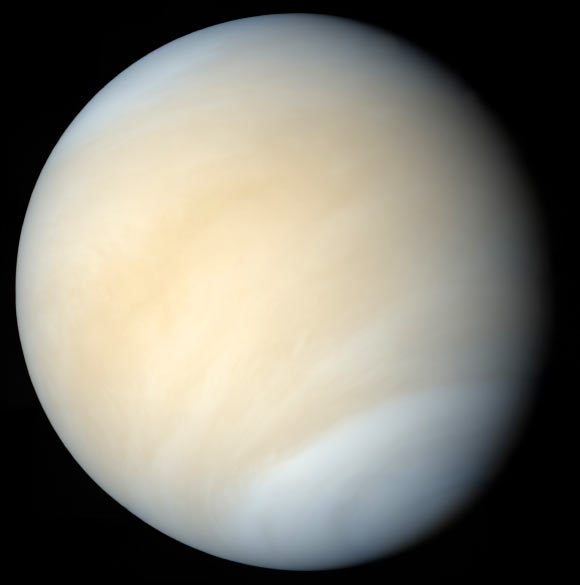
Venus looks like a smooth yellow disc through any backyard telescope. Point an ultraviolet camera at it, and the same clouds darken into a patchwork of bright and dim regions that has been tracked, named, and puzzled over since the 1920s. The dark patches are not shadows. They are absorbers, real material mixed into the sulfuric acid droplets of Venus’s upper cloud deck, and they soak up enough short-wavelength sunlight to change the planet’s appearance at wavelengths the human eye cannot see.
A new analysis from the Foundation for Applied Molecular Evolution puts a sharp quantitative number on how strong that absorption has to be. The team, led by Jan Spacek with collaborators Yeon Joo Lee of South Korea’s Institute for Basic Science, Janusz Petkowski of the Wroclaw University of Science and Technology, and Paul Rimmer of Cambridge, ran Venus’s observed UV reflectance through a radiative-transfer model that removes the contribution of cloud-droplet scattering and leaves behind a pure absorption coefficient for the liquid inside the droplets. The reported value at 375 nanometers is about 1,278 per centimeter in decadic units, Sci.News writeup of Spacek et al. 2026. That is roughly the absorption strength of a moderately concentrated dye, and it is the kind of number a lab spectroscopist can compare directly against a candidate molecule in a cuvette.
Every Venus mission proposal for the last forty years has, somewhere in its science case, a paragraph about the unknown UV absorber. The substance controls how much sunlight reaches the cloud tops, which sets the upper atmosphere’s energy budget, which feeds back into the superrotation that whips the cloud deck around the planet every four days. If we cannot identify it, every model of Venus’s climate is operating with a free parameter that has been tuned rather than measured. There is also a deeper reason the absorber matters: the cloud deck sits between roughly 50 and 70 kilometers altitude, with pressures and temperatures that on Earth would not be ruled out as a habitat for some kind of microbial life, and the phosphine debate of 2020 was in effect a debate about what kind of chemistry the clouds could host. A clean identification of the absorber would not settle that question, but it would remove one of the major unknowns. The paper was published in Astrobiology on August 25, 2026.
Astronomers have known about Venus’s UV markings since the late 1920s, when ultraviolet-sensitive photographic plates showed the planet as a mottled disc rather than the bland yellow ball it appears at visible wavelengths. The Pioneer Venus Orbiter in the late 1970s, Venus Express from 2006 to 2014, and Akatsuki since 2015 have all mapped the markings in detail. They track the four-day superrotation of the upper cloud deck, which is itself a puzzle: the atmosphere rotates about sixty times faster than the solid planet below. The markings brighten, dim, and re-form over timescales of days to years, and they do not correlate cleanly with any single altitude or temperature layer.
The candidate list is long. Sulfur allotropes, ferrous chloride, hematite, several organic compounds, even microorganisms have all been proposed at various points. None of them, on their own, match all the observational constraints at once: the right absorption strength, the right wavelength dependence, the right behavior over time, and chemical survival in a cloud environment that is mostly concentrated sulfuric acid with traces of water. The Spacek et al. paper takes a different approach. Instead of asking which molecule fits, the team asks how strong the absorption in the bulk cloud liquid has to be, in units a lab spectroscopist recognizes.
They start from spacecraft measurements of Venus’s reflectance between 365 and 455 nanometers and feed those measurements into a radiative-transfer model that treats the cloud droplets as Mie scatterers and accounts for multiple scattering by atmospheric molecules above the cloud deck. The output is the absorption coefficient of the bulk cloud liquid, the same quantity you would get from putting a sample in a cuvette and running a UV-visible spectrometer.
The peak comes out at about 1,278 per centimeter at 375 nanometers. To put that in concrete terms, porphyrin-type pigments in the lab, used here only as familiar examples of efficient absorbers rather than as biological claims, would need to be present at concentrations on the order of 10 grams per liter to hit that coefficient. Many of the inorganic candidates proposed over the years would need to be present at concentrations that strain chemical plausibility in a sulfuric acid aerosol.
A second result is just as important. The spectrum is steep. Between 365 and 455 nanometers, the inferred absorption drops sharply. That rules out the broad, brown, tar-like absorption that simple organics tend to develop when soaked in concentrated sulfuric acid over time. Whatever the absorber is, it resists being converted into that messy mixture. In Spacek’s words, the relatively sharp absorption profile is consistent with a chemically defined absorber that resists conversion into the tar-like mixture. The shape of the spectrum is now a constraint any future candidate has to satisfy.
The radiative-transfer step is the heart of the result and worth a closer look. Venus’s clouds are optically thick, with optical depths well above unity at UV wavelengths, so a photon entering the cloud deck is likely to scatter many times before it is absorbed or reflected back. From orbit, you see a planet that is darker than the underlying absorption alone would suggest, because each scattering event lengthens the photon’s path through the absorbing medium.
Spacek’s group accounts for that with a two-stream treatment, separating the cloud droplet’s scattering cross section from its absorption cross section. The droplet’s bulk refractive index at the relevant wavelengths is the standard sulfuric acid value. The atmospheric path above the cloud deck, mostly carbon dioxide with sulfur dioxide, is treated as a Rayleigh-scattering layer with a small but non-negligible contribution. The model then inverts the observed reflectance to recover the absorption coefficient of the bulk liquid.
The choice of wavelength window matters. Below 365 nanometers, Venus’s atmosphere starts to absorb strongly on its own, mainly through sulfur dioxide bands, and the cloud signal gets harder to disentangle from the gas signal. Above 455 nanometers, the absorber is less active, and the signal-to-noise ratio on the recovered absorption coefficient drops. The 365 to 455 nanometer window is the cleanest band where the absorption is dominated by the cloud droplet’s liquid content.
The 1,278 per centimeter number is a decadic absorption coefficient, the base-10 version of the natural absorption coefficient. In spectroscopy, a value around 1,000 per centimeter in a one-centimeter path length corresponds to roughly 90 percent absorption. That is an aggressive target for any single-component absorber at the concentrations likely in a Venusian cloud droplet, which is why the paper frames its conclusion in terms of either very high concentration, very efficient molecules, or both. The porphyrin-class example is used precisely because porphyrins are exceptionally efficient absorbers per molecule.
A subtler point: the constraint applies to the bulk liquid absorption, not to a single molecule’s molar extinction. A mixture of moderately efficient absorbers at high enough concentration can also produce a bulk coefficient of 1,278 per centimeter, and the paper’s framing does not distinguish between the two cases.
Spacek et al. have not identified the absorber. They have done something arguably more useful: they have turned a planetary-science puzzle into a laboratory measurement with a specific number. A bulk liquid absorption coefficient of about 1,278 per centimeter at 375 nanometers, with a steep roll-off toward 455 nanometers, is now the constraint any candidate has to hit.
The next steps are clearer for it. Lab spectroscopy can screen proposed compounds against this number without flying anything to Venus. Atmospheric modelers can use the tight constraint to reduce the free parameters in their climate simulations. And mission planners designing future Venus cloud-sampling platforms, whether they are looking for chemistry or for the more speculative question of cloud-borne biology, now have a sharper target list to test.
 Subscribe to our RSS feed









There are no comments.
Add A Comment