


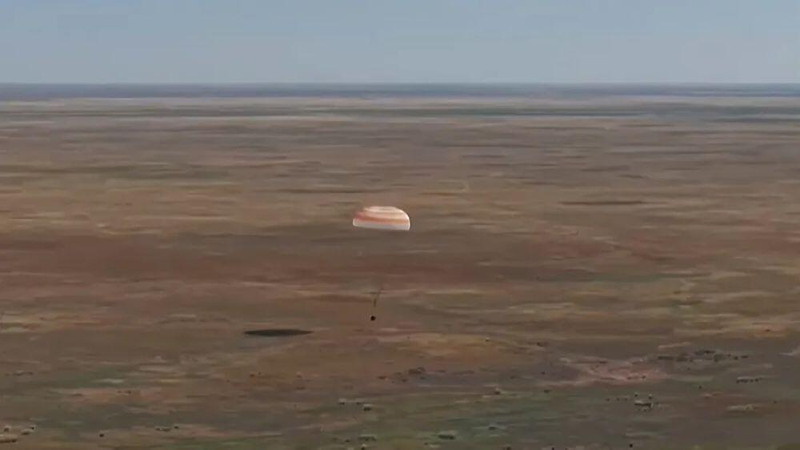
The Soyuz MS-28 spacecraft touched down on the Kazakh steppe at 5:27 a.m. local time on Sunday, July 26, 2026, with three crew members strapped into a descent module that had just survived a 7.6 km/s hypersonic dive through the atmosphere. By the time the capsule rolled to a stop about 147 km southeast of Dzhezkazgan, NASA’s Chris Williams, Roscosmos’s Sergey Kud-Sverchkov, and Sergei Mikaev had spent 241 days in orbit and crossed 3,856 orbits of the Earth, roughly 164 million kilometers of free fall, longer than the average round-trip distance from Earth to Mars (NASA, July 2026).
The Soyuz landing sequence has not changed meaningfully since 1967. The capsule separates from its orbital and service modules, fires a braking engine, falls semi-ballistically for about seven minutes through 1,500 °C plasma, deploys two drogue chutes and a 1,000-square-meter main, jettisons its heat shield, and fires six solid-fuel soft-landing engines about 70 cm above the steppe (Energia/RussianSpaceWeb, 2024). Every crew member who has flown on a Soyuz, from the first 1967 boilerplate to Williams’s 2026 flight, has come home in essentially the same hardware lineage. No other crewed spacecraft has logged more return flights to Earth.
That continuity is narrowing. The U.S. Deorbit Vehicle (USDV), a heavily modified Cargo Dragon with 46 Draco thrusters and roughly 16 tonnes of propellant, is scheduled for delivery readiness in October 2028, with launch around mid-2029, after which the 420-tonne ISS will be steered into the Pacific at Point Nemo no earlier than late 2030 (NASA Office of Inspector General, 2025). Every Soyuz landing between now and then is one of the last acts of a 30-year joint occupation of low Earth orbit. On July 26, Expedition 74 ended; Expedition 75, with Jessica Meir in command and Anil Menon freshly arrived on Soyuz MS-29, took over.
Williams, a medical physicist by training, became the 642nd person to enter orbit when Soyuz MS-28 launched on Thanksgiving Day, November 27, 2025, from the Baikonur Cosmodrome. He and his two Russian crewmates joined Expedition 73/74 and spent eight months supporting more than 200 experiments, including semiconductor crystal growth, bioprinting of vascular tissue for cancer research, and testing a new European exercise device called the E4D that combines cycling, rowing, and resistance in one frame (NASA, March 2026).
The handover began on July 14, when Soyuz MS-29, carrying NASA astronaut Anil Menon and Roscosmos’s Pyotr Dubrov and Anna Kikina, docked at the Prichal node module after a three-hour rendezvous. Twelve days later, on July 25, Kud-Sverchkov passed command of the ISS to Meir. The next morning at 3:03 a.m. EDT, MS-28 undocked from the Rassvet module. For about two and a half hours, it drifted away in free fall, trailing by roughly 12 m/s of relative velocity, while ground controllers computed the deorbit burn.
At 5:32 a.m. EDT, the KTDU-35A main engine fired for 282 seconds, slowing the spacecraft by 115 m/s, enough to drop its perigee into the upper atmosphere. Twenty-two minutes later, the habitation and instrument modules separated, leaving only the 2.9-tonne descent module pointed heat-shield-first at an entry interface around 99.7 km. For the next six minutes, the capsule was silent through ionized plasma blackout as it bled off orbital velocity through friction alone.
The drogue chutes unfurled at 10.8 km, slowing the capsule from about 230 m/s to roughly 80 m/s, then the main canopy deployed at 8.5 km and trimmed the descent to a stately 6–7 m/s. The heat shield was jettisoned at 5.5 km, exposing the six solid-fuel soft-landing engines. At 0.7 m above the steppe, the Kaktus altimeter fired them, cutting touchdown speed to about 1.5 m/s. The capsule tipped onto its side, the way Soyuz always does. Recovery teams in Mi-8 helicopters reached the site within minutes. Williams was extracted, given a matryoshka doll with his face, and flown by helicopter to Karaganda before boarding a NASA aircraft back to Houston.
The Soyuz landing is a physics exam compressed into 24 hours of flying. Three constraints drive the design.
First, the lift-to-drag ratio of the descent module is intentionally low (about 0.3 to 0.4), achieved by offsetting the capsule’s center of mass. This generates just enough lift to steer the trajectory and trim peak deceleration to roughly 4 g during a guided reentry, instead of the 8 to 9 g the crew would experience in a fully ballistic descent. When something fails, as it did on Soyuz TMA-1 in 2003, TMA-10 in 2007, and TMA-11 in 2008, the capsule rolls at high speed to wash out the lift vector and falls steeply, sometimes hundreds of kilometers off-target. The lower L/D also caps heating at 150 to 200 W/cm², which is why the ablative shield can be phenolic resin and silica-fiber blanket rather than reusable tiles.
Second, the propulsion system is split. The KTDU-35A main engine, burning UDMH and nitrogen tetroxide (N₂O₄), lives on the service module and is jettisoned before entry. It provides the 115 m/s Δv for the deorbit burn. The six DMP soft-landing engines are solid-propellant, total mass around 60 kg, hidden under the heat shield, fire only once. From Tsiolkovsky’s rocket equation, the deorbit Δv comes out as:
Δv = v_e * ln(m_0 / m_f)
For the KTDU-35A, with a vacuum specific impulse near 315 seconds (v_e ≈ 3,090 m/s), losing 2.9 of the spacecraft’s roughly 7.2-tonne stack mass produces the needed 115 m/s. The math is forgiving; the margin lives in the parachute system.
Third, the parachute system is redundant by design. Two pilot chutes extract a 24 m² drogue, which pulls out a 1,000 m² main canopy. A separate 500 m² reserve canopy is packed independently in case the main fouls. The main weighs about 110 kg and inflates in roughly 1.5 seconds, producing a peak shock load of about 4–5 g.
The Kaktus altimeter deserves a separate mention. Older Soyuz used a cesium-137 source firing downward through a collimator, counting backscattered gamma rays from the soil; modern variants use sealed cobalt-60 in a redundant design. When the count rate climbs above a threshold at about 0.7 m altitude, it triggers the soft-landing engines. The system is mechanical-electronic, not radar, which is part of why Soyuz landings are timed to the second regardless of weather.
By the time the USDV fires its 46 Draco thrusters to drop the ISS into the South Pacific in 2030 or 2031, Soyuz will have completed more than 175 crewed flights and brought more than 500 people home from orbit. The descent module that carried Williams, Kud-Sverchkov, and Mikaev to the Kazakh steppe on July 26, 2026 is a direct descendant of the capsule that killed Vladimir Komarov in 1967. The parachutes are bigger, the altimeter is better, and the crews wear Sokol pressure suits, but the compromise is the same: trade g-load and landing accuracy for simplicity, redundancy, and a soft landing where helicopters can find you.
Expedition 75 now has a seven-person crew and a packed manifest through spring 2027, with a commercial rotation arriving in September aboard Crew-13. The station’s end is on the engineering calendar, but the landing sequence that has defined how humans come home from orbit will outlive it.
Sources: NASA Space Station blog (July 26, 2026); NASA media advisory (July 27, 2026); RussianSpaceWeb Soyuz landing systems reference (Energia, 2024); NASA Office of Inspector General report on USDV (IG-25-001, 2025); Soyuz MS-28 and MS-29 mission press kits (Roscosmos, 2025–2026). Photo credit: NASA/Bill Ingalls.
 Subscribe to our RSS feed









There are no comments.
Add A Comment