“Rosetta launched in 2004 and travelled for ten years to its destination before deploying the lander Philae to the comet’s surface. Following the comet along its orbit around the Sun, Rosetta studied the comet’s surface changes, its dusty, gassy environment and its interaction with the solar wind. Even though scientific operations concluded in September 2016 with Rosetta’s own descent to the comet’s surface, analysis of the mission’s data will continue for decades.”
“Rosetta was a space probe built by the European Space Agency launched on 2 March 2004. Along with Philae, its lander module, Rosetta performed a detailed study of comet 67P/Churyumov–Gerasimenko (67P). During its journey to the comet, the spacecraft flew by Mars and the asteroids 21 Lutetia and 2867 Šteins. It was launched as the third cornerstone mission of the ESA’s Horizon 2000 programme, after SOHO / Cluster and XMM-Newton.
On 6 August 2014, the spacecraft reached the comet and performed a series of manoeuvres to eventually orbit the comet at distances of 30 to 10 kilometres (19 to 6 mi). On 12 November, its lander module Philae performed the first successful landing on a comet, though its battery power ran out two days later. Communications with Philae were briefly restored in June and July 2015, but due to diminishing solar power, Rosetta’s communications module with the lander was turned off on 27 July 2016. On 30 September 2016, the Rosetta spacecraft ended its mission by hard-landing on the comet in its Ma’at region.
The probe is named after the Rosetta Stone, a stele of Egyptian origin featuring a decree in three scripts. The lander is named after the Philae obelisk, which bears a bilingual Greek and Egyptian hieroglyphic inscription.”
“Rosetta was a space probe built by the European Space Agency launched on 2 March 2004. Along with Philae, its lander module, Rosetta performed a detailed study of comet 67P/Churyumov–Gerasimenko (67P). During its journey to the comet, the spacecraft flew by Mars and the asteroids 21 Lutetia and 2867 Šteins.
On 6 August 2014, the spacecraft reached the comet and performed a series of manoeuvres to be captured in its orbit. On 12 November, the lander module performed the first successful landing on a comet, though its battery power ran out two days later. Communications with Philae were briefly restored in June and July 2015, but due to diminishing solar power, Rosetta’s communications module with the lander was turned off on 27 July 2016. On 30 September 2016, the Rosetta spacecraft ended its mission by landing on the comet in its Ma’at region.
The probe is named after the Rosetta Stone, a stele of Egyptian origin featuring a decree in three scripts. The lander is named after the Philae obelisk, which bears a bilingual Greek and Egyptian hieroglyphic inscription. A comparison of its hieroglyphs with those on the Rosetta Stone catalysed the deciphering of the Egyptian writing system. Similarly, it is hoped that these spacecraft will result in better understanding of comets and the early Solar System. In a more direct analogy to its namesake, the Rosetta spacecraft also carries a micro-etched nickel alloy Rosetta disc donated by the Long Now Foundation inscribed with 13,000 pages of text in 1,200 languages.”
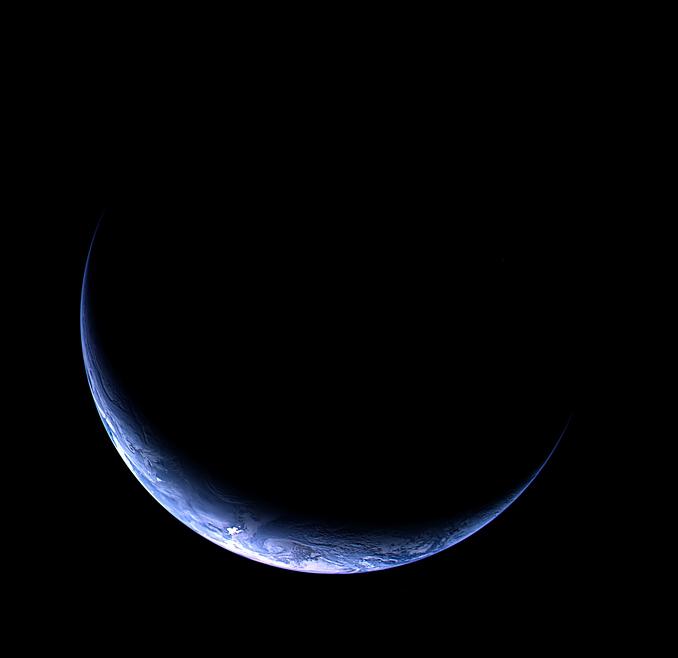
Credits: ESA OSIRIS Team MPS/UPD/LAM/IAA/RSSD/INTA/UPM/DASP/IDA
On November 13, 2009, at 8:45 AM CET, ESA’s comet chaser Rosetta swung by Earth. Rosetta passed just South of the Indonesian island of Java at an altitude of 2481 km. Its speed relative to Earth was 13.34 km/s. The maneuver provided a boost of 3.6 km/s.
Rosetta will meet asteroid 21 Lutetia in 2010. The final destination of Rosetta is the comet 67P/Churyumov-Gerasimenko, which the spacecraft will reach in 2014. Rosetta will deploy a lander to the surface of the comet, and will also orbit the nucleus of the comet and fly alongside as it heads towards the inner Solar System. Most of the time, the probe will hibernate with the majority of its systems shut down in order to optimize the power consumption.



 Subscribe to blog posts using RSS








