OrbitalHub

The place where space exploration, science, and engineering meet

Domain is for sale. $50,000,000.00 USD. Direct any inquiries to contact@orbitalhub.com.


Credits: SpaceX


SpaceX recently reached two major milestones towards the goal of servicing the International Space Station (ISS) after the retirement of the Space Shuttle in September 2010.


The milestones are the successful testing of the heat shield material used for the thermal protective system of the Dragon spacecraft, and a mission-length firing of the Merlin Vacuum engine that powers the second stage of the Falcon 9 launch vehicle.


On February 23, 2009, SpaceX announced that the PICA-X high performance heat shield material passed an arc jet testing. During the test that recreates the conditions experienced during an atmospheric reentry, the material was subjected to temperatures as high as 1850 degrees Celsius.


PICA is short for Phenolic Impregnated Carbon Ablator. It is a material used for thermal protection, which was initially developed by NASA. PICA-X is an improved variation of the original PICA and was developed by SpaceX with the assistance of NASA. SpaceX becomes the second commercial source for this high-performance carbon-based material.


“We tested three different variants developed by SpaceX,” said Tom Mueller, VP of Propulsion, SpaceX. “Compared to the PICA heat shield flown successfully on NASA’s Stardust sample return capsule, our SpaceX versions equaled or improved the performance of the heritage material in all cases.”


Credits: SpaceX


The arc jet tests were performed at the Arc Jet Complex at NASA Ames Research Center, as the test center is capable of creating the reentry conditions. The Arc Jet Complex has a long history in the development of thermal protective systems.


PICA-X will protect the Dragon spacecraft and the crew during the reentry in the atmosphere from low Earth orbit (LEO).


One remarkable detail that I discovered when reading the press release is that PICA-X will also be used to coat the second stage of the Falcon 9 launch vehicle, as SpaceX plans to reuse the second stage of the launch vehicle as well.


On March 7, 2009, the Merlin Vacuum engine completed a full mission duration firing at the SpaceX Test Facility in McGregor, Texas. During the test that lasted 6 minutes, the engine consumed more than 100,000 pounds of liquid oxygen and rocket grade kerosene.


The Merlin Vacuum engine is a variation of the Merlin 1C engine that powers the Falcon 1 launch vehicle, and it accommodates changes that make it more efficient to fire in the vacuum of space (most notably the shape of the nozzle).


Credits: SpaceX


“Specific impulse, or Isp, indicates how efficiently a rocket engine converts propellant into thrust,” said Tom Mueller. “With a vacuum Isp of 342 seconds, the new Merlin Vacuum engine has exceeded our requirements, setting a new standard for American hydrocarbon engine performance in space.”


The engine uses a regeneratively cooled combustion chamber, which means that the propellant is injected into the walls of the combustion chamber and prevents them from melting.


The nozzle is radiatively cooled and much larger, and also has a larger exhaust section than the Merlin 1C. This results in an improved performance of the engine. The engine is capable of multiple restarts and can operate at reduced thrust, which will enable the upper stage to deliver payloads matching a broad range of orbital profiles.


“Falcon 9 was designed from the ground up to provide our customers with breakthrough advances in reliability,” said Elon Musk, CEO and CTO of SpaceX. “In successfully adapting our flight tested first stage engine for use on the second stage, this recent test further validates the architecture of Falcon 9, designed to provide customers with high reliability at a fraction of traditional costs.”


The first flight of the Falcon 9 /Dragon launch system is scheduled for late 2009 from Launch Pad SLC-40 at Cape Canaveral, Florida. For more information about SpaceX and the Falcon 9 /Dragon launch system, you can visit the SpaceX website.


  • Facebook
  • Google
  • Slashdot
  • Reddit
  • Live
  • TwitThis


Credits: SpaceX


SpaceX has announced that the Falcon 9 launch vehicle was raised to vertical on its launch pad at Space Launch Complex 40 (SLC-40) in Cape Canaveral, Florida.


SpaceX was awarded a Commercial Resupply Service (CRS) contract in December 2008. The Falcon 9 launch vehicle and the Dragon spacecraft will be used as the primary means of transporting cargo to and from the International Space Station (ISS) after the Space Shuttle is retired by NASA.


The Falcon 9 launch vehicle will provide the lowest cost per kilogram to orbit. The 54.9 m long and 3.6 m wide launcher will be able to lift payloads with a mass of 12,500 kg to a low Earth orbit (LEO) for only $36.75 million. For more details on the pricing of the Falcon 9 missions, you can check out the page dedicated to Falcon 9 on SpaceX’s web site.


“This entire process has helped us validate key interfaces and operations prior to executing our launch campaign with the vehicle in its final flight configuration,” said Elon Musk, CEO and CTO of SpaceX. “We encountered no show-stoppers or significant delays. I am highly confident that we will achieve our goal of being able to go from hangar to liftoff in under 60 minutes, which would be a big leap forward in capability compared with the days to weeks required of other launch vehicles.”


  • Facebook
  • Google
  • Slashdot
  • Reddit
  • Live
  • TwitThis


Credits: SpaceX


NASA has awarded two International Space Station (ISS) Commercial Resupply Services (CRS) contracts to Space Exploration Technologies (SpaceX) and Orbital Sciences Corporation (Orbital).


NASA has ordered eight flights valued at about $1.9 billion from Orbital and twelve flights valued at about $1.6 billion from SpaceX.


The maximum potential value of each contract is roughly $3.1 billion. Based on known requirements, the value of both contracts combined is projected at $3.5 billion.


Credits: Orbital


The awarded contracts are fixed-price indefinite delivery, indefinite quantity contracts. They will begin January 1, 2009, and are effective through December 31, 2016. SpaceX and Orbital each will have to deliver a minimum of twenty metric tons of cargo to the space station, and they will also have to deliver non-standard services in support of the cargo resupply, including analysis and special tasks as the government deems necessary.


SpaceX will service the ISS with its Falcon9/Dragon system.


“The SpaceX team is honored to have been selected by NASA as the winner of the Cargo Resupply Services contract,” said Elon Musk, CEO and CTO, SpaceX. “This is a tremendous responsibility, given the swiftly approaching retirement of the Space Shuttle and the significant future needs of the Space Station. This also demonstrates the success of the NASA COTS program, which has opened a new era for NASA in US Commercial spaceflight.”


Orbital will employ the Taurus IITM medium-lift launch vehicle and the CygnusTM maneuvering space vehicle.


“We are very appreciative of the trust NASA has placed with us to provide commercial cargo transportation services to and from the International Space Station, beginning with our demonstration flight scheduled in late 2010,” said Mr. David W. Thompson, Orbital’s Chairman and Chief Executive Officer. “The CRS program will serve as a showcase for the types of commercial services U.S. space companies can offer NASA, allowing the space agency to devote a greater proportion of its resources for the challenges of human spaceflight, deep space exploration and scientific investigations of our planet and the universe in which we live.”


Both Orbital and SpaceX have issued press releases with more details about the CRS contracts.


  • Facebook
  • Google
  • Slashdot
  • Reddit
  • Live
  • TwitThis


Credits: SpaceX


Another critical milestone has been reached by SpaceX with the arrival of Falcon 9 hardware at Cape Canaveral.


After the full mission-length firing test of the Falcon 9 first stage engines and the firing test of the Dragon maneuvering thruster, the arrival of the Falcon 9 first stage fuel tank fulfills SpaceX’s commitment to having Falcon 9 hardware at Cape Canaveral by year-end.


“Christmas has arrived a few days early for our team at the Cape,” said Brian Mosdell, Director of Florida Launch Operations for SpaceX. “The packages measure extra large this year, and they will keep everyone busy in the coming weeks.”


All of the Falcon 9 elements and the ground support hardware have already left the SpaceX manufacturing facility in Hawthorne, California. The hardware will make its way to the launch site at Cape Canaveral over the next two weeks. The Falcon 9 will then be assembled on horizontal and raised to vertical on the custom built erector.


Credits: SpaceX


There are four Falcon 9 launches scheduled for 2009. Two of these launches are demonstration flights with the Dragon spacecraft as part of the NASA Commercial Orbital Transportation Services (COTS) competition. A total of three flights of the Falcon 9/Dragon launch system will be conducted under the agreement, in order to demonstrate cargo delivery capability to the International Space Station (ISS).


NASA’s agreement with SpaceX can be extended to include demonstrating transport of crew to and from the ISS.


“2008 has been a year of rapid progress for SpaceX,” said Elon Musk, CEO and CTO of SpaceX. “The delivery of the Falcon 9 to the Cape is a major milestone in designing and deploying the most reliable, cost-efficient fleet of launch vehicles in the world. I applaud our SpaceX team who has worked 24/7 to make this happen.”


SpaceX has made available a video of Elon Musk giving a tour of the SpaceX Falcon 9 launch site at Space Launch Complex 40, Cape Canaveral AFS, Florida.


  • Facebook
  • Google
  • Slashdot
  • Reddit
  • Live
  • TwitThis


Credits: NASA


The propulsion division of SpaceX has performed another important test. After the test of the Falcon 9’s first stage Merlin engines, the smallest engine of the SpaceX family, Draco, has been put to test.


During the test, the thruster fired for ten minutes, paused for ten minutes, and then was restarted for an additional minute.


The test was performed on a new vacuum test stand built by SpaceX, and put into operation in March 2008 at the SpaceX Test Facility outside McGregor, Texas.


“Draco performed perfectly during the entire test, with expected temperatures and excellent performance,” said David Giger, Propulsion Manager, SpaceX. “We also broke the SpaceX record for longest continuous burn previously held by Kestrel, the Falcon 1 second stage engine.”


The Dragon spacecraft uses eighteen Draco thrusters for orbital maneuvering, attitude control, and to initiate the atmospheric re-entry. Each Draco thruster can deliver up to 400N of force. The thruster is powered by a combination of mono methyl hydrazine (MMH) and nitrogen tetroxide (NTO), which is the same bipropellant used by the orbital maneuvering system (OMS) of the Space Shuttle.


Credits: NASA


MMH and NTO are used as propellants because they have long on-orbit lifetimes. This will allow the Dragon spacecraft to perform longer missions to the International Space Station (ISS). The goal is to use the spacecraft as an emergency escape capsule for the crew working on the ISS.


SpaceX has released a video of the Draco thruster vacuum firing.


  • Facebook
  • Google
  • Slashdot
  • Reddit
  • Live
  • TwitThis
11-4-08

SpaceX Enters The Dragon

Posted by


Credits: SpaceX


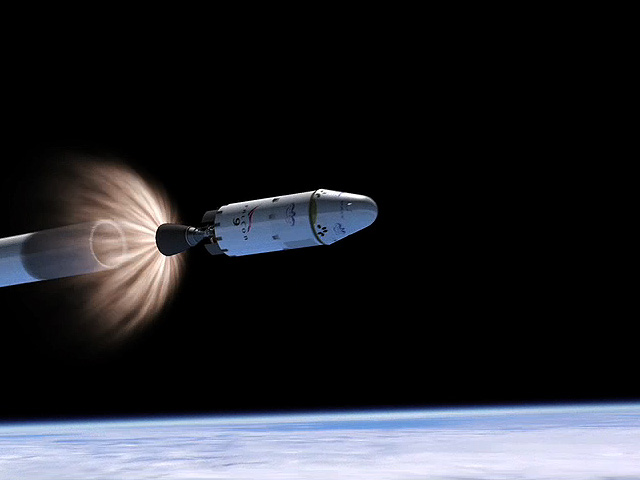
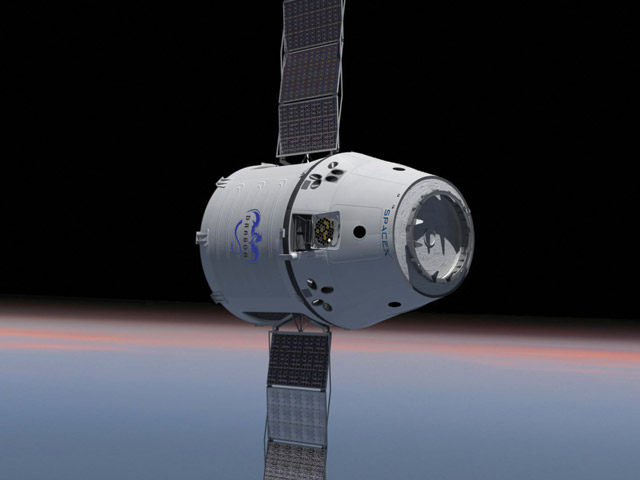
SpaceX just announced the DragonLab Spacecraft. DragonLab is a reusable spacecraft capable of delivering pressurized and un-pressurized payloads to and from space. SpaceX will use Falcon 9 (the heavier version of Falcon 1) to launch the DragonLab spacecraft into orbit.


Dragon will perform two missions in 2009. These missions will test the telemetry, orbital maneuvering and thermal control, and a rendezvous simulation with the Falcon 9 upper stage. The first full cargo mission to ISS is scheduled for 2010.


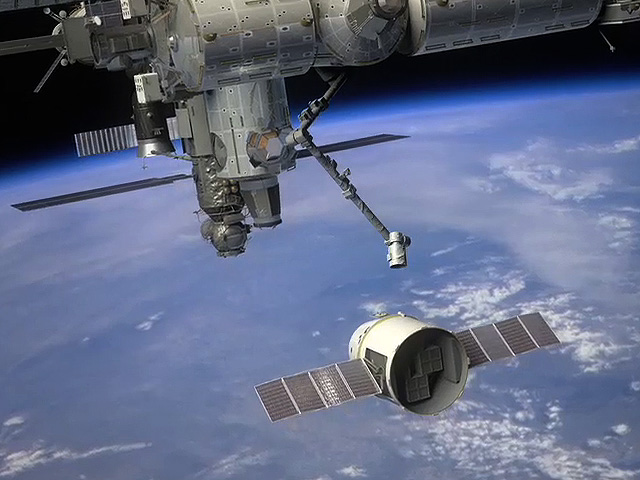
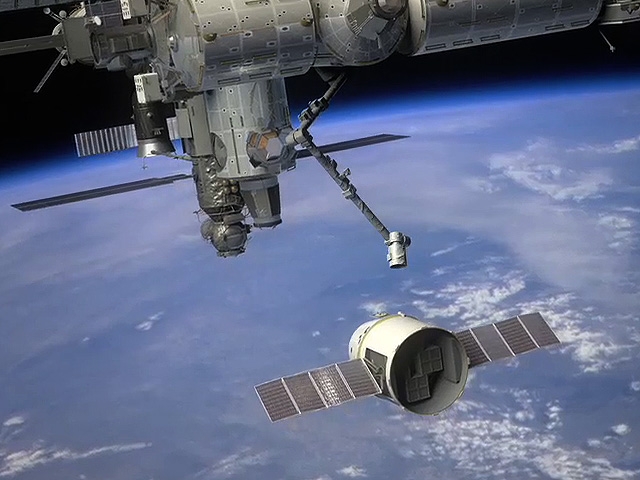
The technical page dedicated to the Dragon spacecraft is quite impressive. Just to mention a few features: down-cargo capability is equal to up-cargo, and up to seven passengers in crew configuration. SpaceX claims fully autonomous rendezvous and docking, but the simulation developed by Odyssey Space Research shows capture operations similar to HTV (the Dragon spacecraft will approach the ISS and then the ISS robotic manipulator will capture the spacecraft and guide it to the docking module).


Credits: NASA/SpaceX


DragonLab will compete with the ATV spacecraft (and the future CTV, LCR versions) that ESA is developing.


SpaceX also announced that it is hosting a workshop on November 6, 2008. Registration is mandatory, so time is of the essence! I am pretty sure the seats are selling like hot cakes…


  • Facebook
  • Google
  • Slashdot
  • Reddit
  • Live
  • TwitThis