


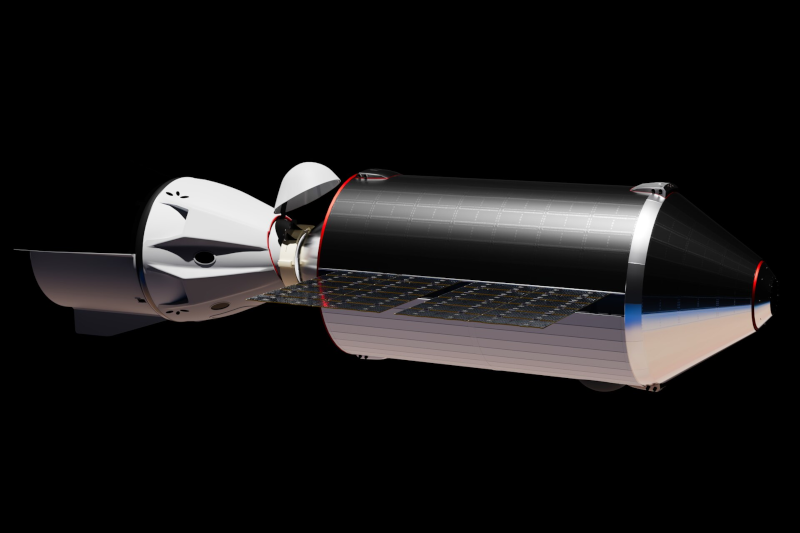
Vast, the California-based startup developing what it calls the world’s first commercial space station, announced significant progress in March and April 2026 as Haven-1 moves toward its target launch in the first quarter of 2027. The company secured $500 million in Series C funding in March 2026, led by the Qatar Investment Authority with participation from Mitsui, MUFG, and Balerion Space Ventures.
The funding will accelerate production of the Haven-1 station and support development of the follow-on Haven-2 design. Vast has also expanded manufacturing facilities in Long Beach, California, where the station modules are being assembled. The company’s workforce has grown to over 400 employees, up from approximately 200 in early 2025.
Haven-1 entered the full integration phase in January 2026, with the spacecraft’s major subsystems being assembled and tested together for the first time. Life support systems, critical for sustaining crew members, have undergone extended testing including模拟 long-duration missions. The station’s interior has been outfitted with cargo storage systems, crew accommodations, and research equipment.
The Haven Demo mission, which tested key technologies in orbit, completed a successful deorbit in February 2026 after 49 experiments. The test validated systems including the station’s attitude control, thermal management, and communications infrastructure. Data from the mission has informed final modifications to the Haven-1 design.
Vast received a Private Astronaut Mission (PAM) award from NASA in February 2026, designating the company to conduct a commercial crewed mission to Haven-1 in late 2026 or 2027. This contract represents one of the first awards under NASA’s post-ISS transition strategy and validates the company’s technical approach.
The station design calls for a single large module approximately 12 meters in length, providing volume comparable to the International Space Station’s node modules. The station will initially accommodate up to four crew members, with expansion potential through additional modules. Each crew member will have a dedicated sleep station and access to galley facilities for food preparation.
Research facilities on Haven-1 will support experiments in fluid physics, materials science, and biological studies. The station’s location at approximately 500 kilometers altitude, slightly lower than the ISS, provides a stable microgravity environment while minimizing exposure to the South Atlantic Anomaly where Earth’s radiation belts dip closest to the planet’s surface.
Vast faces competition from Axiom Space, which is developing its own commercial station with the backing of NASA. Axiom raised $350 million in February 2026 and is targeting 2028 for initial station elements. The two companies represent different approaches: Vast designed its station from the ground up for commercial operations, while Axiom is building on heritage from its ISS visiting mission experience.
The commercial station market is emerging in response to the planned retirement of the ISS around 2030. NASA has indicated it will purchase services from private stations as a customer rather than an operator, fundamentally changing the agency’s role in human spaceflight. This transition presents both opportunities for private companies and risks regarding the continuity of human presence in low Earth orbit.
The choice of orbital altitude for a space station involves trade-offs between accessibility, decay rate, and radiation exposure. At 500 kilometers, Haven-1 experiences atmospheric drag that requires periodic reboosting to maintain altitude. The ISS orbits at approximately 420 kilometers for similar reasons, balancing the propellant cost of station-keeping against the difficulty of reaching higher orbits.
The orbital decay rate depends on atmospheric density, which varies with solar activity. During periods of high solar output, Earth’s upper atmosphere expands, increasing drag and accelerating orbital decay. Station operators must monitor solar activity and plan reboost maneuvers accordingly.
The station’s orbital plane also determines lighting conditions for Earth observation and solar power generation. Most stations operate in inclinations that provide coverage of most of Earth’s surface while allowing launch and landing from mid-latitude facilities. The specific inclination is chosen to balance these factors against launch site limitations.


 Subscribe to our RSS feed













There are no comments.
Add A Comment