


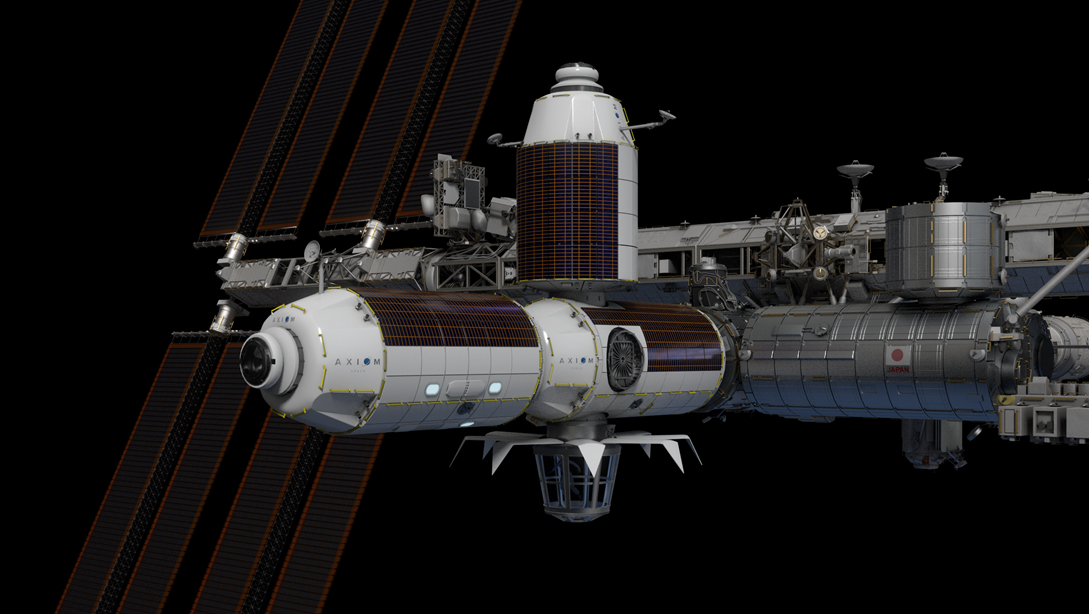
Axiom Space has closed a $350 million financing round in February 2026, accelerating development of what could become the world’s first commercial space station. The Houston-based company is building modular habitats designed to attach to the International Space Station before eventually separating to form a free-flying orbital facility. The funding provides critical capital as the company works toward launching its first module in 2027, pending continued progress on hardware development and NASA approvals.
The company’s architecture begins with the Payload Power Thermal Module, the foundational element that will connect to the ISS and provide infrastructure for research and payload operations. Subsequent modules will expand the station’s capabilities, adding crew quarters, research facilities, and an airlock for spacewalk operations. The station will initially rely on SpaceX Crew Dragon vehicles for crew transportation, with Axiom’s own AxEMU spacesuits providing capabilities for extravehicular activities.
Axiom has now completed NASA’s preliminary and critical design reviews, demonstrating that the proposed architecture meets agency requirements for safety and performance. Thales Alenia Space, the company’s primary manufacturing partner, is producing primary structures at facilities in Europe and the United States. The first flight hardware pieces have arrived in Houston for final integration, though the company still faces substantial work before the modules are ready for launch.
The commercial station concept addresses a critical transition in human spaceflight. The International Space Station, operated continuously since November 2000, faces an uncertain future as participating agencies evaluate options for continued operations beyond 2030. NASA has expressed support for commercial stations as successors to the ISS, believing that commercial operators can provide orbital research capabilities at lower cost than government-operated facilities. Axiom’s station represents the leading effort to make that vision a reality.
The company’s approach emphasizes research and manufacturing capabilities that could benefit from microgravity conditions. Pharmaceutical development, advanced materials processing, and biological research all show promise for improved outcomes when conducted in orbit. Axiom has already demonstrated interest through its private astronaut missions to the ISS, including the Ax-5 mission scheduled for January 2027 that will provide additional experience before the company’s own station becomes operational.
Designing space habitats that attach to existing infrastructure requires careful consideration of mechanical interfaces, power transfer, and data connectivity. The ISS provides power through solar arrays and thermal control through external radiators, but these systems were not designed to support significant additional loads. Axiom’s modules must integrate with existing systems without compromising station operations or crew safety, requiring extensive analysis and testing to verify compatibility.
The station’s expandable design allows for incremental capability growth as demand develops. Initial modules provide basic research and habitation space, with later additions offering specialized facilities for manufacturing or observatory operations. This approach mirrors how the ISS itself grew from a modest facility into a massive research complex over more than two decades of continuous assembly.
Power generation and thermal control present particular challenges for the larger station configuration. As modules are added, power requirements increase proportionally, necessitating expanded solar array capacity and more sophisticated thermal management. The station will need to dissipate heat generated by scientific equipment and life support systems while maintaining comfortable temperatures for crew members.


 Subscribe to our RSS feed













There are no comments.
Add A Comment