


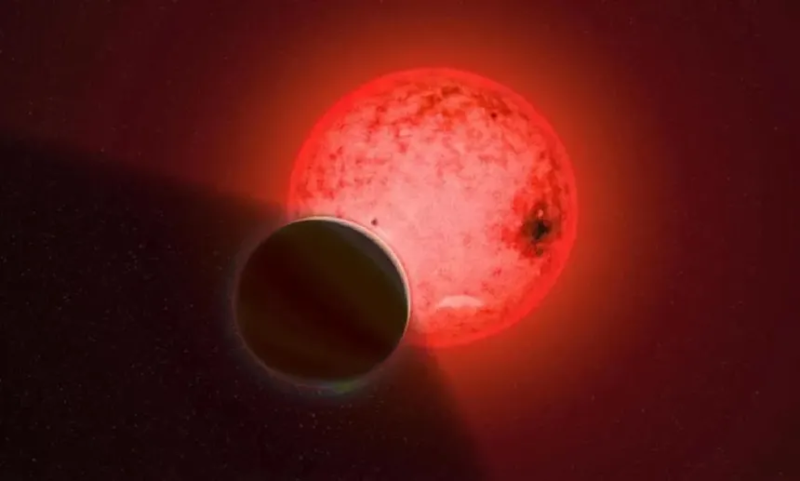
A remarkable discovery announced in early April 2026 has revealed the atmospheric composition of a giant planet orbiting one of the smallest stars known to host such a world, challenging fundamental assumptions about how planets form and evolve around red dwarf stars. The James Webb Space Telescope’s observations of TOI-5205b represent the first detailed atmospheric analysis of a gas giant orbiting a star with roughly 40% of the Sun’s mass, a combination that theorists had considered unlikely to produce massive planetary companions.
TOI-5205b was first identified as a candidate exoplanet by NASA’s Transiting Exoplanet Survey Satellite in 2023, based on the characteristic dimming of its host star when the planet passes between the star and Earth. The planet orbits at a distance of only 0.15 astronomical units from its host star, completing one orbit in approximately 7.8 days. This proximity places the planet well within the standard formation zones where giant planets might be expected, yet the host star’s small size raised questions about whether sufficient material existed in the protoplanetary disk to form such a large planet.
The JWST observations, conducted as part of the Guaranteed Time Observation programs known as GEMS and JEDI, used transmission spectroscopy to analyze starlight that passed through the planet’s atmosphere during transits. The telescope’s infrared sensitivity allowed detection of molecules that would be invisible to shorter-wavelength observations, revealing the presence of methane, hydrogen sulfide, and water vapor in the atmosphere. These findings, published in the Astronomical Journal on April 6, 2026, provide the first detailed chemical inventory of an exoplanet atmosphere around such a small star.
The unexpected result from these observations concerns the metallicity of the atmosphere, which measures the abundance of elements heavier than hydrogen and helium. Giant planets in our solar system show a correlation between metallicity and the mass of their host star, with more massive stars tending to host planets with lower metallicities. TOI-5205b breaks this pattern, showing significantly lower metallicity than expected for a planet of its mass orbiting a star of this size.
This discrepancy suggests that our current models of planet formation may be incomplete, particularly for the environment around small red dwarf stars. The leading hypothesis suggests thatTOI-5205b may have formed through gravitational instability in the protoplanetary disk rather than the core accretion process that built the giant planets in our solar system. This alternative formation pathway would produce planets with different compositions than those formed through core accretion.
The host star itself, known by its catalog designation TOI-5205 (and also as Gliese 4114 in some listings), is a red dwarf with a surface temperature of approximately 3,400 degrees Celsius, less than half the Sun’s photospheric temperature. The star’s small size means that TOI-5205b, despite being somewhat larger than Jupiter, appears as a relatively large silhouette against the stellar disk during transits, enabling the transmission spectroscopy that revealed its atmospheric composition.
The GEMS and JEDI observation programs represent substantial investments of JWST time, allocated to ensure comprehensive studies of exoplanet atmospheres. These observations build on earlier findings from the telescope, including discoveries of water vapor, carbon dioxide, and other molecules in the atmospheres of hot Jupiters and sub-Neptunes. The TOI-5205b observations add a new category of worlds to this growing inventory.
Transmission spectroscopy works by comparing the spectrum of starlight during a transit to the spectrum when the planet is not transiting. The difference between these spectra reveals absorption features from molecules in the planet’s atmosphere, which remove specific wavelengths from the light that passes through. The depth of these absorption features increases with the scale height of the atmosphere, making expanded atmospheres easier to detect.
JWST’s infrared instrumentation is particularly well-suited to this work because many important molecules have strong absorption features at longer wavelengths. Water vapor, methane, and carbon dioxide all have characteristic signatures in the mid-infrared that can be detected with the telescope’s spectroscopy instruments. The resolution of these instruments allows individual spectral lines to be resolved, enabling precise identification of the molecules present.
The challenge of detecting atmospheres around small planets increases with decreasing planet size. Earth-sized planets have atmospheres with scale heights too small to detect with current technology, making the slightly larger sub-Neptunes and super-Earths the smallest worlds whose atmospheres can be characterized. TOI-5205b, being larger than Jupiter, provides an ideal target for these studies.
The detection of hydrogen sulfide in TOI-5205b’s atmosphere marks only the second known instance of this molecule in an exoplanet atmosphere. On Earth, hydrogen sulfide is associated with biological processes in certain environments, though its presence in an exoplanet atmosphere does not indicate life—only that sulfur chemistry is active in the planetary environment.


 Subscribe to our RSS feed













There are no comments.
Add A Comment