


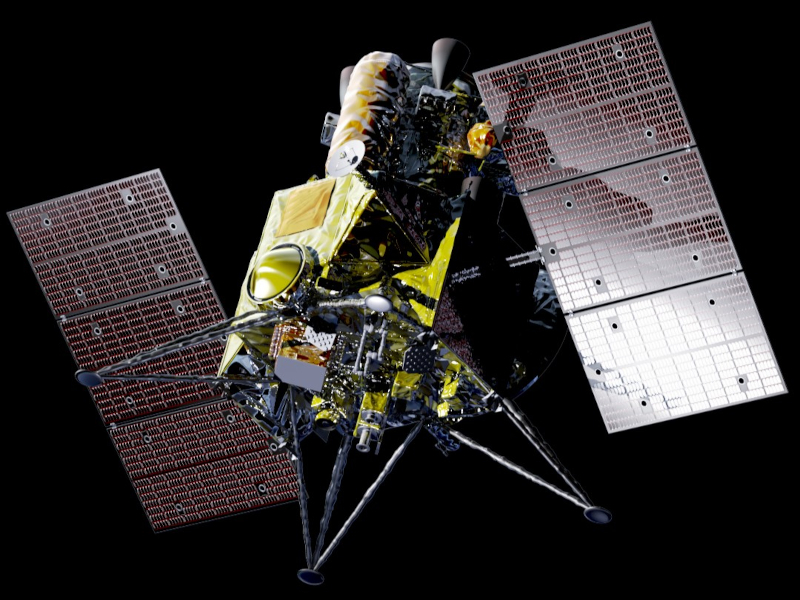
Japan’s ambitious mission to explore the moons of Mars is entering its final phase of preparation at the Tanegashima Space Center, with launch targeted for the latter half of 2026 aboard the country’s H3 rocket. The Martian Moons eXploration, or MMX, represents one of the most complex interplanetary missions ever undertaken by the Japan Aerospace Exploration Agency, combining multiple scientific objectives with demanding navigation and operations in the relatively unexplored environment around the Red Planet’s two small moons, Phobos and Deimos.
The spacecraft, developed by JAXA in partnership with Mitsubishi Electric and numerous international contributors, arrived at the Tanegashima Space Center in early April 2026 following its transport from Mitsubishi Electric’s manufacturing facilities. The spacecraft is now undergoing protoflight testing in the Spacecraft Test and Assembly Building, where engineers will verify that all systems function correctly in simulated space conditions before committing to launch. This testing phase represents the final major milestone before the mission receives its launch window confirmation.
The scientific objectives of MMX address fundamental questions about the origin and evolution of Mars and its moons. Phobos and Deimos, with their irregular shapes and relatively low densities, have long puzzled planetary scientists. Several competing theories suggest they could be captured asteroids, remnants of a disrupted moon, or debris from a giant impact on Mars. MMX carries instruments designed to determine which hypothesis is correct by characterizing the moons’ composition, internal structure, and surface geology in unprecedented detail.
The spacecraft is equipped with a suite of scientific instruments from multiple space agencies. NASA’s contribution includes a neutron spectrometer and a gamma-ray spectrometer that will measure the elemental composition of the moon surfaces. The European Space Agency provides a hyperspectral camera system capable of mapping mineral distributions across the moons’ surfaces. France’s CNES contributed the microphone instrument, which will attempt to detect seismic signals from marsquakes transmitted through the moons themselves. Germany and Italy round out the international partnership with additional sensors and support systems.
One of the most ambitious elements of the mission involves a small rover that will land on Phobos and explore its surface. The rover, designed with contributions from both JAXA and the German Aerospace Center, uses a hopping mobility system that allows it to traverse the low-gravity environment of the moon, where conventional wheeled rovers would struggle. The rover carries instruments to analyze the composition of Phobos regolith and will collect samples for return to Earth.
The sample return component of MMX represents a critical capability that has not been attempted at Mars since the Soviet Union’s Phobos 2 mission in the 1980s. The mission plans to collect surface material from Phobos using a pneumatic sampling system and return it to Earth aboard a dedicated return capsule. The samples will be analyzed in laboratories worldwide, where researchers can apply the full range of analytical techniques impossible to duplicate with remote sensing instruments.
The navigation challenges of MMX are substantial. The spacecraft must arrive at Mars during a specific window when the orbital geometries allow efficient insertion into Mars orbit and subsequent approach to Phobos. The moon orbits at only approximately 6,000 kilometers above the Martian surface, placing it well within the planet’s gravitational influence. Maintaining a stable orbit around this small body requires precise understanding of its gravitational field, which scientists have been refinement through analysis of data from previous Mars missions.
The mission timeline calls for approximately one year of operations at Mars, beginning with a period of remote observation from Mars orbit before any descent attempts. During this reconnaissance phase, the spacecraft will map the surface of Phobos to identify safe landing sites and scientific targets of interest. The descent and landing operations will occur during a subsequent phase, with the rover deployment following successful touchdown.
Phobos, the larger of Mars’s two moons, measures approximately 22.4 kilometers in its longest dimension, making it one of the smaller objects ever orbited by a spacecraft. The moon’s gravitational acceleration at its surface is only approximately 0.008 meters per second squared, less than one thousandth of Earth’s surface gravity. This weak gravitational field presents unique challenges for orbital operations.
A spacecraft orbiting such a small body experiences perturbations from multiple sources. Mars’s gravitational influence dominates the orbital dynamics, causing the spacecraft’s orbit to precess rapidly. The irregular shape of Phobos creates variations in gravitational acceleration across the moon, which can cause orbital instability if the spacecraft approaches too closely. The MMX mission plans to operate at orbital distances that balance scientific observation needs against navigation safety.
The low-gravity environment also affects how the spacecraft must approach for landing. A simple descent trajectory would require constant thrust to avoid accelerating into the surface, unlike landing on larger bodies where ballistic trajectories are possible. The MMX spacecraft uses a combination of chemical propulsion and gravity-turn guidance to achieve controlled descents to the moon’s surface.
 Subscribe to our RSS feed









There are no comments.
Add A Comment