OrbitalHub

The place where space exploration, science, and engineering meet

Domain is for sale. $50,000,000.00 USD. Direct any inquiries to contact@orbitalhub.com.

04-22-09

Q&A With An Alien Hunter

Posted by


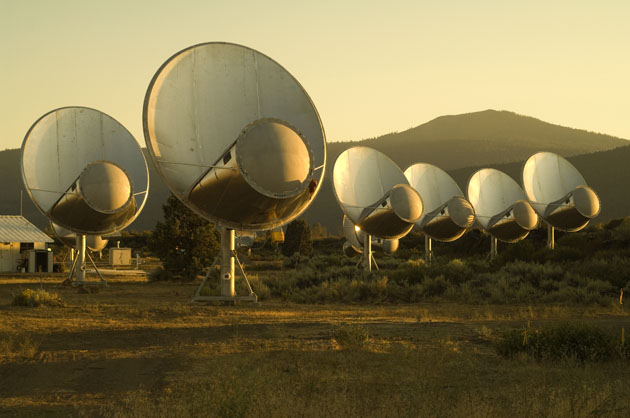
Credits: SETI Institute


SETI stands for Search for Extraterrestrial Intelligence. Initially a program supported by NASA, SETI is now a privately funded institute that conducts research activities to detect intelligent extraterrestrial life.


SETI Institute is currently collaborating with the Radio Astronomy Laboratory at UC Berkley to develop the Allen Telescope Array, which is a specialized radio telescope array designed for SETI studies.


Seth Shostak, senior astronomer at the SETI Institute, kindly answered a few questions related to the search for extraterrestrial intelligence.


DJ: Why did you choose to work for SETI?
Seth Shostak: It probably sounds too easy, and thoroughly trite, but I’ve been interested in the idea of extraterrestrial intelligence since I was ten years old. When, quite by chance, the opportunity arose to work for the SETI Institute, it was like finding that a dream was suddenly reality.


DJ: Besides listening for transmissions in the microwave range of radio frequencies, which methods do you think are most likely to prove successful for SETI?
S.Shostak: I happen to be a big fan of so-called Optical SETI, as well as traditional radio SETI. In other words, look for laser flashes that might be sent our way by extraterrestrial societies trying to get in touch. This would be a great way to initiate contact, as the transmitting civilization could “ping” many thousands — indeed, many millions — of star systems in short order, and then do it again. This would be a sort of endless ping to so many star systems that it might reliably generate some reaction. In any case, I think we need to expand our search for these quick flashes in the sky.


DJ: Is SETI looking only for carbon-based ET? Are there any other possibilities to consider when searching for extraterrestrial intelligence?
S.Shostak: SETI searches are agnostic when it comes to the biochemistry of the aliens. After all, from our point of view, what makes them “intelligent” is their ability to build a radio transmitter or a powerful laser. The details of their construction are of no consequence for the search — except insofar as they might not be living on planets surrounding an ordinary star. If they are machine intelligence, they may have migrated away from their natal solar system, and of course that WOULD affect our search strategies.


DJ: Do new discoveries made by astronomers using space telescopes (for example, discovery of exo-planets, detection of their atmospheres, and the study of the composition of these atmospheres using spectral lines, etc.) have any implications for the way SETI conducts searches? Is SETI using this information to fine-tune the search?
S.Shostak: One of the first SETI experiments planned for the Allen Telescope Array is to examine star systems that are known to have planets (the work of astronomers during the past dozen years). Of course, we would like to know which star systems have HABITABLE planets, but that information still eludes us. NASA’s Kepler Mission will give us invaluable insight into what fraction of the cosmos might be suitable for life — and life of the intelligent variety, as well.


DJ: How do you see a two-way communication with ET? What concepts can be considered universal so that they can be used for such communication?
S.Shostak: Given the likely distance between societies, I don’t think that two-way communication is very likely or practical. But there’s still the problem that any deliberate transmissions should be encoded in such a way that the recipients can figure out what is being said. Lots of thought has gone into this problem — should the aliens send dictionaries, mathematics, music, or just a lot of pictures? In general, I figure that the more information they send, the greater the chance that we’ll understand at least some of it.


DJ: Can you make a prediction as to when an ET radio transmission could be picked up by terrestrial receivers? Besides the pace at which terrestrial technology is evolving, what other factors should be considered when making such a prediction?
S.Shostak: The most important parameter affecting SETI success these days is money: do we have sufficient funds to keep up the search? But if the money is forthcoming, then technical developments in the coming decades will allow us to examine a million or more star systems by 2025 or so. I think a million star systems is the right number to expect success, so that’s my prediction — we’ll find ET by 2025. Otherwise, I’ll be disappointed and slightly embarassed.


Seth Shostak’s new book, Confessions of An Alien Hunter: A Scientist’s Search for Extraterrestrial Intelligence, tells the true story of SETI. The book contains answers to many questions about SETI: what frequencies are monitored, where the antennas are aimed, how we should respond if a signal is received, etc. By reading this book, I have learned a great deal about the search for extraterrestrial intelligence.

Paul Gilster of Centauri Dreams has posted a review of the book. I invite everyone to read it.


  • Facebook
  • Google
  • Slashdot
  • Reddit
  • Live
  • TwitThis
04-17-09

Delta II

Posted by


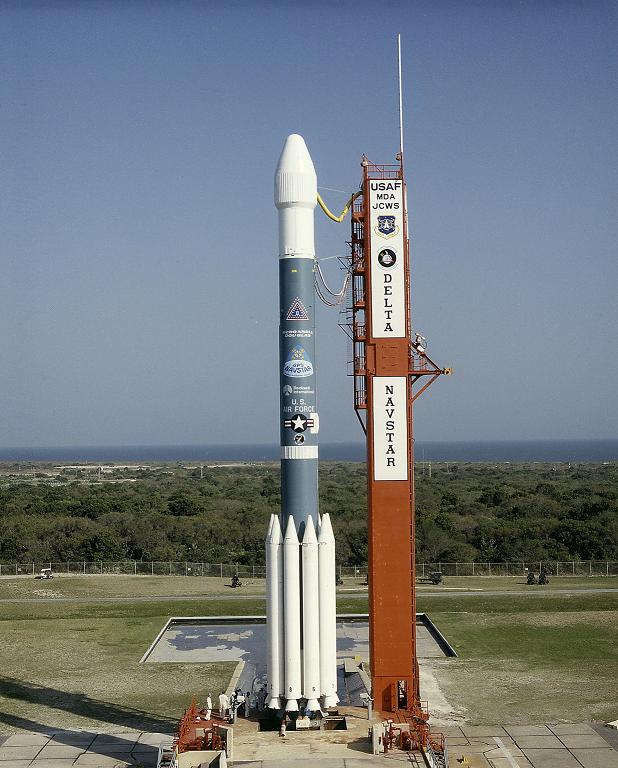
Credits: NASA/MSFC


Delta II is a space launch system operated by United Launch Alliance (ULA), which was initially built by McDonnell Douglas, and by Boeing Integrated Defense Systems after McDonnell Douglas merged with Boeing in 1997.


As any other early space launch system, it evolved from a ballistic missile. In the 1960s, the Thor intermediate-range ballistic missile was modified to become the Delta launch vehicle. In 1981, after being operated for 24 years, Delta production was halted due to a change in U.S. space policy. However, in 1986, after the Challenger accident, it was decided that the Space Shuttle fleet would not carry commercial payloads anymore, paving the way for the return of the Delta launch vehicle. Delta II had its maiden flight on February 14, 1989.


Delta II launch vehicle is 38.2 to 39 m long, with a diameter of 2.44 m, and a mass that can range from 151,700 to 231,870 kg, depending on configuration. Delta II can be configured with two or three stages.


Delta II can inject a payload having a mass of 2,700 to 6,100 kg in low Earth orbit (LEO). Payloads deployed to Geosynchronous Transfer Orbit (GTO) can have a mass from 900 to 2,170 kg.


The first stage, Thor/Delta XLT-C, is powered by one Pratt & Whitney Rocketdyne RS-27A liquid fuel engine. The RS-27A engine is fueled by RP-1 and liquid oxygen. The RS-27A engine provides around 1,000 kN of thrust.


Credits: NASA


The solid boosters are used to increase the thrust of the launch vehicle. The first solid boosters used by Delta II 6000 series were Castor 4A motors. The 7000 and 7000 Heavy series use GEM 40 and GEM 46 solid motors respectively. The increase in thrust from Castor 4A to GEM 46 is substantial, from 480 kN to 630 kN.


Stage two, Delta K, is powered by a hypergolic restartable Aerojet AJ10-118K engine that can provide 43 kN. The AJ10-118K can fire more than once in order to insert the payload into LEO. The engine uses dinitrogen tetroxide as oxidizer and aerozine 50 (which is a mix of hydrazine and unsymmetrical dimethylhydrazine) as fuel. Besides having hard to pronounce names, the oxidizer and the fuel are very toxic and corrosive. The second stage contains the flight control system, which is a combined inertial system and guidance system.


The third stage, if present in the configuration, is a Payload Assist Module (PAM). This stage is powered by an ATK-Thiokol motor, which provides the velocity change needed for missions beyond Earth orbit. The stage has no active guidance control and it is spin-stabilized.


The de-spin mechanism used to slow the spin of the spacecraft after the burn and before the stage separation is a yo-yo de-spin mechanism. This mechanism consists of two cables with weights on the ends. The weights are released and the angular momentum transferred from the stage reduces the spin to a value that can be controlled by the attitude control system of the spacecraft.


Delta II can launch single, dual, or multiple payloads during the same mission. There are three fairing sizes available: composite 3-meter diameter, aluminum 2.9-meter diameter, and stretched composite 3-meter diameter.


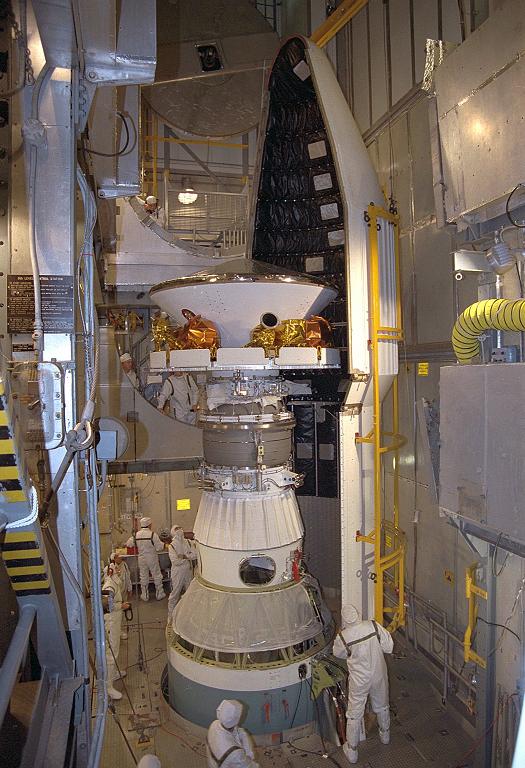
Credits: NASA


Delta II is assembled on the launch pad. After hoisting the first stage into position, the solid boosters are hoisted and mated with the first stage. The second stage is then hoisted atop the first stage.


Delta II launch vehicles have a four-digit naming system. The first digit can be either 6 or 7, designating the 6000 or 7000 series. The second digit indicates the number of solid boosters used for the mission. Delta II can have three, four, or nine solid boosters strapped to the first stage. The third digit denotes the engine type used for the second stage. This digit is two for 6000 and 7000 series Delta II, which indicates the Aerojet A10 engine. The last digit designates the type of the third stage. Zero means that no third stage is used, whereas five indicates a third stage powered by a Star 48B solid motor, and 6 marks a third stage powered by a Star 37FM motor. A Delta II 7426 has 4 solid boosters and a third stage powered by a Star 37FM motor.


Delta II proved to be a very reliable Expendable Launch Vehicle (ELV). Some NASA missions that used Delta II as launch vehicle include: Mars Global Surveyor, Mars Pathfinder, Mars Exploration Rovers (MER-A Spirit and MER-B Opportunity), Mars Phoenix Lander, Dawn, STEREO, and Kepler.


After long years of service, Delta II is getting close to retirement. The final mission for Delta II is currently scheduled for 2011.


You can find more information about the Delta launch vehicles on the Delta web page on Boeing’s web site.


  • Facebook
  • Google
  • Slashdot
  • Reddit
  • Live
  • TwitThis
04-9-09

LCROSS Lecture

Posted by


Credits: NASA/Northrop Grumman


The launch date for the Lunar CRater Observation and Sensing Satellite (LCROSS), initially set for April 24, 2009, was pushed to June 2, 2009.


Dr. Anthony Colaprete, a planetary scientist at NASA Ames Research Center and the principal investigator for the LCROSS mission, gave a lecture as part of the Silicon Valley Astronomy Lecture series. The lecture was posted on NASA’s website as Prospecting for Water on the Moon: The Upcoming LCROSS Mission.


If you are an amateur astronomer and have a telescope, you can contribute to the LCROSS mission by participating in the LCROSS Observation Campaign. Images provided by the public will be a valuable addition to the mission archive.


Please stay tuned on OrbitalHub for more details about the LCROSS mission.


  • Facebook
  • Google
  • Slashdot
  • Reddit
  • Live
  • TwitThis


Credits: NASA/JPL


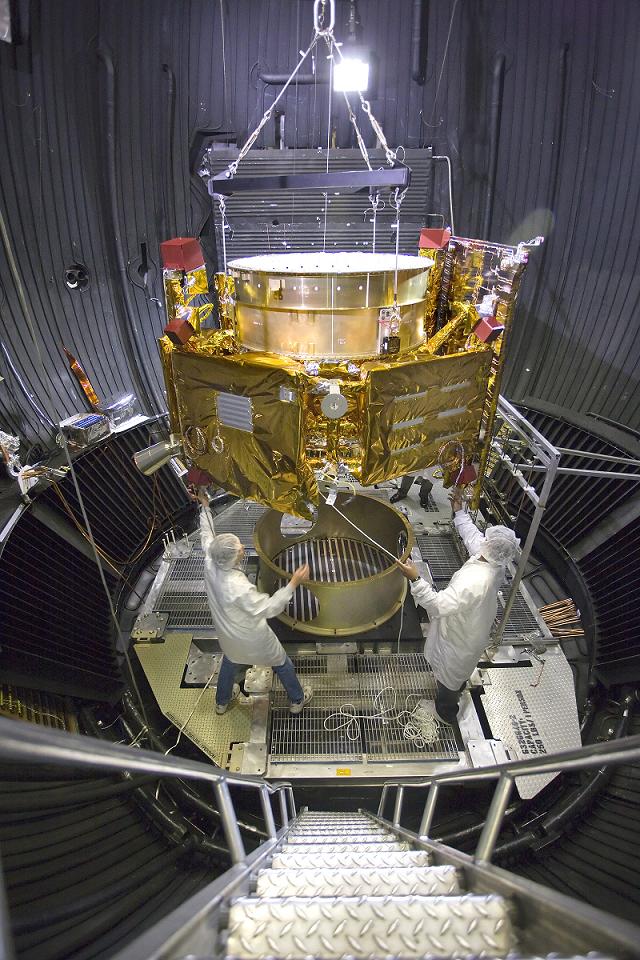
The Nuclear Spectroscopic Telescope Array (NuSTAR) is a high-energy X-ray space telescope that will expand our understanding of the origins and the development of stars and galaxies.


NuSTAR was proposed to NASA in May 2003. In 2006, while NuSTAR was undergoing an extended feasibility study, NASA cancelled the program due to budgetary constraints. However, in September 2007, the program was restarted.


In 2007, Orbital Sciences Corporation was selected by NASA to design, manufacture, and test the NuSTAR telescope.


The spacecraft is based on a proven design, used by Orbital for other NASA Small Explorer missions: SORGE, GALEX, AIM, and OCO. NuSTAR will have a launch mass of 360 kg, and will be powered by articulated solar arrays providing 600 W.


The spacecraft incorporates a ten-meter long extendable mast. The mast allows the telescope to fit into a small launch vehicle.


The technology used to build the telescope is not new. A team of researchers, led by Dr. Fiona Harrison, professor of physics and astronomy at Caltech, has been improving the NuSTAR technology for the last ten years. A previous high energy X-ray telescope (High Energy Focusing Telescope or HEFT) was developed as part of a high altitude balloon payload.


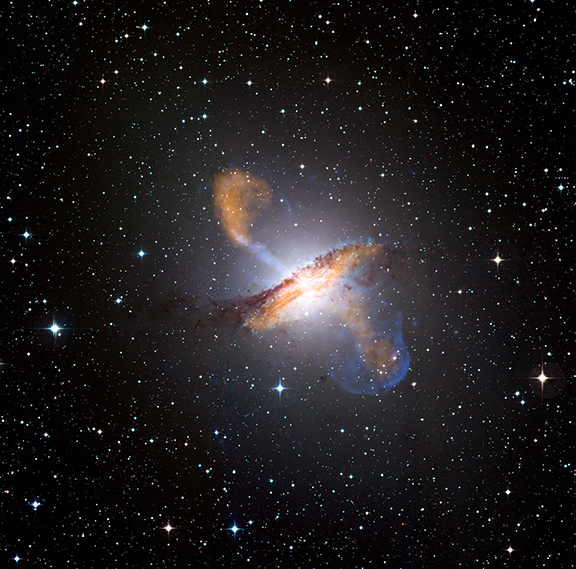
The currently operational X-ray telescopes, Chandra and XMM-Newton, observe the sky in the low energy X-ray spectrum (X-ray energies less than 10 keV). NuSTAR will make observations in a higher range, up to 79 keV. As much of the energy emitted by a black hole is absorbed by the surrounding gas and dust, observations in the high-energy X-ray spectrum can reveal in greater detail what is happening closer to the event horizon.


Credit: NASA/CXC/CfA/R.Kraft et al./MPIfR/ESO/APEX/A.Weiss et al./ESO/WFI


The NuSTAR telescope will have a sensitivity two orders of magnitude greater than any other instrument used to detect black holes. NuSTAR will help scientists understand how black holes are distributed throughout the universe, and what powers the most active galaxies.


The NuSTAR instrument consists of two co-aligned hard X-ray telescopes. The ten-meter mast mentioned above separates the mirrors and the imaging detectors. The detectors are Cadmium Zinc Telluride (CdZnTe) detectors and do not require cryogenic operation.


On February 9, 2009, NASA awarded Orbital the launch services contract for the NuSTAR mission. The telescope will be launched in 2011 aboard a Pegasus XL launch vehicle. Pegasus XL will be carried beneath a L-1011 aircraft and released over the Pacific Ocean. The air-launch system is very cost-effective, providing flexibility during operation and requiring minimal ground support.


NuSTAR will be deployed into a 525×525 km low Earth orbit (LEO) with a twenty-seven degree inclination.


For more details about the science of NuSTAR, you can visit the mission’s home page at Caltech. Orbital has also posted a NuSTAR fact sheet on their web site.


  • Facebook
  • Google
  • Slashdot
  • Reddit
  • Live
  • TwitThis


Credits: SpaceX


SpaceX recently reached two major milestones towards the goal of servicing the International Space Station (ISS) after the retirement of the Space Shuttle in September 2010.


The milestones are the successful testing of the heat shield material used for the thermal protective system of the Dragon spacecraft, and a mission-length firing of the Merlin Vacuum engine that powers the second stage of the Falcon 9 launch vehicle.


On February 23, 2009, SpaceX announced that the PICA-X high performance heat shield material passed an arc jet testing. During the test that recreates the conditions experienced during an atmospheric reentry, the material was subjected to temperatures as high as 1850 degrees Celsius.


PICA is short for Phenolic Impregnated Carbon Ablator. It is a material used for thermal protection, which was initially developed by NASA. PICA-X is an improved variation of the original PICA and was developed by SpaceX with the assistance of NASA. SpaceX becomes the second commercial source for this high-performance carbon-based material.


“We tested three different variants developed by SpaceX,” said Tom Mueller, VP of Propulsion, SpaceX. “Compared to the PICA heat shield flown successfully on NASA’s Stardust sample return capsule, our SpaceX versions equaled or improved the performance of the heritage material in all cases.”


Credits: SpaceX


The arc jet tests were performed at the Arc Jet Complex at NASA Ames Research Center, as the test center is capable of creating the reentry conditions. The Arc Jet Complex has a long history in the development of thermal protective systems.


PICA-X will protect the Dragon spacecraft and the crew during the reentry in the atmosphere from low Earth orbit (LEO).


One remarkable detail that I discovered when reading the press release is that PICA-X will also be used to coat the second stage of the Falcon 9 launch vehicle, as SpaceX plans to reuse the second stage of the launch vehicle as well.


On March 7, 2009, the Merlin Vacuum engine completed a full mission duration firing at the SpaceX Test Facility in McGregor, Texas. During the test that lasted 6 minutes, the engine consumed more than 100,000 pounds of liquid oxygen and rocket grade kerosene.


The Merlin Vacuum engine is a variation of the Merlin 1C engine that powers the Falcon 1 launch vehicle, and it accommodates changes that make it more efficient to fire in the vacuum of space (most notably the shape of the nozzle).


Credits: SpaceX


“Specific impulse, or Isp, indicates how efficiently a rocket engine converts propellant into thrust,” said Tom Mueller. “With a vacuum Isp of 342 seconds, the new Merlin Vacuum engine has exceeded our requirements, setting a new standard for American hydrocarbon engine performance in space.”


The engine uses a regeneratively cooled combustion chamber, which means that the propellant is injected into the walls of the combustion chamber and prevents them from melting.


The nozzle is radiatively cooled and much larger, and also has a larger exhaust section than the Merlin 1C. This results in an improved performance of the engine. The engine is capable of multiple restarts and can operate at reduced thrust, which will enable the upper stage to deliver payloads matching a broad range of orbital profiles.


“Falcon 9 was designed from the ground up to provide our customers with breakthrough advances in reliability,” said Elon Musk, CEO and CTO of SpaceX. “In successfully adapting our flight tested first stage engine for use on the second stage, this recent test further validates the architecture of Falcon 9, designed to provide customers with high reliability at a fraction of traditional costs.”


The first flight of the Falcon 9 /Dragon launch system is scheduled for late 2009 from Launch Pad SLC-40 at Cape Canaveral, Florida. For more information about SpaceX and the Falcon 9 /Dragon launch system, you can visit the SpaceX website.


  • Facebook
  • Google
  • Slashdot
  • Reddit
  • Live
  • TwitThis


Credits: Donna Coveney/MIT


MIT is developing an ion propulsion system that uses nitrogen as propellant. The new system is called Mini-Helicon Plasma Thruster.


Research and development of the Mini-Helicon is taking place at MIT’s Space Propulsion Laboratory (SPL).


“The Mini-Helicon is one exciting example of the sorts of thrusters one can devise using external electrical energy instead of the locked-in chemical energy. Others we in the SPL work on include Hall thrusters and Electrospray thrusters. This area tends to attract students with a strong physics background, because it sits at the intersection of physics and engineering, with ample room for invention,” said Manuel Martinez-Sanchez, director of the SPL and a professor in the Department of Aeronautics and Astronautics.


The Mini-Helicon has a simple design: a quartz tube wrapped by a coiled antenna, surrounded by magnets. The gas used as propellant is pumped into the quartz tube, where it is turned into plasma. The magnets confine, guide, and accelerate the plasma into an exhaust beam, which creates the thrust.


The Mini-Helicon design has its roots in a larger and more powerful propulsion system developed in collaboration with former NASA astronaut Franklin Chang-Diaz. A team led by Oleg Batishchev, principal research scientist in the Department of Aeronautics and Astronautics, did a theoretical analysis showing that components of the larger system could be used for different applications. The idea “was that a rocket based on the first stage [of Chang-Diaz’s system] could be small and simple, for more economical applications,” said Batishchev, who noted that the team’s prototype would fit in a large shoe box.


Batishchev notes that it could be years before the technology can be used commercially, in part due to certification policies through NASA and other agencies.


For more information about MIT’s Mini-Helicon, check out the MIT News Office website.


  • Facebook
  • Google
  • Slashdot
  • Reddit
  • Live
  • TwitThis