OrbitalHub

The place where space exploration, science, and engineering meet

Domain is for sale. $50,000,000.00 USD. Direct any inquiries to contact@orbitalhub.com.


Credits: NASA


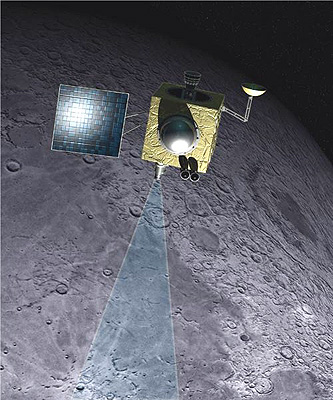
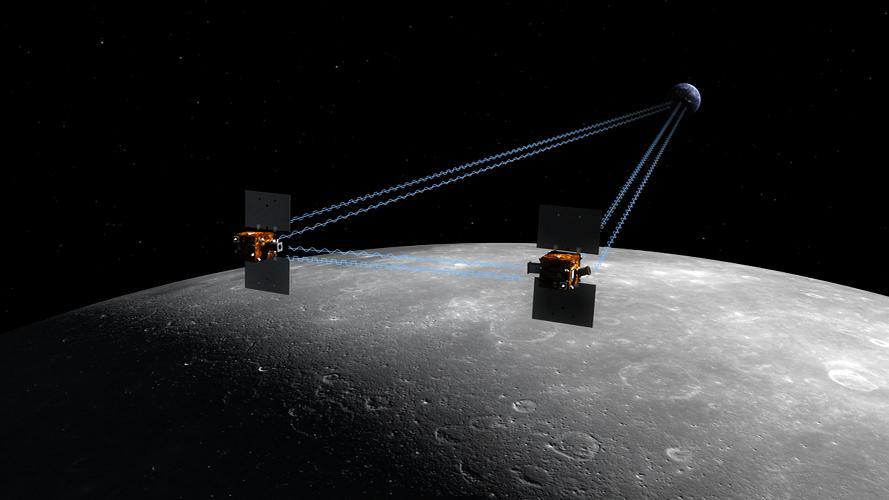
The Gravity Recovery And Interior Laboratory (GRAIL) is a mission that will measure the lunar gravity field in unprecedented detail. The twin spacecraft will orbit the Moon in tandem and collect scientific data for several months.


The GRAIL mission will cost $375 million and launch in 2011 as part of NASA’s Discovery Program. The window for the launch is 26 days long and opens on September 8, 2011.


After a dual launch aboard a Delta II 2920-10, the spacecraft will spend three to four months cruising on a low-energy trans-lunar trajectory. The two spacecraft will orbit the moon on 50 km, near-circular polar orbits, with a spacecraft separation of 175 – 225 km. The science phase of the mission will take 90 days, and it will be followed by a 12-month science data analysis.


The technique used by GRAIL for collecting scientific data was also used for the Gravity Recovery And Climate Experiment (GRACE) mission, launched in 2002. Small changes in the distance that separates the two spacecraft are translated in variations of the lunar gravity field.


The GRAIL spacecraft are based on the Lockheed Martin XSS-11 bus. The XSS-11 (Experimental Small Satellite 11) is the result of research done at Lockheed Martin Space Systems in the field of agile and affordable micro-satellites. Interesting to mention here is that there were speculations that XSS-11 could also be used as the base for the development of a kinetic anti-satellite weapon (ASAT).


The spacecraft is a rectangular composite structure. Two non-articulated solar arrays and lithium ion battery provides power. The attitude control system, the power management system, and the telecommunications system are also inherited from the XSS-11 bus.


The payload consists of a Ka-band Lunar Gravity Ranging System (LGRS), which is derived from the instrument carried by the GRACE spacecraft.


The spacecraft flight operations will be conducted from Lockheed Martin’s Denver facility. Science Level 0 and 1 data processing will be done at Jet Propulsion Laboratory (JPL), Level 2 data processing at JPL, the Goddard Space Flight Center (GSFC) and the Massachusetts Institute of Technology (MIT). The final scientific data will be delivered by MIT.


While missions like the Lunar Reconnaissance Orbiter (LRO) will find safe landing sites, locate potential resources, and take measurements of the radiation environment of the lunar surface, GRAIL will explore the moon from crust to core, and determine the moon’s internal structure and evolution.


More information about GRAIL is available on the GRAIL mission page on MIT’s web site.


  • Facebook
  • Google
  • Slashdot
  • Reddit
  • Live
  • TwitThis


Credits: NASA/JPL


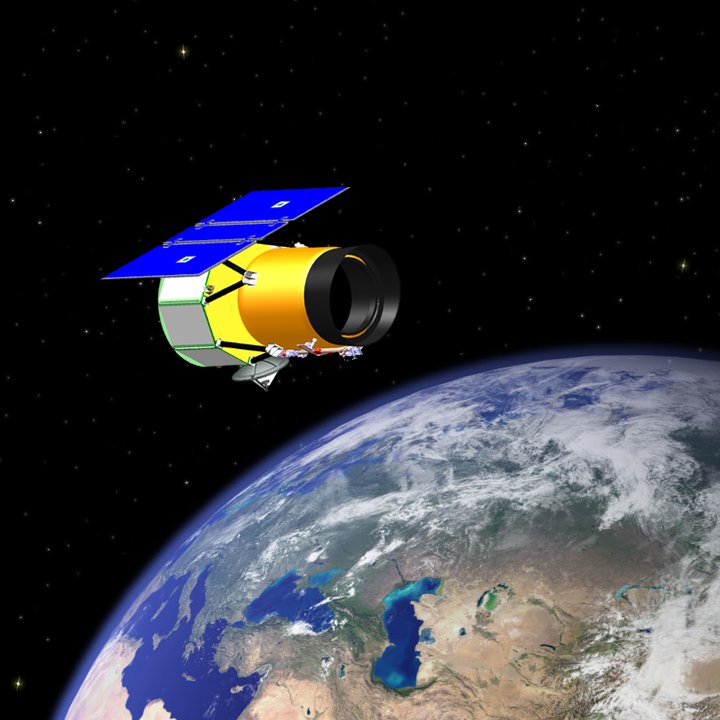
Wide-field Infrared Survey Explorer or WISE is a NASA-funded scientific research project that will provide an all-sky survey in the mid-infrared wavelength range.


WISE will collect data that will allow scientists to compile an all-sky infrared image atlas and catalogue of over 300 million infrared sources. WISE will be able to measure the diameters of more than 100,000 asteroids that glow in the mid-infrared, and make observations of the coldest and nearest stars, regions of new star and planet formation, and the structure of our own galaxy.


WISE will only operate for seven to thirteen months. WISE will explore the entire Universe from a 523×523 km, 97.4-inclined orbit above the ground. The spacecraft will orbit in a Sun-synchronous orbit, so the solar panel will always be pointed at the Sun.


The cryostat will run for thirteen months. After a one-month in-orbit checkout period, the telescope will operate for six months. An additional pass of the sky (that would take another six months) is possible, if funded to do so by NASA.


Credits: UCLA/JPL


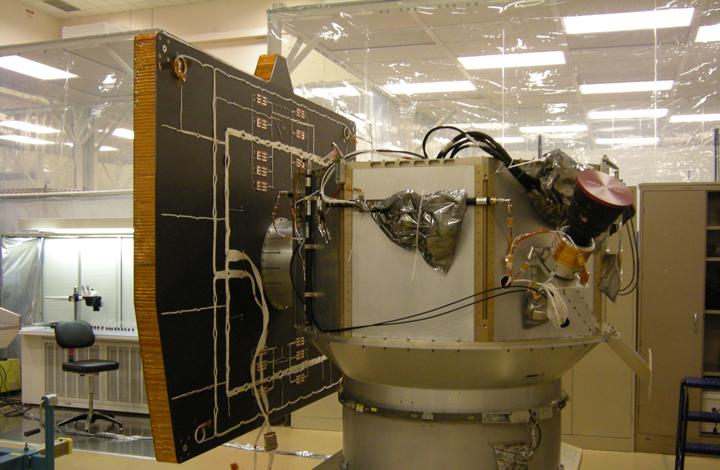
The spacecraft is 2.85 m long, 2.0 m wide, and 1.73 m deep. The spacecraft does not carry propellant. The telescope will make all pointing adjustments using reaction wheels and torque rods. Star trackers, sun sensors, a magnetometer, and gyroscopes will be the sensors used by the attitude control subsystem. The TDRSS (Tracking and Data Relay Satellite System) satellites will relay commands and data with ground stations.


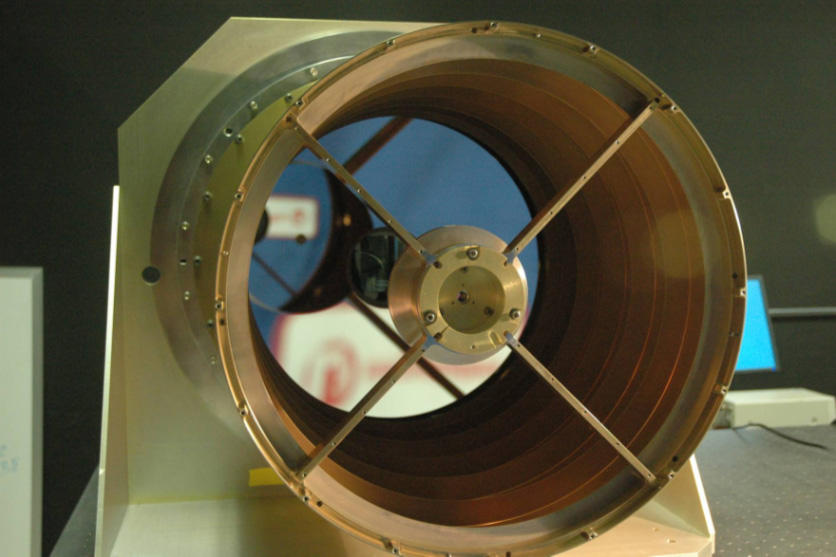
The field of view is 47 arc minutes and it comes from a small telescope diameter (only 40 cm) and large detector arrays. The telescope has four infrared sensitive detector arrays, 1024×1024 pixels each. For the near-infrared bands, there are Mercury-Cadmium-Telluride (MCT) detectors, while for the mid-infrared bands, Arsenic-doped Silicon (Si:As) detectors are used.


Credits: UCLA/JPL


The optics instruments have to be cooled to very low temperatures in order to lower noise detection. The MCT detectors operate at 32 K, while the Si:As detectors will be cooled to less than 8 K.


The WISE launch is scheduled for November 2009. WISE will launch aboard a Delta II launch vehicle from Vandenberg Air Force Base, in California.


The WISE team consists of UCLA (University of California at Los Angeles), JPL (Jet Propulsion Laboratory), SDL (Space Dynamics Labs in Utah), BATC (Ball Aerospace & Technology Corporation), IPAC (Infrared Processing and Analysis Center), and UCB (University of California at Berkeley).


For more information about the WISE mission, you can visit the WISE mission homepage at the Space Science Laboratory, University of California, Berkeley, website.


  • Facebook
  • Google
  • Slashdot
  • Reddit
  • Live
  • TwitThis
07-16-09

Q&A With Ed Belbruno

Posted by


Credits: NASA


NASA’s GRAIL mission will be one of the few missions to utilize the chaos associated with the subtle gravitational forces between planets in order to reach lunar orbit. The mission is scheduled to launch in 2011 and will use a low-fuel trajectory to the Moon.


Ed Belbruno, the first to use weak stability boundary theory to design trajectories for space missions, has agreed to answer some questions for OrbitalHub readers.


DJ: You graduated in mathematics from New York University, and received your PhD in mathematics from New York University’s Courant Institute. As a mathematician, how did you develop an interest in celestial mechanics?
Ed Belbruno: I was always interested in space since I was very young, going back to 4 years old. When I went to undergraduate school, also at NYU, I was a joint chemistry and mathematics major. At that time I was also interested in astrochemistry. When I got my BS, I went on to the Courant Institute and immediately wanted to get involved in an area of mathematics involved with space. I asked around, and found that there was a very famous mathematician there who was considered to be one of the leaders in the world in the subject, Juergen Moser. I learned that he was also a leader in a field called theoretical celestial mechanics. So, I asked to work with him and he agreed. For me it was great because I loved mathematics and I loved space. I am also an artist, and my early paintings involved a lot of space scenes. My being drawn to celestial mechanics was a natural thing.


DJ: I think of celestial mechanics as a precise discipline… the word CHAOS from the titles of the presentations you are giving would make any aerospace engineer nervous. Is this a misnomer or it is really the foundation for the new class of trajectories you designed?
E.B.: When I arrived at JPL in 1986, I was previously an assistant professor of mathematics at Boston University. I arrived at JPL and found myself at a leading space center – to work on the following missions: Galileo, Cassini, Magellan, Ulysses. My job was to do trajectory design. I noticed that all these missions and all the others I saw in the past, relied mainly on Hohmann transfers which are straightforward trajectories found using algebra. They are very well behaved and linear in nature. There was nothing chaotic about them. I noticed that in the field of astrodynamics, which designs trajectories for spacecraft, that advanced mathematical techniques using a general subject called dynamical systems theory, which includes chaos theory, was never used. I figured if you could incorporate that into astrodynamics, new exciting low fuel trajectories could be found. No one at JPL really believed me, but in 1986 I started investigating whether or not one could use the subtle gravitational interactions between the Earth and Moon to get a spacecraft into orbit about the Moon without the use of rocket engines – that is, automatically. This had never been done before. I also found that chaos methods had to be employed to do this since the gravitational interactions between the Earth and Moon give rise to chaotic motions for a spacecraft. I succeeded in 1986 and found a way to do this for a mission study at JPL called LGAS – Lunar Get Away Special, where I found a 2-year route to the Moon with automatic capture at the Moon that was chaotic. This was the first time chaos was used for a lunar capture for a spacecraft – or capture at any planet. It was the first systematic use of chaos in astrodynamics as far as I know. The LGAS design was eventually used by the European Space Agency for their SMART-1 lunar mission in 2004. In 1991 I found a 3-4 month route to the Moon using automatic chaotic capture for Japan’s Hiten mission. This transfer first moves out to 1.5 million kilometers from the Earth, then falls back to the Earth-Moon system and into automatic ballistic capture about the Moon. This same transfer type is going to be used for NASA’s GRAIL mission in 2011. All these trajectories that go to automatic capture at the Moon are chaotic since they are very sensitive to small changes.


DJ: Was there any resistance from the scientific community when you first published the results of your research?
E.B.: Yes. When I first started designing routes to the Moon that employed automatic capture (or ‘ballistic capture”) back in 1986-1990 at JPL, that employed chaos as described above there was a good deal resistance, in spite of publishing papers and demonstrating actual trajectories via computer simulations. This is because no one had ever heard of this before, and also, chaos was a not a term that was desired to be associated with space travel. In 1990 I had a disagreement at JPL over this and found myself looking for another job. Luckily, soon, a couple of months after that while still at JPL, ready to leave for another job, I was able to take part in the rescue of a Japanese lunar mission, and get its spacecraft, Hiten, successfully to the Moon on one of these new transfers employing ballistic capture, that vindicated my work – and saved my career.


DJ: Are there any computational challenges that make the class of trajectories you designed difficult to compute? Is the lack of computational power the reason they are a recent development in celestial mechanics?
E.B.: Yes, they require more accuracy than is typically used since the motions involved are very sensitive in nature. So, different methods, other than classical optimization methods, have to be employed. These methods involve using ideas from chaos theory and dynamical systems and making use of regions that support chaotic motions called weak stability boundaries. Once the motions in these regions were better understood, then the methods have been refined and the trajectories can be more easily generated. More powerful computers were/are not necessary. What was necessary were new numerical methods.


DJ: I believe solar sails would match the profile of low-energy space missions. Have you ever considered applying the weak stability boundary theory in order to design trajectories for spacecraft propelled by solar sails?
E.B.: I agree that solar sails would be a great thing to use with these low energy trajectories. I have considered them and made some designs actually, but never designed any missions using them.


DJ: Considering your experience in designing low-cost trajectories for lunar missions, have you been contacted by any Google X-Prize team for assistance? How feasible would it be for a Google X-Prize team to use such a trajectory (costs aside, they would have to launch at least three months before any other team in order to make an attempt to win the prize)?
E.B.: Yes, I was on the so-called ‘Mystery team’ for the Google X-prize from latter 2007 to latter 08. The base design was to use one of these low energy transfers to the Moon of the type that Hiten used, described earlier, and that GRAIL is planning to use. I don’t know how feasible it would be to use this trajectory – certainly no more or less feasible than using a direct Hohmann transfer. It ultimately depends on the launch vehicle, which are very expensive. I don’t think the three months flight time is a factor since it is very unlikely that there will be that kind of time pressure considering how difficult it is to send something to the Moon for a private company.


DJ: What other space missions are you currently involved in? Can you provide a brief description?
E.B.: I am involved, indirectly, with NASA’s STEREO solar science mission in the sense that they have recently redirected that mission to do an excursion to L4, L5 of the Earth-Sun to try and verify a theory of Richard Gott and myself on the origin of the Moon. This theory was published by Gott and myself in 2005 (see http://www.edbelbruno.com) in the Astronomical Journal entitled, Where Did the Moon Come From? In that paper we hypothesized that the giant Mars-sized impactor that is thought to have hit the Earth to form the Moon, billions of years ago (that Hayden has a fabulous show on), actually originated at special locations in space. These locations are called Earth-Sun equilateral L4, L5 points, 93 million miles from the Earth in either direction, on the Earth’s orbit. The impactor is called Theia. It is felt that if our theory is correct that residual material and perhaps asteroids exist near L4, L5. To verify this, the STEREO mission, consisting of two spacecraft, are being redirected to go to these points to investigate the possible remains of the mysterious planet called Theia that may have been there long ago. The NASA press release explains this in detail. The spacecraft are due to arrive at L4, L5 in September, October this year and are currently approaching these locations.


DJ: It is not often you meet someone who is both an artist and a mathematician. How do these roles complement each other?
E.B.: When I do paintings, I find that I have to completely turn off any logical mathematical way of thinking and work on a subconscious level. This is exactly the opposite of working mathematically where you have to be very logical and work mostly with the conscious part of your mind. These two processes are totally different. There is a little subconscious thought when doing mathematical/scientific work, of course, but you have to pay close attention to deductive reasoning. In doing a painting, especially abstract expressionist painting, you have to avoid as much as possible deductive reasoning and be very spontaneous without thinking, which would ruin the painting. I have found it challenging to work in these two different ways – but now I can do it fairly easily.

 

Credits: Linda Gambone


If you happen to be in New York on July 20, 2009, you can attend the presentation A New Path To The Moon and Beyond Using Gravitational Chaos, at the Hayden Planetarium Space Theater, American Museum of Natural History.


Ed Belbruno will present the weak stability boundary theory and the alternative approach to space travel he developed in the 1980s.


  • Facebook
  • Google
  • Slashdot
  • Reddit
  • Live
  • TwitThis
07-10-09

End of Journey for Ulysses

Posted by


Credits: ESA – D. Hardy


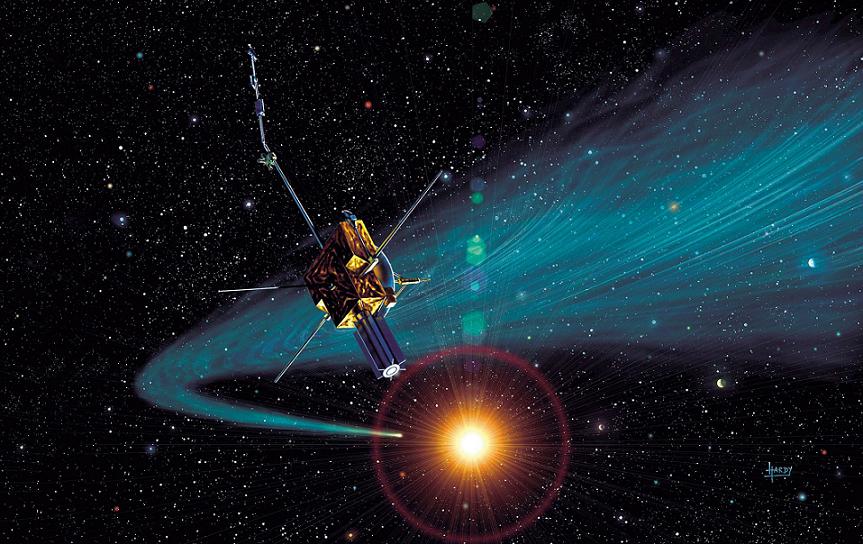
On June 30, 2009, the Ulysses mission came to an end, one year after the predicted mission end date. Ulysses is one of the longest space missions to date, and holds the record for the longest running ESA operated spacecraft, with a total mission duration of 6,842 days (18 years, 8 months, and 24 days).


A joint venture of NASA and ESA, Ulysses was launched on October 6, 1990, from the STS-41 Space Shuttle Discovery mission. Being an Out-Of-The-Ecliptic (OOE) mission, the Ulysses mission studied the Sun at all latitudes. The initial gravity assist at Jupiter on February 8, 1992, injected the spacecraft in an orbit around the Sun with an inclination to the ecliptic of 80.2 degrees.


Besides studying the north and south poles of the Sun, Ulysses also made observations on Jupiter and the comets Hyakutake and McNaught-Hartley.


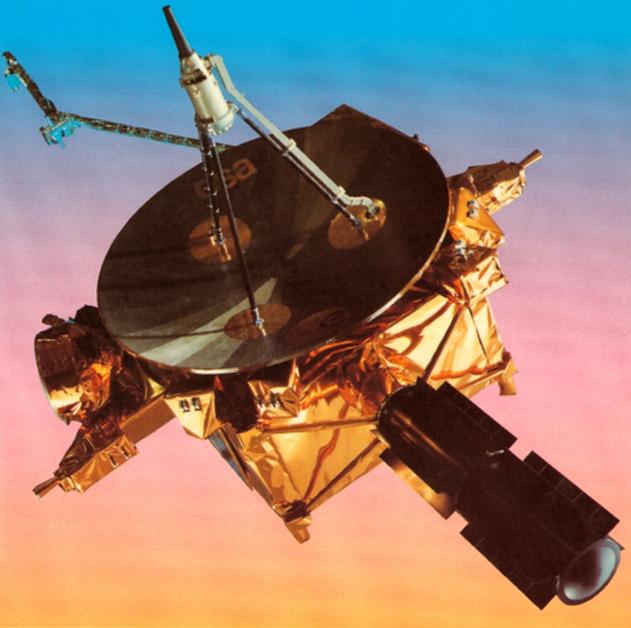
The spacecraft is box-shaped, 3.2×3.3×2.1 m in size. Three external features of the spacecraft are the High Gain Antenna (HGA), which is a 1.65 m diameter parabolic dish, the Radio-isotope Thermoelectric Generator (RTG), and the two 35 m antennae for the Unified Radio and Plasma (URAP) instrument. The HGA was used for communicating with ground-based stations in both X-band and S-band radio frequency bands.


Credits: ESA


If you are passionate about spacecraft design, an overview of the Ulysses spacecraft, with subsystem schematics and descriptions of all units, is available.


The link contains presentations of the Attitude and Orbit Control Subsystem, the Telemetry, Tracking, and Command Subsystem, the Data Handling Subsystem, and the Power and Thermal Subsystem. It is 1980s technology, but very tasty food for an engineer’s brains.


During its long-duration mission, Ulysses made observations above and below the poles of the Sun. Fundamental scientific discoveries and contributions to our understanding of the Sun and the heliosphere were made. Due to the characteristics of its orbit, Ulysses was able to perform direct measurements of interstellar dust and gas.


You can find out more about Ulysses on ESA’s and NASA’s websites.


Planetary Radio released an interview with Nigel Angold, the ESA Ulysses Mission Operations Manager. Find out how engineers kept the Ulysses spacecraft alive for so long. I invite everyone to listen to it.


  • Facebook
  • Google
  • Slashdot
  • Reddit
  • Live
  • TwitThis


Credits: NASA/ESA


The Hubble Space Telescope (HST) is a joint creation of NASA, ESA, hundreds of industrial companies, government and university groups, and thousands of engineers and scientists. Since April 1990, when it was released into orbit from Discovery’s payload bay, Hubble has returned scientific data and stunning images of stars, nebulae, and distant galaxies.


The construction of the space telescope began in the 1980s, when the optics company Perkin-Elmer initiated the work on Hubble’s primary light-collecting mirror. The Hubble Space Telescope was completed in 1985, but was not deployed in Earth’s orbit for another five years.


In 1983, the Space Telescope Science Institute (STScI) was founded and it assumed from NASA the science management of the Hubble Space Telescope. STScI is located at Johns Hopkins University.


In its initial configuration, Hubble carried the Wide Field and Planetary Camera (WF/PC), the Goddard High Resolution Spectrograph (GHRS), the Faint Object Camera (FOC), and the Faint Object Spectrograph (FOS). It was soon to be discovered that the primary mirror had a flaw, and that the space telescope suffered from blurry vision.


The Hubble Servicing Mission 1 installed a corrective optics package, COSTAR, and replaced the original WF/PC with the Wide Field and Planetary Camera 2. Hubble Servicing Mission 2 replaced the GHRS and FOS with the Space Telescope Imaging Spectrograph (STIS) and the Near Infrared Camera and Multi-Object Spectrometer (NICMOS). Servicing Mission 3A replaced all six gyroscopes, a Fine Guidance Sensor, and the onboard computer. Servicing Mission 3B saw the installation of the Advanced Camera for Surveys (ACS), which replaced the FOC, and the revival of NICMOS through the installation of a new cooling system.


All this, and the history of astronomic discoveries beginning with Galileo Galilei in 1609 and continued by William Herschel, William Huggins, George Ellery Hale, and Edwin Hubble, are presented in Hubble – Imaging Space And Time, a book authored by David DeVorkin and Robert W. Smith. The book is replete with spectacular images captured by the Hubble Space Telescope. Images of Carina Nebula, Eagle Nebula, Orion Nebula, and Swan Nebula, just to name a few, are a celebration of color and convey the majestic beauty of the Cosmos.


David DeVorkin is curator of the history of astronomy and the space sciences at the National Air and Space Museum, Smithsonian Institution. Among other books he has authored are Beyond Earth: Mapping the Universe and The Hubble Space Telescope: Imaging the Universe.


Robert W. Smith is a professor of history and Director of the Science, Technology and Society Program at the University of Alberta. He is also the author of The Space Telescope: A Study of NASA, Science, Technology and Politics, The Hubble Space Telescope: Imaging the Universe, and The Expanding Universe.


  • Facebook
  • Google
  • Slashdot
  • Reddit
  • Live
  • TwitThis
05-27-09

STS-125 Recap

Posted by


Credits: NASA


STS-125 Space Shuttle Atlantis was the final Hubble Space Telescope servicing mission (SM4). The STS-125 crew consisted of Gregory C. Johnson, pilot; Scott D. Altman, commander; Michael J. Massimino, Michael T. Good, K. Megan McArthur, John M. Grunsfeld, and Andrew J. Feustel, all mission specialists.


STS-125 has some history behind it. In 2004, NASA head Sean O’Keefe cancelled the long-planned Hubble Space Telescope Servicing Mission 4, invoking new safety rules that were applied to space shuttle flights after the Columbia disaster. By June 2004, NASA was considering a robotic servicing mission, which was also cancelled due to prohibitive costs. A change in NASA policy came with the new head of NASA, Michael Griffin. The risks associated with the SM4 mission were reassessed, and by 2008 SM4 was back on track.


On May 11, 2009, STS-125 Space Shuttle Atlantis launched at 2:01 PM EDT. There were no obvious debris events during launch and after going through the post-launch checklist, the crew prepared the orbiter for in-orbit operations and conducted a survey of the payload bay and the crew cabin using the robotic arm.


On May 13, 2009, at 17:14 UTC, flight day #3, Hubble Space Telescope was grappled and by 18:12 UTC, the telescope was berthed in the payload bay of Atlantis.


There were a total of five EVAs performed by the STS-125 crew. During EVA#1 (John Grunsfeld/ Andrew Feustel), the Wide Field and Planetary Camera 2 (WFPC2) was replaced with the new Wide Field Camera 3 (WFC3), and the Science Instrument Command and Data Handling Unit were replaced. A Soft Capture Mechanism (SCM) was also installed on Hubble. SCM will be used to capture and de-orbit Hubble at the end of its operational life. EVA#2 (Michael Massimino/ Michael Good) replaced all three gyroscope rate sensing units (RSUs) and one of the battery unit modules. EVA#3 (John Grunsfeld/ Andrew Feustel) removed and replaced COSTAR with the Cosmic Origins Spectrograph, and replaced faulty electronics cards from the Advanced Camera for Surveys. EVA#4 (Michael Massimino/ Michael Good) removed and replaced electronics cards for the Space Telescope Imaging Spectrograph (STIS). EVA#5 (John Grunsfeld/ Andrew Feustel) replaced the second battery unit module, installed the Fine Guidance Sensor #3, replaced degraded insulation panels with New Outer Blanket Layer (NOBL)s, and also replaced a protective cover around Hubble’s low-gain antenna.


Hubble was released on May 19, 2009 (flight day #9). The telescope was lifted out of the orbiter’s payload bay using the robotic arm. After running through the release checklist, the STS-125 crew released Hubble at 12:57 UTC. The new equipment and the upgrades installed on Hubble will be tested for several months before resuming operation in early September.


Due to weather, which was less than favorable for landing, STS-125 had to delay the return to Earth for two days. The de-orbit burn was initiated on May 24, 2009, at 14:24 UTC.

STS-125 Space Shuttle Atlantis landed at Edwards Air Force Base in California, on Sunday May 24, 2009, at 11:39 AM EDT.


  • Facebook
  • Google
  • Slashdot
  • Reddit
  • Live
  • TwitThis