OrbitalHub

The place where space exploration, science, and engineering meet

Domain is for sale. $50,000,000.00 USD. Direct any inquiries to contact@orbitalhub.com.

03-16-20

Dragonfly

Posted by


NASA dicit:

Dragonfly is a NASA mission to explore the chemistry and habitability of Saturn’s largest moon, Titan. The fourth mission in the New Frontiers line, Dragonfly will send an autonomously-operated rotorcraft to visit dozens of sites on Titan, investigating the moon’s surface and shallow subsurface for organic molecules and possible biosignatures. To carry out its mission, Dragonfly is equipped with a neutron spectrometer, a drill system, and a mass spectrometer, allowing scientists to make a detailed survey of Titan’s chemical makeup. Dragonfly is scheduled to launch in 2026 and arrive at Titan in 2034.

Video credit: NASA’s Goddard Space Flight Center/Johns Hopkins APL/Dan Gallagher (USRA): Producer, Narrator, Writer/Jonathan North (USRA): Lead Animator/Melissa Trainer (NASA/GSFC): Lead Writer, Scientist/ Michael Lentz (USRA): Animator/Ann Parsons (NASA/GSFC): Scientist/Elizabeth Turtle (Johns Hopkins University/APL): Scientist/Aaron E. Lepsch (ADNET): Technical Support


  • Facebook
  • Google
  • Slashdot
  • Reddit
  • Live
  • TwitThis
09-17-19

Moons Circling Saturn

Posted by


NASA dicit:

This Hubble time-lapse movie shows the orbits of some of Saturn’s icy moons as they circle the planet over an 18-hour period. The video is composed of 33 Hubble snapshots of the planet, taken June 19 to 20, 2019, by the Wide Field Camera 3.

Saturn’s signature rings are still as stunning as ever. The image reveals that the ring system is tilted toward Earth, giving viewers a magnificent look at the bright, icy structure. Hubble resolves numerous ringlets and the fainter inner rings.

This image reveals an unprecedented clarity only seen previously in snapshots taken by NASA spacecraft visiting the distant planet. Astronomers will continue their yearly monitoring of the planet to track shifting weather patterns and identify other changes. The second in the yearly series, this image is part of the Outer Planets Atmospheres Legacy (OPAL) project. OPAL is helping scientists understand the atmospheric dynamics and evolution of our solar system’s gas giant planets.

Video Credit: NASA


  • Facebook
  • Google
  • Slashdot
  • Reddit
  • Live
  • TwitThis
02-28-19

Sounds of Saturn and Enceladus

Posted by


NASA dicit:

“New research from the up-close Grand Finale orbits of NASA’s Cassini mission shows a surprisingly powerful interaction of plasma waves moving from Saturn to its moon Enceladus. Researchers converted the recording of plasma waves into a “whooshing” audio file that we can hear — in the same way a radio translates electromagnetic waves into music. Much like air or water, plasma (the fourth state of matter) generates waves to carry energy. The recording was captured by the Radio Plasma Wave Science (RPWS) instrument September 2, 2017, two weeks before Cassini was deliberately plunged into the atmosphere of Saturn.”

Video Credit: NASA/JPL-Caltech/University of Iowa


  • Facebook
  • Google
  • Slashdot
  • Reddit
  • Live
  • TwitThis
01-11-19

Rings of Saturn

Posted by


NASA dixit:

“Scientists from NASA Goddard have discovered that not only are Saturn’s rings younger than previously thought, but also that the rings are actually disappearing at a rapid pace through a process called ring rain.”

Video Credit: NASA


  • Facebook
  • Google
  • Slashdot
  • Reddit
  • Live
  • TwitThis
03-9-18

Phobos and Saturn

Posted by


NASA dixit:

“These observations of Phobos and Saturn were taken by the Super Resolution Channel of the High Resolution Stereo Camera on Mars Express. The video comprises 30 separate images acquired during Mars Express orbit 16 346 on 26 November 2016. The slight up and down movement of Saturn and Phobos in these images is caused by the oscillation of the spacecraft’s orientation after completing the turn towards the moon. Phobos can be seen in the foreground, partially illuminated, with Saturn visible as a small ringed dot in the distance.”

Video credit: NASA


  • Facebook
  • Google
  • Slashdot
  • Reddit
  • Live
  • TwitThis
10-19-17

Propeller in Saturn’s A Ring

Posted by


NASA dixit:

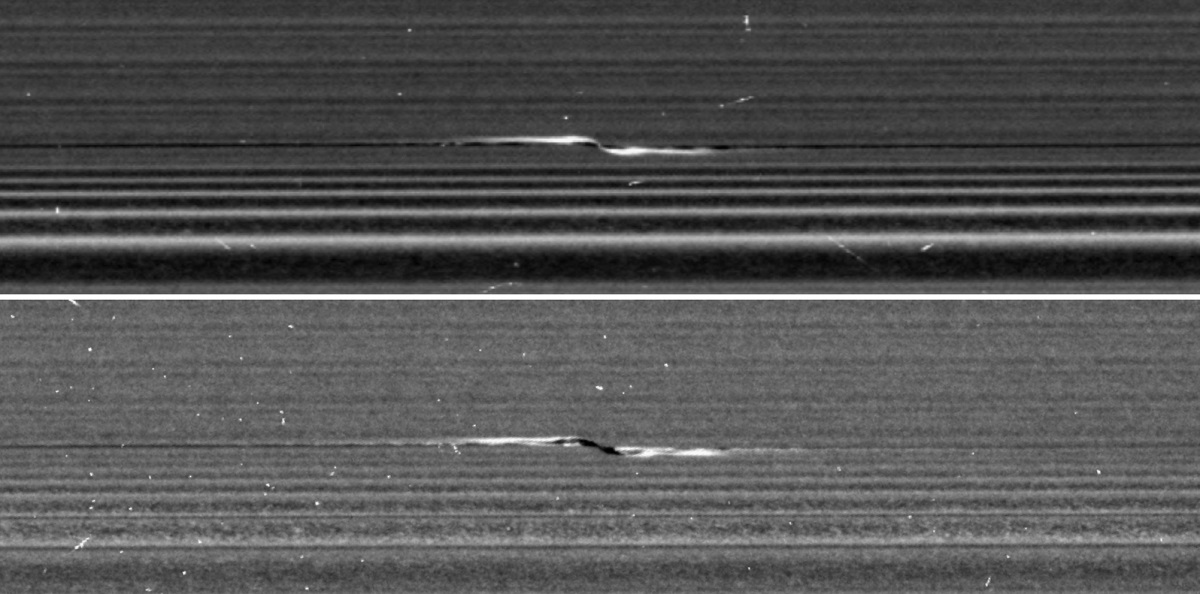
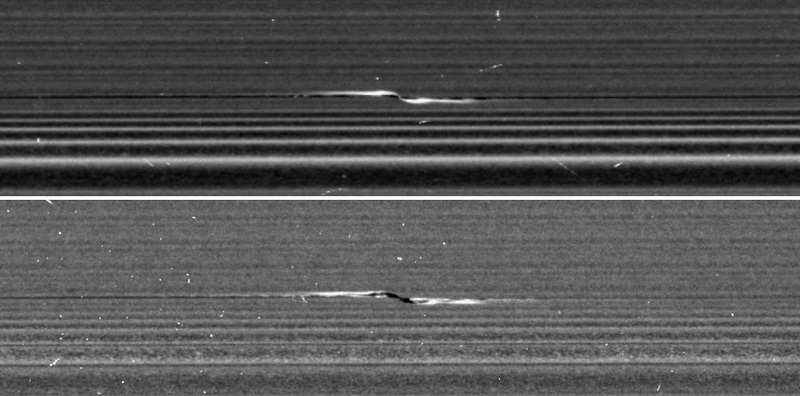
“February 21, 2017. NASA’s Cassini spacecraft captured these remarkable views of a propeller feature in Saturn’s A ring. These are the sharpest images taken of a propeller so far, and show an unprecedented level of detail. The propeller is nicknamed “Santos-Dumont,” after the pioneering Brazilian-French aviator. This observation was Cassini’s first targeted flyby of a propeller. The views show the object from vantage points on opposite sides of the rings. The top image looks toward the rings’ sunlit side, while the bottom image shows the unilluminated side, where sunlight filters through the backlit ring.

The two images are reprojected at the same scale (0.13 mile or 207 meters per pixel) in order to facilitate comparison. Cassini scientists have been tracking the orbit of this object for the past decade, tracing the effect that the ring has upon it. Now, as Cassini has moved in close to the ring as part of its ring-grazing orbits, it was able to obtain this extreme close-up view of the propeller, enabling researchers to examine its effects on the ring. These views, and others like them, will inform models and studies in new ways going forward.

Like a frosted window, Saturn’s rings look different depending on whether they are seen fully sunlit or backlit. On the lit side, the rings look darker where there is less material to reflect sunlight. On the unlit side, some regions look darker because there is less material, but other regions look dark because there is so much material that the ring becomes opaque. Observing the same propeller on both the lit and unlit sides allows scientists to gather richer information about how the moonlet affects the ring. For example, in the unlit-side view, the broad, dark band through the middle of the propeller seems to be a combination of both empty and opaque regions. The propeller’s central moonlet would only be a couple of pixels across in these images, and may not actually be resolved here. The lit-side image shows that a bright, narrow band of material connects the moonlet directly to the larger ring, in agreement with dynamical models. That same thin band of material may also be obscuring the moonlet from view. Lengthwise along the propeller is a gap in the ring that the moonlet has pried open. The gap appears dark on both the lit and unlit sides. Flanking the gap near the moonlet are regions of enhanced density, which appear bright on the lit side and more mottled on the unlit side.

One benefit of the high resolution of these images is that, for the first time, wavy edges are clearly visible in the gap. These waves are also expected from dynamical models, and they emphasize that the gap must be sharp-edged. Furthermore, the distance between the wave crests tells scientists the width of the gap (1.2 miles or 2 kilometers), which in turn reveals the mass of the central moonlet. From these measurements, Cassini imaging scientists deduce that the moonlet’s mass is comparable to that of a snowball about 0.6 mile (1 kilometer) wide.”

Image credit: NASA/JPL-Caltech/Space Science Institute

 

  • Facebook
  • Google
  • Slashdot
  • Reddit
  • Live
  • TwitThis