OrbitalHub

The place where space exploration, science, and engineering meet

Domain is for sale. $50,000,000.00 USD. Direct any inquiries to contact@orbitalhub.com.

10-6-17

Regarding Rhea

Posted by


NASA dixit:

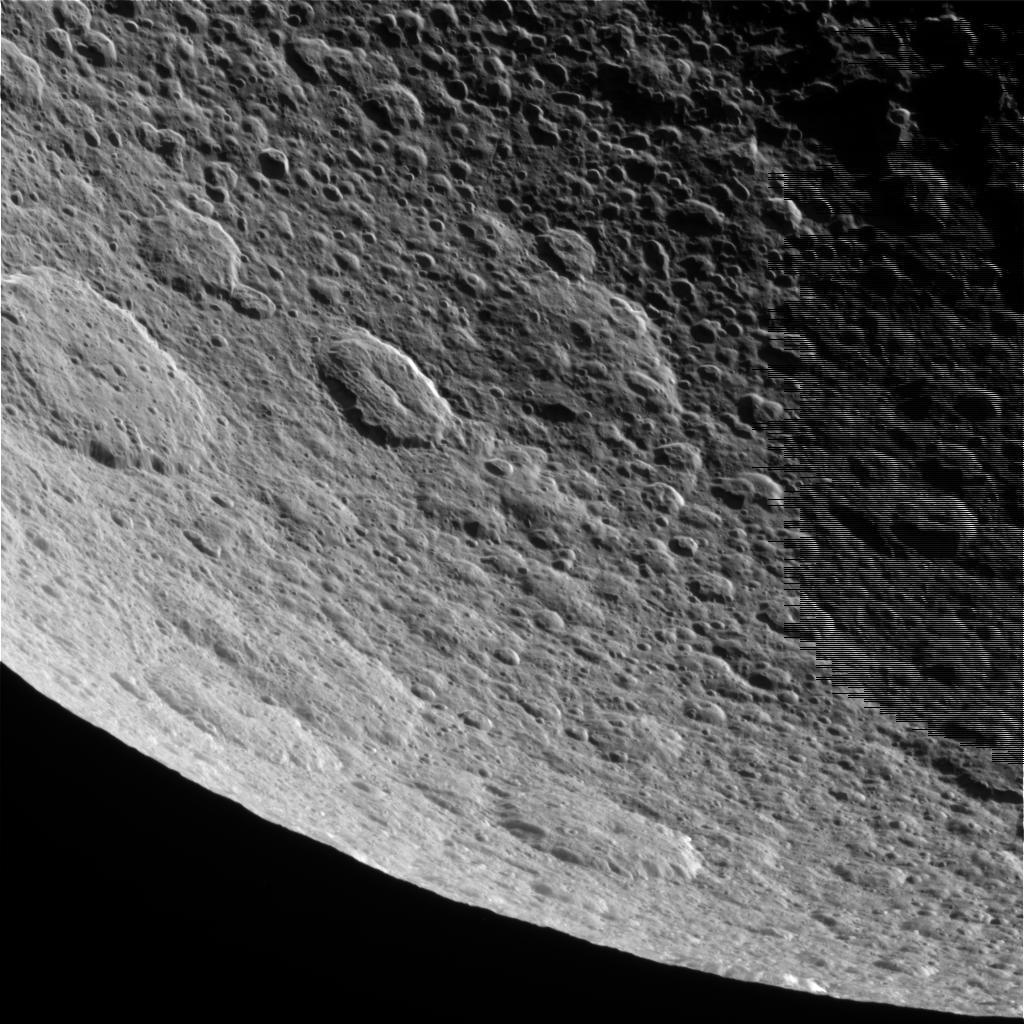
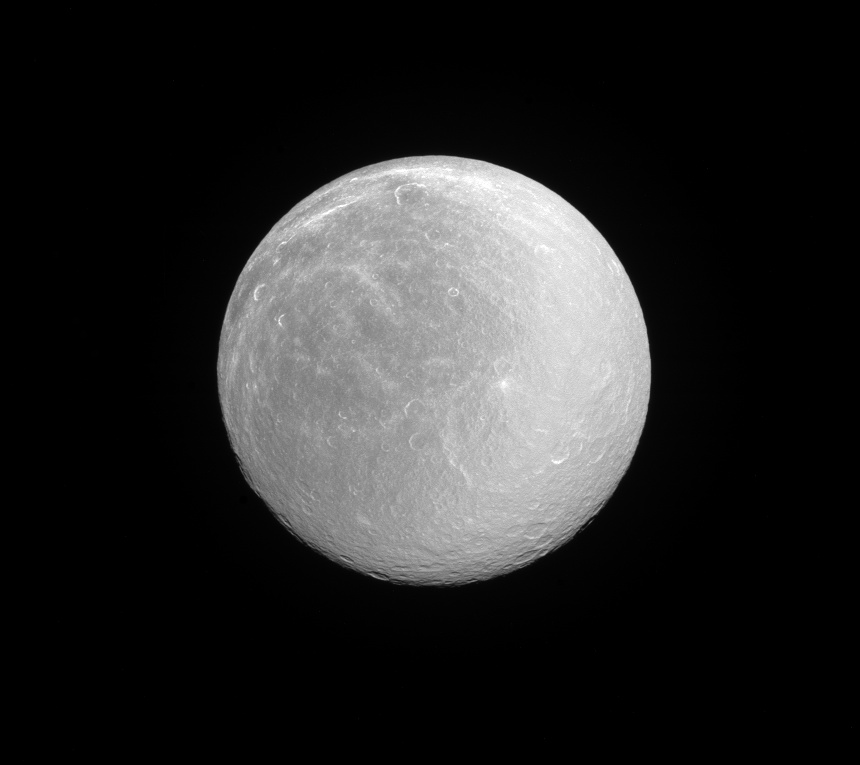
“June 3, 2016. Rhea, like many moons in the outer solar system, appears dazzlingly bright in full sunlight. This is the signature of the water ice that forms most of the moon’s surface. Rhea (949 miles or 1,527 kilometers across) is Saturn’s second largest moon after Titan. Its ancient surface is one of the most heavily cratered of all of Saturn’s moons. Subtle albedo variations across the disk of Rhea hint at past geologic activity.

This view looks toward the anti-Saturn hemisphere of Rhea. North on Rhea is up and rotated 36 degrees to the right. The image was taken with the Cassini spacecraft narrow-angle camera using a spectral filter which preferentially admits wavelengths of ultraviolet light centered at 338 nanometers. The view was acquired at a distance of approximately 365,000 miles (587,000 kilometers) from Rhea and at a Sun-Rhea-spacecraft, or phase, angle of 9 degrees. Image scale is 2.4 miles (3.9 kilometers) per pixel.”

Image credit: NASA/JPL-Caltech/Space Science Institute


  • Facebook
  • Google
  • Slashdot
  • Reddit
  • Live
  • TwitThis
09-30-17

Triple Play

Posted by


NASA dixit:

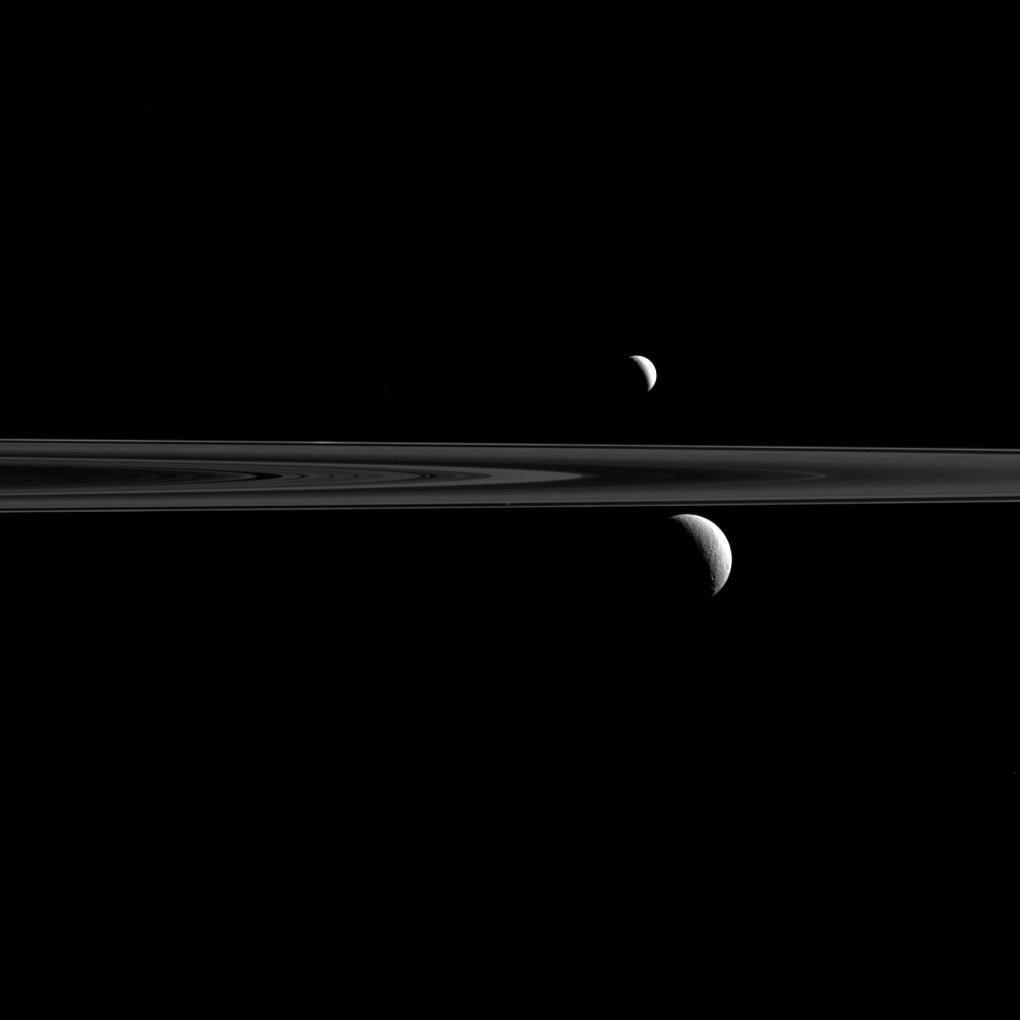
“September 24, 2015. What looks like a pair of Saturnian satellites is actually a trio upon close inspection. Here, Cassini has captured Enceladus (313 miles or 504 kilometers across) above the rings and Rhea (949 miles or 1,527 kilometers across) below. The comparatively tiny speck of Atlas (19 miles or 30 kilometers across) can also be seen just above and to the left of Rhea, and just above the thin line of Saturn’s F ring. This view looks toward the unilluminated side of the rings from about 0.34 degrees below the ring plane.

The image was taken in visible light with the Cassini spacecraft narrow-angle camera. The view was obtained at a distance of approximately 1.8 million miles (2.8 million kilometers) from Rhea. Image scale on Rhea is 10 miles (16 kilometers) per pixel. The distance to Enceladus was 1.3 million miles (2.1 million kilometers) for a scale of 5 miles (8 kilometers) per pixel. The distance to Atlas was 1.5 million miles (2.4 million) kilometers) for an image scale at Atlas of 9 miles (14 kilometers) per pixel.”

Image credit: NASA/JPL-Caltech/Space Science Institute


  • Facebook
  • Google
  • Slashdot
  • Reddit
  • Live
  • TwitThis
09-25-17

Rhea in Relief

Posted by


NASA dixit:

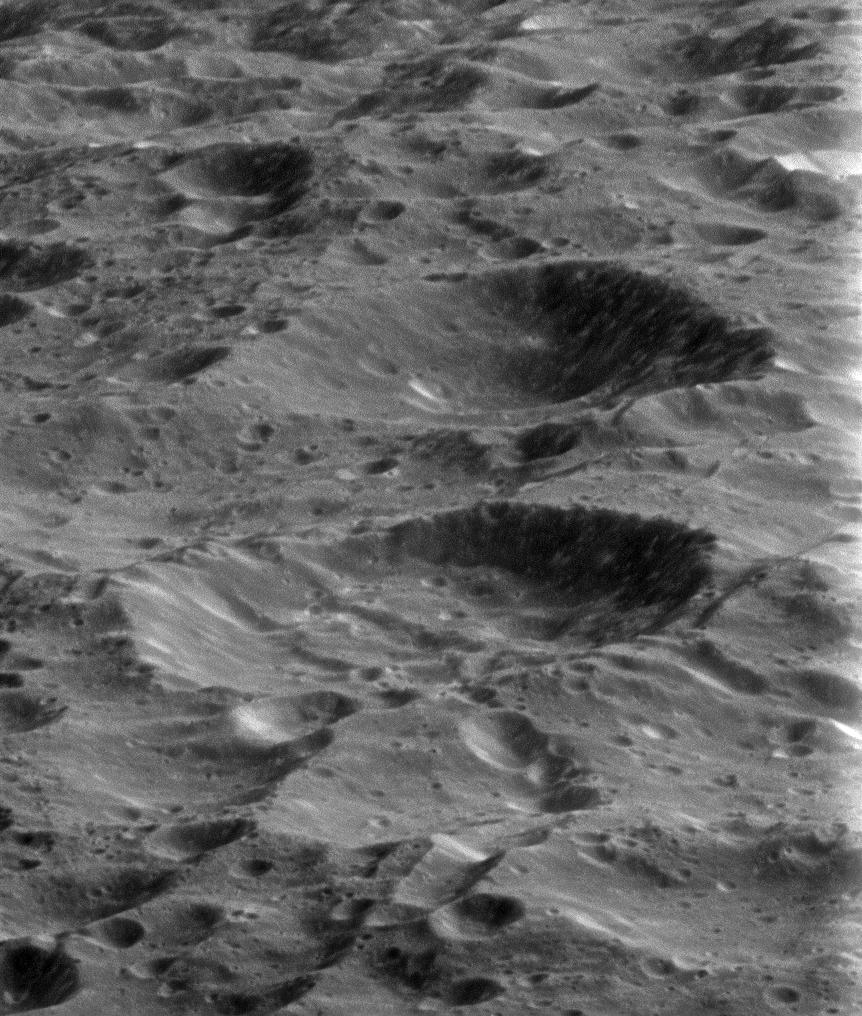
“February 10, 2015. Surface features on Rhea – mostly impact craters in this image – are thrown into sharp relief thanks to long shadows. Viewing this terrain near the day/night terminator makes it easier to appreciate just how violent Rhea’s geological history has been. The craters on Rhea (949 miles, or 1,527 kilometers across) are the result of 4.6 billion years of bombardment by small bodies. With very little erosion, the scars and craters remain unless they are overwritten by other, newer impacts.

This view looks toward the anti-Saturn hemisphere of Rhea. North on Rhea is up and rotated 11 degrees to the right. The image was taken in visible light with the Cassini spacecraft narrow-angle camera. The view was acquired at a distance of approximately 47,000 miles (76,000 kilometers) from Rhea. Image scale is 1,500 feet (460 meters) per pixel.”

Image credit: NASA/JPL-Caltech/Space Science Institute


  • Facebook
  • Google
  • Slashdot
  • Reddit
  • Live
  • TwitThis
09-12-17

Goodbye to Rhea

Posted by


NASA dixit:

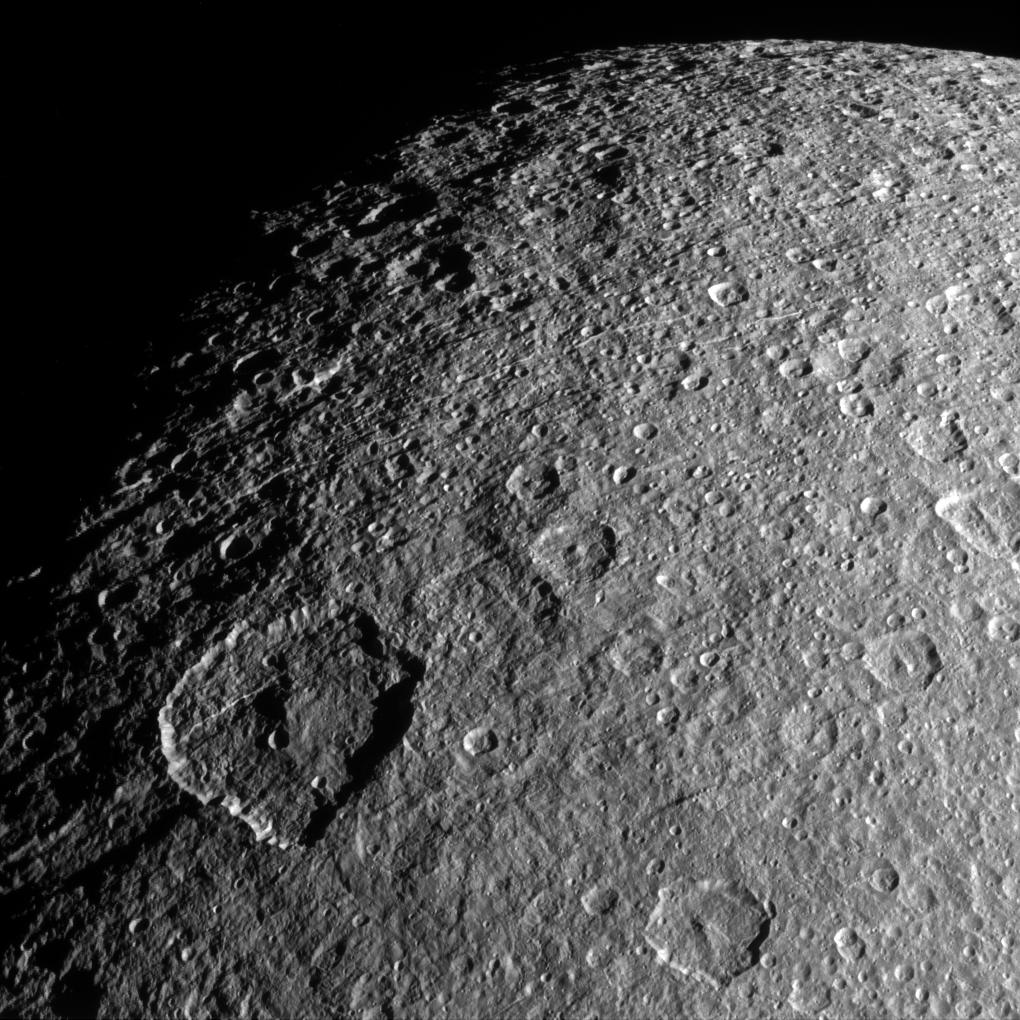
“March 9, 2013. On its fourth and final targeted flyby of Rhea, the Cassini spacecraft provided this stunning view of the ancient and heavily cratered surface. Billions of years of impacts have sculpted Rhea’s surface into the form we see today. With a diameter of 949 miles (1,528 kilometers) Rhea is Saturn’s second-largest moon.

This view is centered on terrain at 33 degrees north latitude, 358 degrees west longitude. The image was taken in visible light with the Cassini spacecraft narrow-angle camera. The view was acquired at a distance of approximately 2,280 miles (3,670 kilometers) from Rhea and at a Sun-Rhea-spacecraft, or phase, angle of 92 degrees. Image scale is 72 feet (22 meters) per pixel.”

“After almost 20 years in space, NASA’s Cassini spacecraft begins the final chapter of its remarkable story of exploration: its Grand Finale. Between April and September 2017, Cassini will undertake a daring set of orbits that is, in many ways, like a whole new mission. Following a final close flyby of Saturn’s moon Titan, Cassini will leap over the planet’s icy rings and begin a series of 22 weekly dives between the planet and the rings.

No other mission has ever explored this unique region. What we learn from these final orbits will help to improve our understanding of how giant planets – and planetary systems everywhere – form and evolve.

On the final orbit, Cassini will plunge into Saturn’s atmosphere, sending back new and unique science to the very end. After losing contact with Earth, the spacecraft will burn up like a meteor, becoming part of the planet itself.

Cassini’s Grand Finale is about so much more than the spacecraft’s final dive into Saturn. That dramatic event is the capstone of six months of daring exploration and scientific discovery. And those six months are the thrilling final chapter in a historic 20-year journey.”

Image credit: NASA


  • Facebook
  • Google
  • Slashdot
  • Reddit
  • Live
  • TwitThis
09-11-17

Battered Icy Moon

Posted by


NASA dixit:

“This image was taken on March 09, 2013, and received on Earth March 10, 2013, by NASA’s Cassini spacecraft. The camera was pointing toward Rhea at approximately 39,072 miles (62,880 kilometers) away, and the image was taken using the CL1 and CL2 filters.”

“After almost 20 years in space, NASA’s Cassini spacecraft begins the final chapter of its remarkable story of exploration: its Grand Finale. Between April and September 2017, Cassini will undertake a daring set of orbits that is, in many ways, like a whole new mission. Following a final close flyby of Saturn’s moon Titan, Cassini will leap over the planet’s icy rings and begin a series of 22 weekly dives between the planet and the rings.

No other mission has ever explored this unique region. What we learn from these final orbits will help to improve our understanding of how giant planets – and planetary systems everywhere – form and evolve.

On the final orbit, Cassini will plunge into Saturn’s atmosphere, sending back new and unique science to the very end. After losing contact with Earth, the spacecraft will burn up like a meteor, becoming part of the planet itself.

Cassini’s Grand Finale is about so much more than the spacecraft’s final dive into Saturn. That dramatic event is the capstone of six months of daring exploration and scientific discovery. And those six months are the thrilling final chapter in a historic 20-year journey.”

Image credit: NASA


  • Facebook
  • Google
  • Slashdot
  • Reddit
  • Live
  • TwitThis
09-7-17

Tethys the Spy

Posted by


NASA dixit:

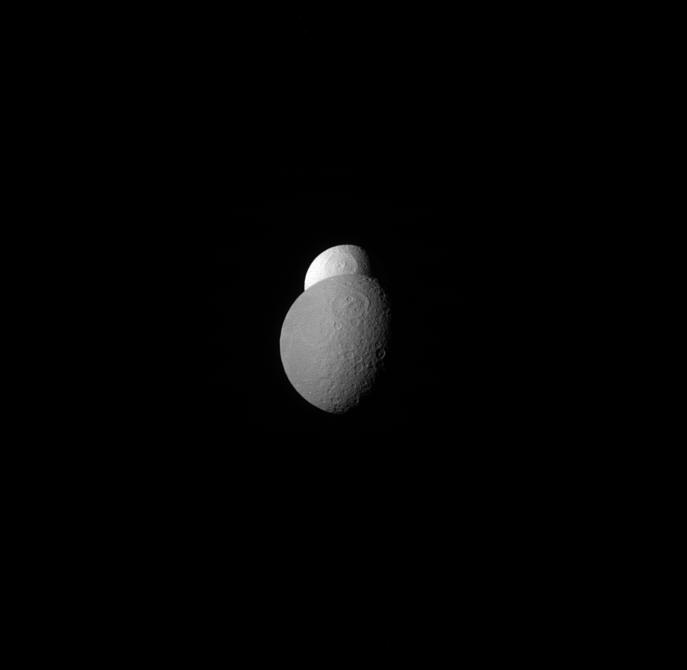
“April 20, 2012. Tethys appears to be peeking out from behind Rhea, watching the watcher. Scientists believe that Tethys’ surprisingly high albedo is due to the water ice jets emerging from its neighbor, Enceladus. The fresh water ice becomes the E ring and can eventually arrive at Tethys, giving it a fresh surface layer of clean ice. Lit terrain seen here is on the anti-Saturn side of Rhea. North on Rhea is up. The image was taken in red light with the Cassini spacecraft narrow-angle camera.

The view was obtained at a distance of approximately 1.1 million miles (1.8 million kilometers) from Rhea and at a Sun-Rhea-spacecraft, or phase, angle of 59 degrees. Image scale is 7 miles (11 kilometers) per pixel.”

“After almost 20 years in space, NASA’s Cassini spacecraft begins the final chapter of its remarkable story of exploration: its Grand Finale. Between April and September 2017, Cassini will undertake a daring set of orbits that is, in many ways, like a whole new mission. Following a final close flyby of Saturn’s moon Titan, Cassini will leap over the planet’s icy rings and begin a series of 22 weekly dives between the planet and the rings.

No other mission has ever explored this unique region. What we learn from these final orbits will help to improve our understanding of how giant planets – and planetary systems everywhere – form and evolve.

On the final orbit, Cassini will plunge into Saturn’s atmosphere, sending back new and unique science to the very end. After losing contact with Earth, the spacecraft will burn up like a meteor, becoming part of the planet itself.

Cassini’s Grand Finale is about so much more than the spacecraft’s final dive into Saturn. That dramatic event is the capstone of six months of daring exploration and scientific discovery. And those six months are the thrilling final chapter in a historic 20-year journey.”

Image credit: NASA


  • Facebook
  • Google
  • Slashdot
  • Reddit
  • Live
  • TwitThis