


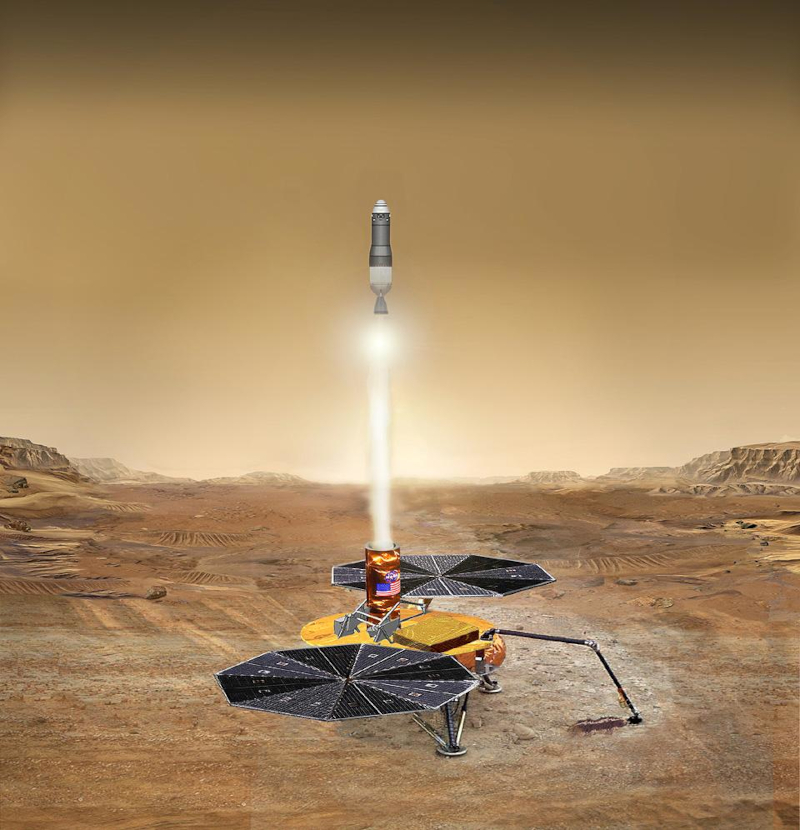
The United States Congress effectively terminated NASA’s Mars Sample Return program in January 2026, redirecting $110 million to a new “Mars Future Missions” line item while explicitly stating that the existing program would not receive support. The decision marks one of the most significant shifts in NASA’s planetary exploration strategy in decades, leaving approximately 30 samples collected by the Perseverance rover stranded on the Martian surface indefinitely.
The cancellation emerged from the Fiscal Year 2026 budget process, where the Trump administration proposed terminating Mars Sample Return due to escalating costs and projected timelines. Estimates placed the total cost at up to $11 billion, with samples potentially not returning until 2040 at the earliest. These figures proved unacceptable to congressional appropriators, who instead passed a compromise spending bill that explicitly excluded support for the existing program.
The Mars Sample Return campaign represented a joint NASA-ESA effort to bring Martian material to Earth for detailed laboratory analysis. Perseverance has been collecting samples since 2021, caching them at strategic locations across Jezero Crater for later retrieval. The original architecture called for a complex sequence of missions: an ascent vehicle to launch the samples into Martian orbit, a transfer spacecraft to capture them, and a return vehicle to bring them to Earth.
The program’s troubles predated the 2026 cancellation. Independent reviews in 2023 and 2024 criticized the architecture as overly complex and expensive, with the Planetary Science Decadal Survey recommending that NASA seek a more affordable approach. The agency paused architecture work and studied alternatives, but cost estimates remained prohibitively high regardless of the chosen approach.
The decision to cut Mars Sample Return has generated substantial criticism from the scientific community. Researchers note that laboratory analysis of Martian material could address fundamental questions about Mars’s past habitability and whether life ever existed on the planet. The samples collected by Perseverance include formations that show potential biosignatures, making their analysis particularly compelling.
ESA, which had committed significant resources to the program, is now reassessing its role in Mars exploration. The European agency’s contributions included the Earth Return Orbiter, which would have captured the sample container in Martian orbit and returned it to Earth. With the NASA program cancelled, ESA faces decisions about whether to pursue independent or alternative approaches.
The $110 million redirected to “Mars Future Missions” could support technology development for future sample retrieval attempts, including work on Mars landing systems and sample containment technologies. However, no specific mission has been proposed, and the funding level represents a fraction of what the full program would have required.
The cancellation leaves China potentially positioned as the first nation to return Martian samples to Earth. That country’s Tianwen-1 mission included an orbiter and lander, though not a sample return component. However, Chinese scientists have discussed sample return ambitions, and the U.S. decision may accelerate those plans.
For now, the samples collected by Perseverance remain where they were deposited, scattered across the floor of Jezero Crater. The rover continues operating, collecting additional samples and conducting scientific investigations, though the ultimate purpose of those samples remains uncertain. Future missions may retrieve them, or they may remain as artifacts of a program that came close to achieving something unprecedented before falling to budget realities.
Returning material from Mars presents one of the most challenging problems in spaceflight. The planet’s gravitational well requires substantial energy to escape, with a velocity delta of approximately 5.6 kilometers per second needed to reach low Mars orbit. This is comparable to the total velocity change required to reach Mars from Earth in the first place.
The Mars Sample Return architecture addressed this challenge through multiple vehicles. A Mars Ascent Vehicle would launch from the surface carrying the sample container, achieving orbital insertion without relying on atmospheric drag for deceleration. An Earth Return Orbiter would then capture this container in orbit and perform the much larger maneuver needed to transfer to an Earth-return trajectory.
The thermal protection required for Earth reentry adds complexity. The sample container would strike Earth’s atmosphere at velocities approaching 12 kilometers per second, generating temperatures exceeding 2,000 degrees Celsius. The capsule design incorporates heat shields similar to those used on Apollo return vehicles, sized appropriately for the mass and velocity of the return trajectory.
Containment represents a critical requirement given the possibility of Martian material posing biological hazards. The samples must remain sealed throughout reentry and landing, with containment verified before any potential exposure to Earth’s biosphere. This requirement adds mass and complexity to the return vehicle, as the sealed container must survive the entire descent and recovery process intact.


 Subscribe to blog posts using RSS












