OrbitalHub

The place where space exploration, science, and engineering meet

Domain is for sale. $50,000,000.00 USD. Direct any inquiries to contact@orbitalhub.com.

02-28-19

Sounds of Saturn and Enceladus

Posted by


NASA dicit:

“New research from the up-close Grand Finale orbits of NASA’s Cassini mission shows a surprisingly powerful interaction of plasma waves moving from Saturn to its moon Enceladus. Researchers converted the recording of plasma waves into a “whooshing” audio file that we can hear — in the same way a radio translates electromagnetic waves into music. Much like air or water, plasma (the fourth state of matter) generates waves to carry energy. The recording was captured by the Radio Plasma Wave Science (RPWS) instrument September 2, 2017, two weeks before Cassini was deliberately plunged into the atmosphere of Saturn.”

Video Credit: NASA/JPL-Caltech/University of Iowa


  • Facebook
  • Google
  • Slashdot
  • Reddit
  • Live
  • TwitThis
10-13-17

Enceladus

Posted by


NASA dixit:

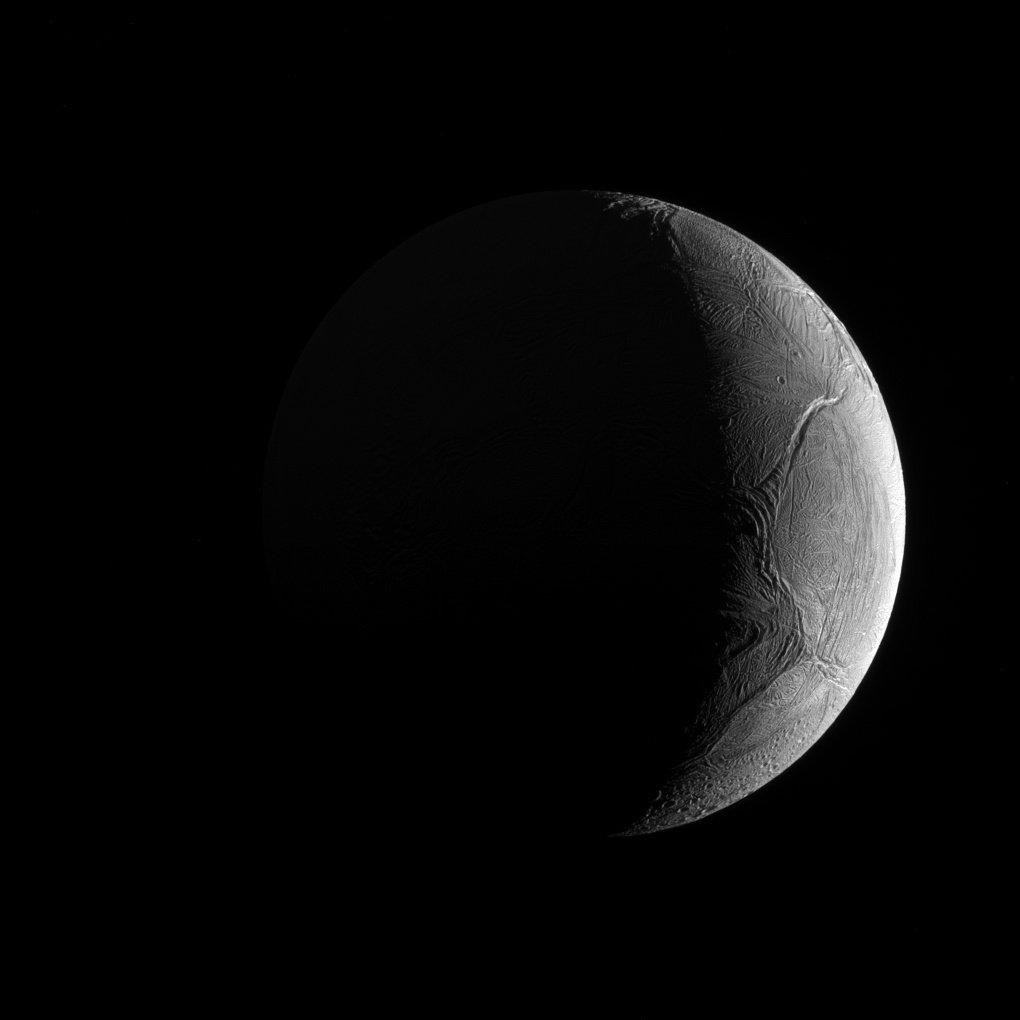
“November 27, 2016. Seen from outside, Enceladus appears to be like most of its sibling moons: cold, icy and inhospitable. But under that forbidding exterior may exist the very conditions needed for life. Over the course of the Cassini mission, observations have shown that Enceladus (313 miles or 504 kilometers across) not only has watery jets sending icy grains into space; under its icy crust it also has a global ocean, and may have hydrothermal activity as well. Since scientists believe liquid water is a key ingredient for life, the implications for future missions searching for life elsewhere in our solar system could be significant.

This view looks toward the Saturn-facing hemisphere of Enceladus. North on Enceladus is up and rotated 6 degrees to the right. The image was taken in green light with the Cassini spacecraft narrow-angle camera. The view was obtained at a distance of approximately 81,000 miles (130,000 kilometers) from Enceladus. Image scale is 2,566 feet (782 meters) per pixel.”

Image credit: NASA/JPL-Caltech/Space Science Institute


  • Facebook
  • Google
  • Slashdot
  • Reddit
  • Live
  • TwitThis
10-3-17

Three Times the Fun

Posted by


NASA dixit:

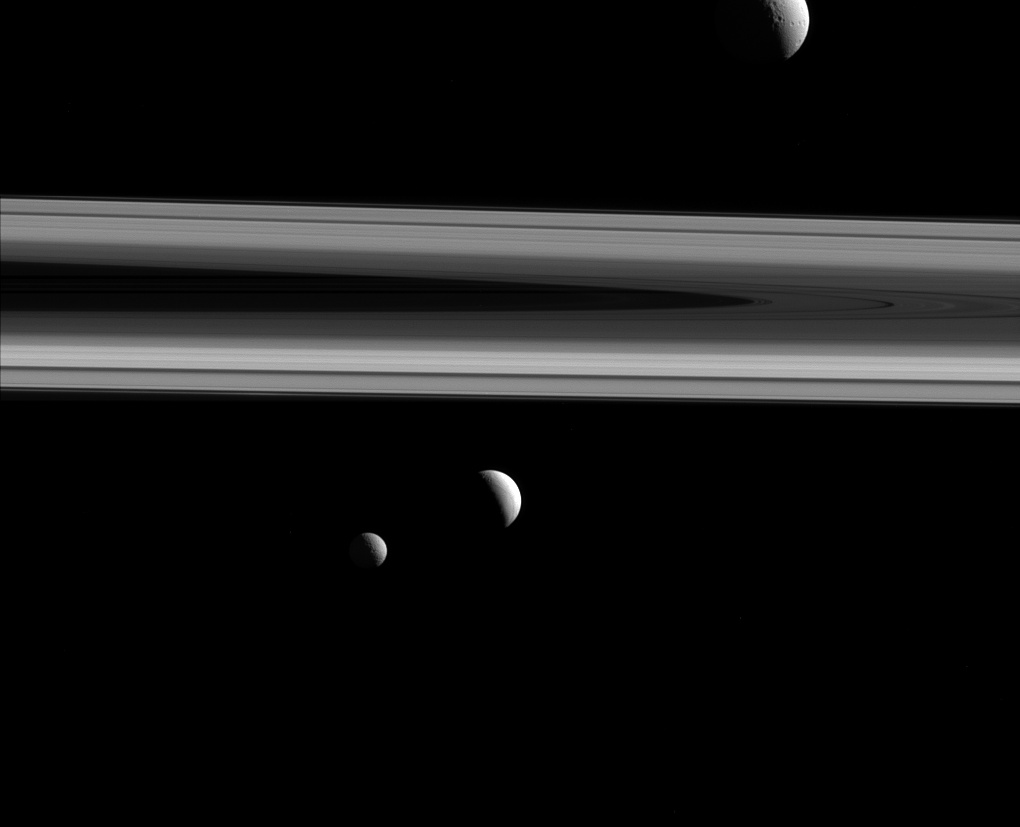
“December 3, 2015. Three of Saturn’s moons, Tethys, Enceladus, and Mimas, are captured in this group photo from NASA’s Cassini spacecraft. Tethys (660 miles or 1062 kilometers across) appears above the rings, while Enceladus (313 miles or 504 kilometers across) sits just below center. Mimas (246 miles or 396 kilometers across) hangs below and to the left of Enceladus.

This view looks toward the sunlit side of the rings from about 0.4 degrees above the ring plane. The image was taken in visible light with the Cassini spacecraft narrow-angle camera. The view was acquired at a distance of approximately 837,000 miles (1.35 million kilometers) from Enceladus, with an image scale of 5 miles (8 kilometers) per pixel. Tethys was approximately 1.2 million miles (1.9 million kilometers) away with an image scale of 7 miles (11 kilometers) per pixel. Mimas was approximately 1.1 million miles (1.7 million kilometers) away with an image scale of 6 miles (10 kilometers) per pixel.”

Image credit: NASA/JPL-Caltech/Space Science Institute


  • Facebook
  • Google
  • Slashdot
  • Reddit
  • Live
  • TwitThis
09-30-17

Triple Play

Posted by


NASA dixit:

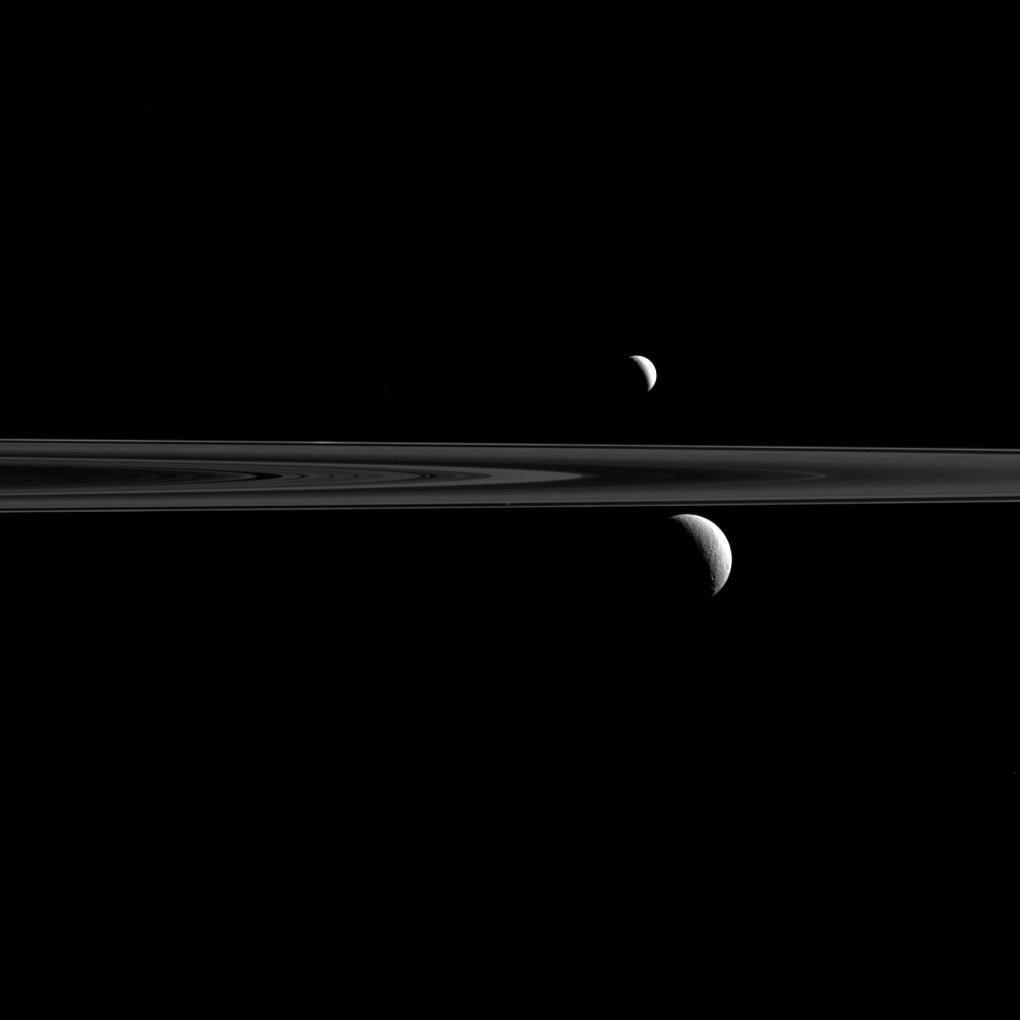
“September 24, 2015. What looks like a pair of Saturnian satellites is actually a trio upon close inspection. Here, Cassini has captured Enceladus (313 miles or 504 kilometers across) above the rings and Rhea (949 miles or 1,527 kilometers across) below. The comparatively tiny speck of Atlas (19 miles or 30 kilometers across) can also be seen just above and to the left of Rhea, and just above the thin line of Saturn’s F ring. This view looks toward the unilluminated side of the rings from about 0.34 degrees below the ring plane.

The image was taken in visible light with the Cassini spacecraft narrow-angle camera. The view was obtained at a distance of approximately 1.8 million miles (2.8 million kilometers) from Rhea. Image scale on Rhea is 10 miles (16 kilometers) per pixel. The distance to Enceladus was 1.3 million miles (2.1 million kilometers) for a scale of 5 miles (8 kilometers) per pixel. The distance to Atlas was 1.5 million miles (2.4 million) kilometers) for an image scale at Atlas of 9 miles (14 kilometers) per pixel.”

Image credit: NASA/JPL-Caltech/Space Science Institute


  • Facebook
  • Google
  • Slashdot
  • Reddit
  • Live
  • TwitThis
09-29-17

Water World

Posted by


NASA dixit:

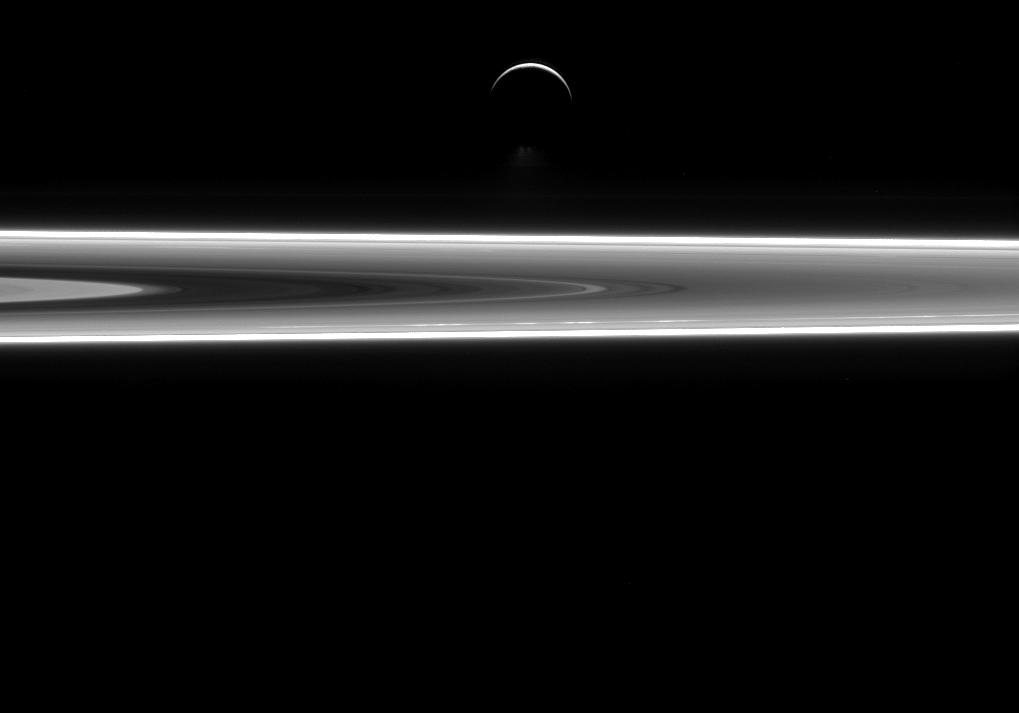
“July 29, 2015. Although Enceladus and Saturn’s rings are largely made up of water ice, they show very different characteristics. The small ring particles are too tiny to retain internal heat and have no way to get warm, so they are frozen and geologically dead. Enceladus, on the other hand, is subject to forces that heat its interior to this very day. This results in its famous south polar water jets, which are just visible above the moon’s dark, southern limb, along with a sub-surface ocean.

Work by Cassini scientists suggests that Enceladus (313 miles or 504 kilometers across) has a global ocean of liquid water under its surface. This discovery increases scientists’ interest in Enceladus and the quest to understand the role of water in the development of life in the solar system.

This view looks toward the unilluminated side of the rings from about 0.3 degrees below the ring plane. The image was taken in visible light with the Cassini spacecraft narrow-angle camera. The view was acquired at a distance of approximately 630,000 miles (1.0 million kilometers) from Enceladus and at a Sun-Enceladus-spacecraft, or phase angle of 155 degrees. Image scale is 4 miles (6 kilometers) per pixel.”

Image credit: NASA/JPL-Caltech/Space Science Institute


  • Facebook
  • Google
  • Slashdot
  • Reddit
  • Live
  • TwitThis
09-7-17

Tethys the Spy

Posted by


NASA dixit:

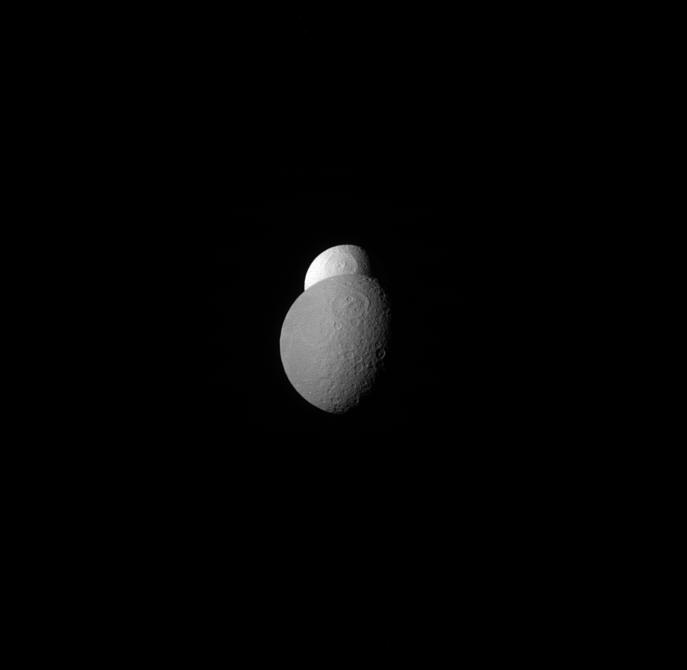
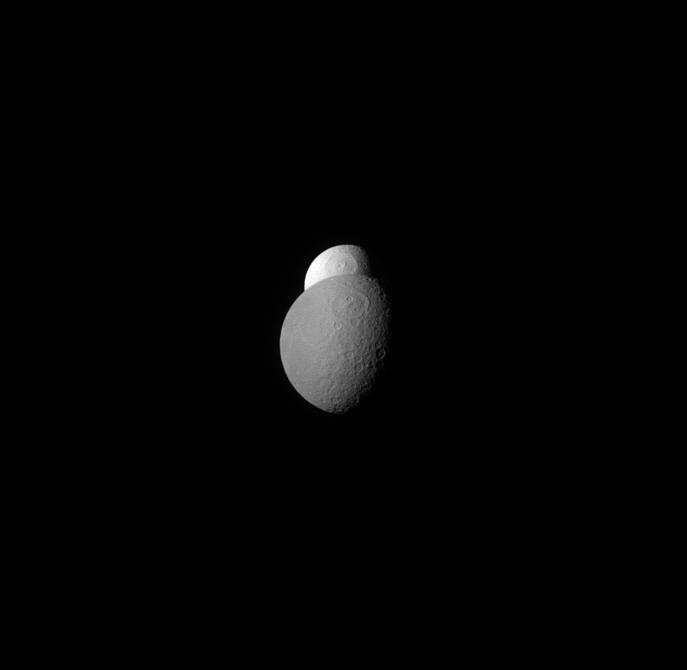
“April 20, 2012. Tethys appears to be peeking out from behind Rhea, watching the watcher. Scientists believe that Tethys’ surprisingly high albedo is due to the water ice jets emerging from its neighbor, Enceladus. The fresh water ice becomes the E ring and can eventually arrive at Tethys, giving it a fresh surface layer of clean ice. Lit terrain seen here is on the anti-Saturn side of Rhea. North on Rhea is up. The image was taken in red light with the Cassini spacecraft narrow-angle camera.

The view was obtained at a distance of approximately 1.1 million miles (1.8 million kilometers) from Rhea and at a Sun-Rhea-spacecraft, or phase, angle of 59 degrees. Image scale is 7 miles (11 kilometers) per pixel.”

“After almost 20 years in space, NASA’s Cassini spacecraft begins the final chapter of its remarkable story of exploration: its Grand Finale. Between April and September 2017, Cassini will undertake a daring set of orbits that is, in many ways, like a whole new mission. Following a final close flyby of Saturn’s moon Titan, Cassini will leap over the planet’s icy rings and begin a series of 22 weekly dives between the planet and the rings.

No other mission has ever explored this unique region. What we learn from these final orbits will help to improve our understanding of how giant planets – and planetary systems everywhere – form and evolve.

On the final orbit, Cassini will plunge into Saturn’s atmosphere, sending back new and unique science to the very end. After losing contact with Earth, the spacecraft will burn up like a meteor, becoming part of the planet itself.

Cassini’s Grand Finale is about so much more than the spacecraft’s final dive into Saturn. That dramatic event is the capstone of six months of daring exploration and scientific discovery. And those six months are the thrilling final chapter in a historic 20-year journey.”

Image credit: NASA

 

  • Facebook
  • Google
  • Slashdot
  • Reddit
  • Live
  • TwitThis