OrbitalHub

The place where space exploration, science, and engineering meet

Domain is for sale. $50,000,000.00 USD. Direct any inquiries to contact@orbitalhub.com.


Credits: NASA


The James Webb Space Telescope (JWST) is the successor of the Hubble Space Telescope (HST). While Hubble looks at the sky in the visible and ultraviolet light, JWST will operate in the infrared.


JWST is a joint mission of NASA, ESA, and the Canadian Space Agency.


The project started in 1996 and was initially known as the Next Generation Space Telescope (NGST). In 2002, the project was renamed the James Webb Space Telescope in honor of NASA administrator James E. Webb, who led the agency from February 1961 to October 1968.


The JWST will use a large deployable sunshade to keep the temperature of the telescope to about 35K. Operating at this temperature gives the telescope exceptional performance in near-infrared and mid-infrared wavebands. The JWST observatory will have a five to ten year lifetime and it will not be serviceable by astronauts.


JWST will be able to see the first galaxies that formed in the early Universe, and how the young stars formed planetary systems.


Credits: NASA


The JWST observatory includes the Integrated Science Instrument Module (ISIM), the Optical Telescope Element (OTE), and the Spacecraft Element containing a spacecraft bus (which offers the support functions for the observatory) and the sunshield.


I will say a few words about each one of them.


The Optical Telescope Element (OTE) collects the light coming from space. Thanks to a 6.5 meter primary mirror, JWST will be able to see the galaxies from the beginning of the Universe. The OTE is also composed of the Fine Steering Mirror (FSM), the secondary mirror support structure (SMSS), and the primary mirror backplane assembly (PMBA). Other subsystems of the OTE are the tertiary mirror and the fine steering mirror. The PMBA contains the Integrated Instrument Module (IIM).


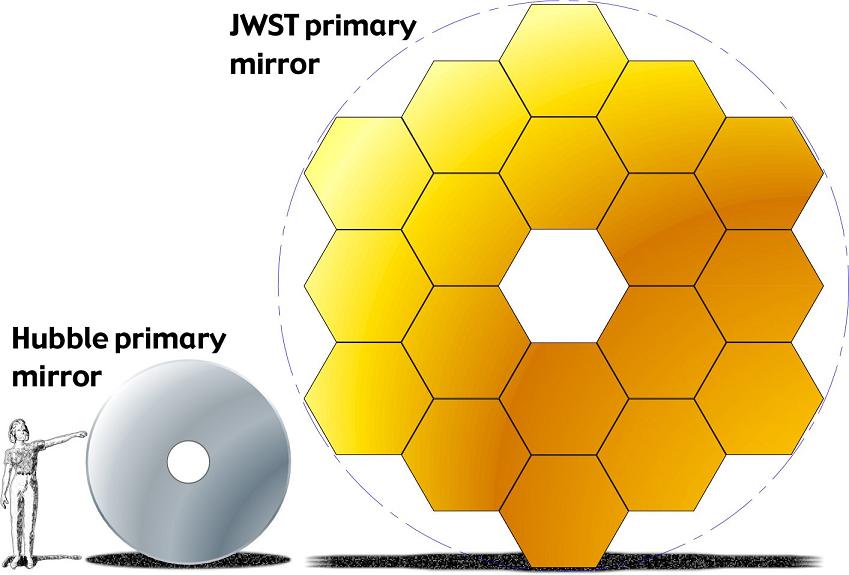
Because the primary mirror is too large to fit inside any available payload fairing, it had to be made out of eighteen hexagonal segments. Some of the elements will be folded before the launch and unfolded during the commissioning phase at the L2 point. NASA made available some neat animations showing how the observatory will be folded in order to fit into the launcher payload, and how the sun shields and the primary mirror will unfold before the observatory becomes operational.


Credits: NASA


The sunshield will keep the scientific payload of the observatory away from any light from the Sun, the Earth, or the Moon. Because JWST will observe primarily the infrared light from very distant objects, the temperature of the scientific payload must be maintained at very low values (under 50K). This requirement is so important that even a part of the observatory (the spacecraft bus) had to be placed on the warm side of the sunshield.


The sunshield not only protects the scientific instruments from the heat of the Sun, the Earth, the Moon, and the warm spacecraft bus electronics, but it also provides a stable thermal environment. This is necessary in order to maintain the alignment of the eighteen hexagonal components of the mirror while the observatory changes its orientation relative to the Sun.


The primary mirror is the essential component of a telescope. The design of the primary mirror was driven by a number of important requirements: the size, the mass, and the temperature at which the mirror will operate.


Credits: NASA


In order to be able to see galaxies from thirteen billion light-years away, scientists determined that the mirror must have a diameter of at least 6.5 meters.


The weight of the primary mirror has only one tenth of the mass of Hubble’s mirror per unit area. Considering the size of the mirror, this made the task of launching the telescope into space achievable.


Due to the fact that the telescope will observe the light in the infrared spectrum, the temperature of the mirror has to be as low as –220 degrees Celsius. If operating at the same temperature as the ground telescopes do, the infrared glow of the mirror would interfere with the light received from distant galaxies. Basically, these distant galaxies would disappear in the noise generated by the telescope.


The engineering challenge that scientists faced was to build a lightweight mirror that would preserve its optical and geometric properties when cooled to –220 degrees Celsius. Using beryllium was the solution. Beryllium is lightweight (it is widely used in the aerospace industry) and it is very good at holding its shape across a range of temperatures.


As we mentioned above, the PMBA contains the Integrated Instrument Module (IIM), which is the scientific payload onboard the observatory. The scientific payload includes the following scientific instruments: the Mid-Infrared Instrument (MIRI), the Near-Infrared Spectrograph (NIRSpec), the Near-Infrared Camera (NIRCam), and the Fine Guidance Sensor (FGS).


The MIRI is an imager/spectrograph that covers the wavelength range from 5 to 27 micrometers. The nominal operating temperature for the MIRI is 7K. The NIRSpec covers two wavelength ranges: from 1 to 5 micrometers (medium-resolution spectroscopy) and from 0.6 to 5 micrometers (lower-resolution spectroscopy). The NIRCam was provided by the University of Arizona. NIRCam covers the spectrum from 0.6 to 5 micrometers. The FGS is a broadband guide camera that is used for guide star acquisition and fine pointing.


Credits: ESA


The spacecraft bus is composed of every subsystem of the observatory minus the sunshield and the scientific payload, and it provides the necessary support functions for the operations of the observatory. The spacecraft bus contains the Electrical Power Subsystem (EPS), the Attitude Control Subsystem (ACS), the Communication Subsystem (CS), the Command and Data Handling Subsystem (C&DHS), the Propulsion Subsystem (PS), and the Thermal Control Subsystem (TCS).


One interesting thing I would like to mention here is that the C&DH subsystem is using a solid-state recorder as memory/data storage for the observatory. I cannot envision a hard disk drive taking all of the vibrations during the launch and running for ten years without any flaws, so the choice of using radiation hardened solid-state memory units on long-term space mission spacecrafts seems to be the optimal choice.


The launch vehicle chosen for this mission is the European Ariane 5. The Ariane 5, carrying the James Webb Space Telescope, will liftoff from Guiana sometime in 2013. The space telescope will operate from the L2 point of the Sun-Earth system.


All three agencies that are part of the project, ESA, NASA, and CSA, have web pages dedicated to the JWST observatory.


  • Facebook
  • Google
  • Slashdot
  • Reddit
  • Live
  • TwitThis


Credits: NASA


Last week we presented GOSAT a.k.a. Ibuki, a mission that has as its objective the mapping of carbon dioxide and methane in the Earth’s atmosphere. A similar mission is getting ready to launch on the other side of the Pacific: the Orbiting Carbon Observatory (OCO). OCO is a NASA Earth System Science Pathfinder (ESSP) Program mission.


The mission team includes the Orbital Sciences Corporation, the Jet Propulsion Laboratory, and Hamilton Sundstrand Sensor Systems.


The atmospheric carbon dioxide (CO2) is an important greenhouse gas. CO2 absorbs and traps infrared radiation emitted by the Earth’s surface, preventing it from escaping to space. OCO will provide global CO2 measurements from space. The data collected during the mission will help scientists understand the global carbon cycle. This understanding is essential to improve the predictions of future atmospheric CO2 increases and its impact on the climate.


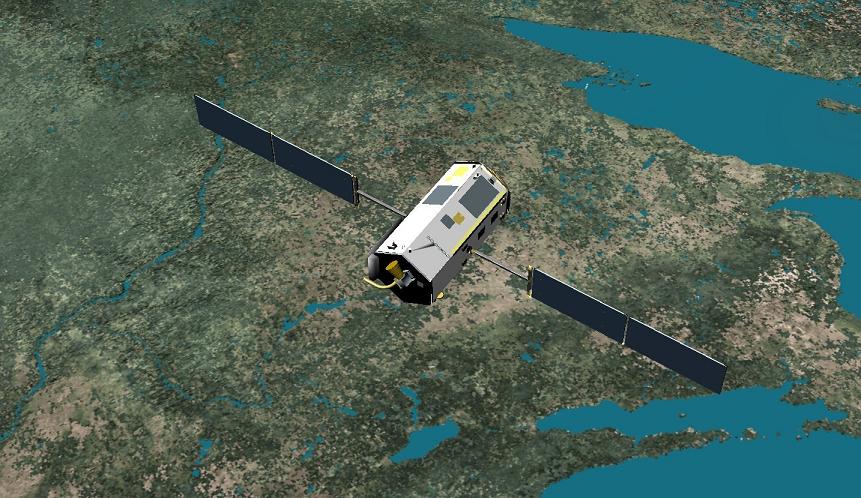
The OCO has a mass of 407 kg. The two GaAs solar arrays will provide 324 W orbit average for the scientific payload onboard. The satellite will use hydrazine thrusters for stabilization while on orbit. The estimated life span for the mission is 24 months.


The scientific payload includes three spectrometers. The spectrometers can detect what gases are in the Earth’s atmosphere and determine their amounts. The measurements will translate into monthly estimates of atmospheric CO2 over 621-square-mile regions of the Earth’s surface. From its sun-synchronous orbit, OCO will map the globe once every sixteen days. These maps will help locate CO2 sources and sinks.


Credits: NASA / Orbital


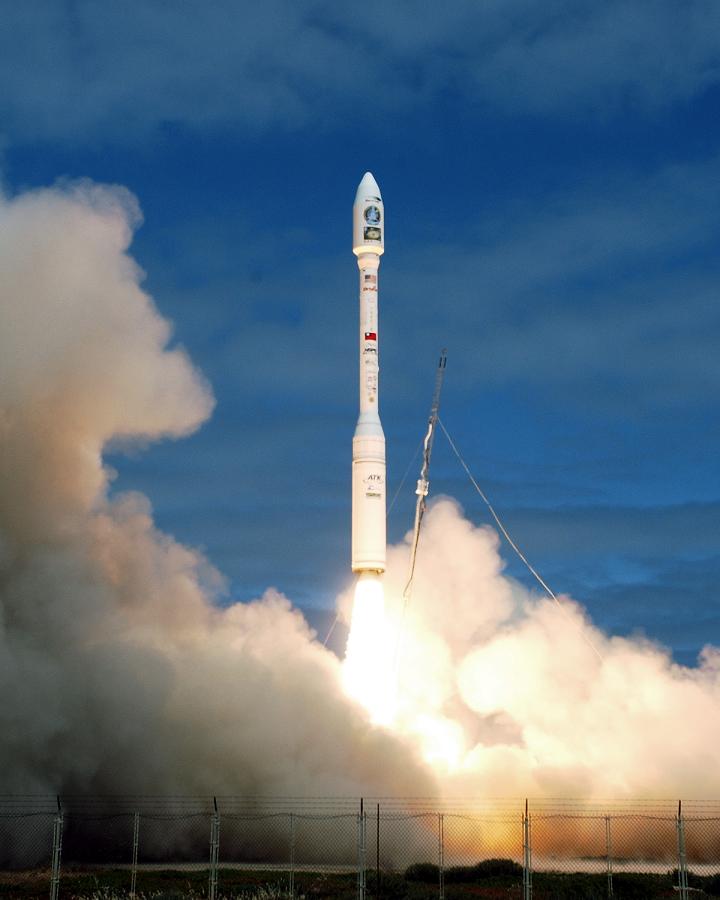
OCO will be placed on orbit by a Taurus XL launch vehicle. Taurus XL is a solid fuel launch vehicle built by the Orbital Sciences Corporation. According to the Taurus fact sheet, it provides launch capability for satellites weighing up to 1,590 kg. The range of launch missions supported by Taurus include low inclination low Earth orbit (LEO), polar LEO, sun-synchronous LEO, geo-transfer orbit, and interplanetary trajectory.


Depending on the configuration, Taurus can have a mass from 69,000 to 77,000 kg and can have a length from 27 to 32 m.


The mission launch is scheduled for early 2009. The Taurus XL launch vehicle will lift off from Vandenberg Air Force Base, California.


  • Facebook
  • Google
  • Slashdot
  • Reddit
  • Live
  • TwitThis


Credits: NASA


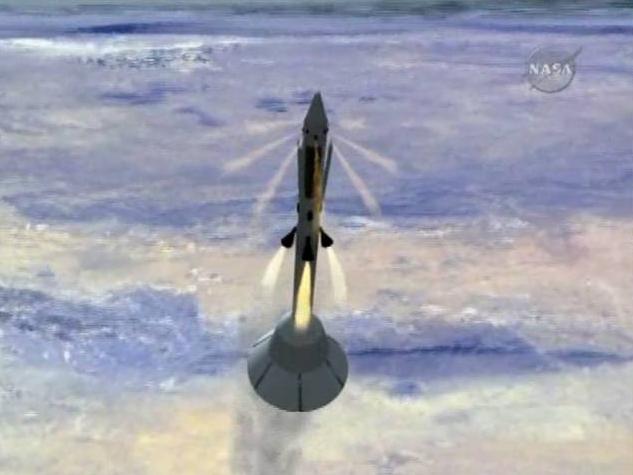
One of the crucial requirements for a man-rated launch system is a reliable Launch Abort System (LAS). LAS is basically a top-mounted rocket connected to a crew module and it is used to separate the crew module from the rest of the launch vehicle in case of emergency.


An emergency can be anything from an explosion of the launch vehicle on the launch pad to a failed separation of the lower stage during flight.


In the case of the Orion Module, several designs were considered for the LAS: the Multiple External Service Module Abort Motor concept, the Crew Module Strap On Motors concept, and the In-Line Tandem Tractor (Tower) concept. The latter concept was incorporated in the Ares I/Orion design.


The Tandem Tractor (Tower) design of the LAS has three motors: an Attitude Control Motor (eight nozzles), a Jettison Motor (four aft nozzles), and the Abort Motor (four exposed flow nozzles). These motors will make possible the separation of the module and the control of the flight after the separation from the launch vehicle. An important component of the LAS is the Boost Protective Cover (BPC), which protects the crew module from the exhaust of the motors.


Credits: NASA


The LAS is designed to perform on the launch pad as well as during the first 300,000 feet after the launch. There are three possible scenarios for the abort procedure: on the launch pad, on the mid-altitude flight segment (up to an altitude of 150,000 feet), and on the high-altitude flight segment (from 150,000 feet to 300,000 feet, where the LAS is jettisoned on a nominal flight). Tests will have to be performed to cover these scenarios: on the launch pad as well in flight.


NASA has made available animations of the test flights planned for the LAS. One is the animation of the Orion Module LAS pad abort flight test. The second presents the Orion Module LAS ascent abort flight test.


Credits: NASA


Currently, the Launch Abort System of the Orion Module is under development.


The first full-scale test fire of the motor that powers the LAS was completed on November 20, 2008. This was the first time a LAS test has been conducted since the 1960s, when the LAS for the Apollo Program was tested.


  • Facebook
  • Google
  • Slashdot
  • Reddit
  • Live
  • TwitThis


Credits: NASA


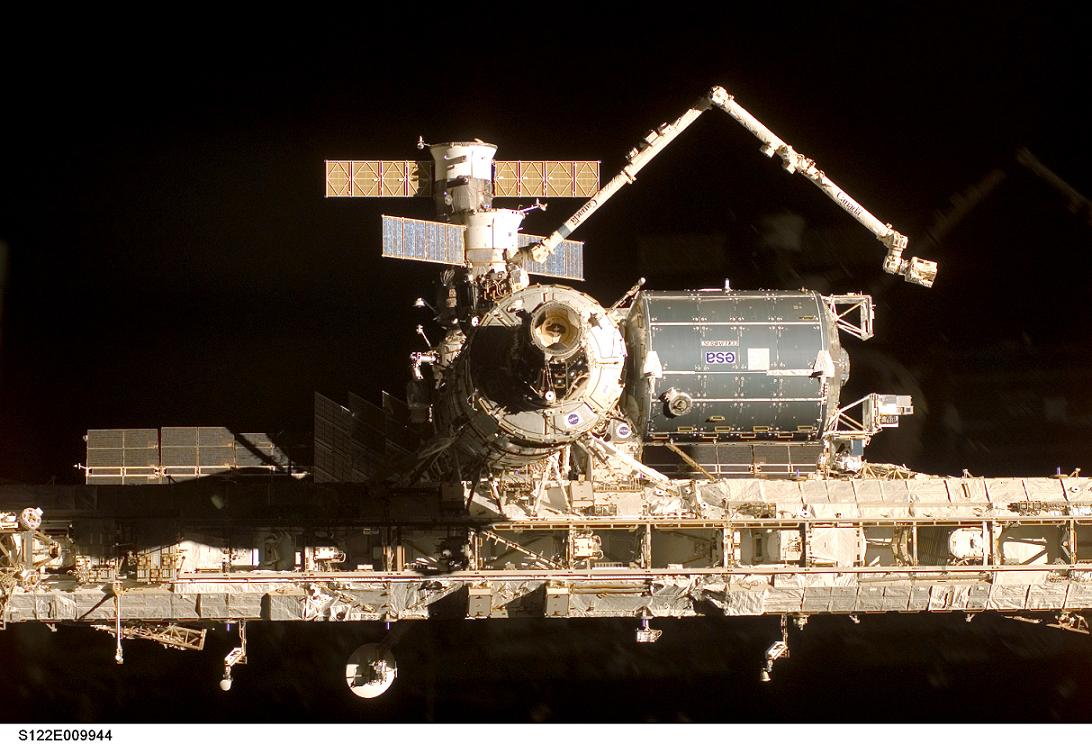
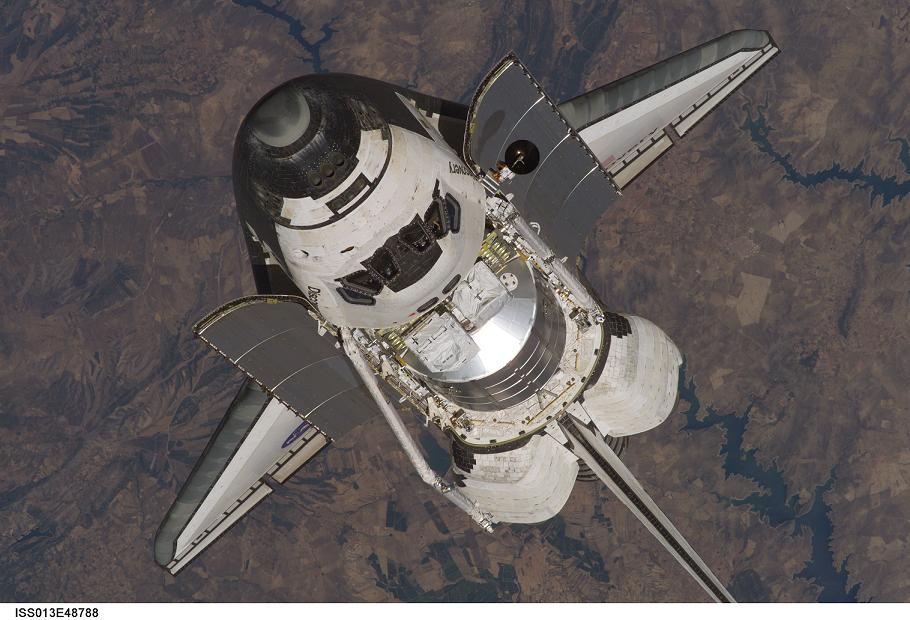
The Multi-Purpose Logistics Module (MPLM) is a pressurized module that is used on Space Shuttle missions to transfer cargo to and from the International Space Station (ISS).


A typical MPLM mission starts in the cargo bay of a Space Shuttle. The MPLM is carried to the ISS and berthed to one of the docking modules by the Canadian robotic arm. The supplies are offloaded and then finished experiments and waste are loaded on to the module. At the end of the mission, the MPLM is moved to the Space Shuttle cargo bay and returned to Earth.


The Italian Space Agency (ASI) provides the modules to NASA. Three MPLMs have been built and delivered to NASA thus far. NASA owns the MPLMs and ASI receives research time on ISS in exchange. The MPLMs were named after great figures in Italian history: Leonardo, Raffaello, and Donatello. However, some of the mission badges display the ninja turtles instead.


The construction of the first MPLM – Leonardo – began in April 1996. Leonardo was delivered to NASA in August 1998. Raffaello and Donatello followed in August 1999 and February 2001, respectively. Each MPLM can make 25 return trips to space.


Credits: NASA


The MPLM is 6.4 meters long and 4.6 meters in diameter. The module weighs 4.5 tons and it can deliver up to 10 tons to the ISS. The design of the module resembles the payload module that is part of the ATV. In addition, ATV has a service module that offers autonomy. Obviously, ATV was the direct beneficiary of the knowledge gained during the design and operational phases of the MPLM.


There is room for sixteen standard payload racks (International Standard Payload Racks – ISPR) in the MPLM. Even if it is not used to carry a human crew, MPLM has its own life-support system. Furthermore, it has a 3 KW internal power supply.


Credits: NASA


The current Space Shuttle mission – STS 126 – has delivered the MPLM Leonardo to the ISS. Leonardo is on its fifth spaceflight and hauled over 14,000 pounds of supplies and equipment to ISS.


Part (a small part) of the payload was turkey, candied yams, stuffing, and dessert for a Thanksgiving meal at the station.


A special piece of equipment, the GLACIER, was also delivered to the station. GLACIER stands for General Laboratory Active Cryogenic ISS Experiment Refrigerator. GLACIER is a double locker cryogenic freezer that will be used for transporting and preserving science experiments. The payload also included a galley for the Destiny laboratory, an advanced Resistive Exercise Device (aRED), and two new crew quarter racks for the expanded station crew.


Credits: NASA


There are two more MPLM missions scheduled before the Space Shuttle retires. STS-128 will carry Leonardo in July 2009, and Raffaello will be docked to ISS during the STS-131 mission in February 2010.


  • Facebook
  • Google
  • Slashdot
  • Reddit
  • Live
  • TwitThis
11-18-08

PHOENIX

Posted by


Credits: NASA


In 2002, an instrument on the Mars Odyssey spacecraft detected hydrogen under the Martian surface. This was regarded as clear evidence that there is subsurface water ice on Mars.


In 2003, NASA decided to revive a mission that was cancelled in 2001 due to the fact that a previous mission, the Mars Polar Lander, was lost in 1999. The revived mission was named Phoenix.


A Lander that could reach out and touch the ice was needed. The half-built spacecraft for the previously cancelled mission already had in place a 7.7-foot robotic arm that could do the trick.


A JPL team reviewed the data from the failed mission in 1999 and corrected the mistakes made. Every system used in the previous design was taken apart, tested, and examined. The suspected culprits were the retrorockets used during landing. More than a dozen issues that could have caused a failure of the new planned mission were found and fixed.


Credits: NASA / JPL


The Phoenix mission inherited a capable spacecraft partially built for the Mars Surveyor Program 2001. As we mentioned, the lessons learned from the Mars Polar Lander helped improve the existing systems. As for any other space mission, the conditions in which the spacecraft operates dictate the design.


In the case of the Phoenix mission, the following phases were considered: the launch, the cruise, the atmospheric entry, the touchdown, and the surface operations phase. The launch induces tremendous load forces and vibrations. The 10-month cruise to Mars exposes the spacecraft to the vacuum of space, solar radiation, and possible impacts with micrometeorites. During the atmospheric entry, the spacecraft is heated to thousands of degrees due to aero braking, and has to withstand tremendous deceleration during the parachute deployment. The extremely cold temperatures of the Martian arctic and the dust storms must be considered during the surface operations phase.


Credits: NASA / JPL


Several instruments are mounted on the Lander: the robotic arm (RA), the robotic arm camera (RAC), the thermal and evolved gas analyzer (TEGA), the Mars descent imager (MARDI), the meteorological station (MET), the surface stereo imager (SSI), and the microscopy, electrochemistry, and conductivity analyzer (MECA).


The RA was built by the Jet Propulsion Laboratory and was designed to perform the scouting operations on Mars, such as digging trenches and scooping the soil and water ice samples. RA delivered the samples to the TEGA and the MECA. RA is 2.35 meters long, it has an elbow joint in the middle, and it is capable of digging trenches 0.5 meters deep in the Martian soil.


The University of Arizona and the Max Planck Institute in Germany built the RAC. The camera is attached to the RA, just above the scoop placed at the end of the arm. RAC provided close-up, full-color images.


Credits: NASA / JPL


TEGA was developed by the University of Arizona and University of Texas, Dallas. TEGA used eight tiny ovens to analyze eight unique ice and soil samples. By employing a process called scanning calorimetry, and by using a mass spectrometer to analyze the gas obtained in the furnaces as the temperature raised to 1000 degrees Celsius, TEGA determined the ratio of various isotopes of hydrogen, oxygen, carbon, and nitrogen.


MARDI was built by Malin Space Science Systems. From what I could gather, the MARDI was not used by the Lander due to some integration issues.


The Canadian Space Agency (YAY Canada!) was responsible for the overall development of the meteorological station (MET). Two companies from Ontario, MD Robotics and Optech Inc., provided the instruments for the station.


The SSI served as the eyes of the Phoenix mission. SSI provided high-resolution, stereo, panoramic images of the Martian arctic. An extended mast holds the SSI, so the images were recorded from two meters above the ground.


Credits: NASA / JPL


MECA was built by the Jet Propulsion Laboratory. The instrument was used to characterize the soil by dissolving small amounts of soil in water. MECA determined the pH, the mineral composition, as well as the concentration of dissolved oxygen and carbon dioxide in the soil samples that were collected.


We would like to highlight some of the important moments during the mission:


August 4, 2007 – Delta II rocket launch from Cape Canaveral. The three-stage Delta II rocket with nine solid rocket boosters lifted off from Cape Canaveral, carrying the Phoenix spacecraft on the first leg of its journey to Mars.


Credits: NASA / JPL -Caltech / University of Arizona


May 25, 2008 – Phoenix Mars Lander touchdown. The Phoenix entered the Martian atmosphere at 13,000 mph. It took 7 minutes for the Lander to slow down with the aid of a parachute and to land using its retrorockets. The mission team did not have to wait long before discovering ice because the blasts from the retrorockets had blown away the topsoil during landing and revealed ice patches under the lander.


November 2, 2008 – Last signal received from the Lander. On this date, communication was established for the last time with Phoenix. Due to the latitude of the landing site, not enough sunlight is available and the solar arrays are unable to collect the power necessary to charge the batteries that operate the instruments mounted on the Lander. At the landing site, the weather conditions are worsening.


November 10, 2008 – Mission declared completed. NASA declares that the Mars Phoenix Lander has completed a successful mission on the Red Planet. Phoenix Mars Lander has ceased communications after being operational for more than five months (the designed operational life of the mission was 90 days).


November 13, 2008 – Mission Honored. NASA’s Phoenix Mars Lander was awarded Best of What’s New Grand Award in the aviation and space category by Popular Science magazine.


Credits: NASA / JPL


The Mars Phoenix Lander made significant contributions to the study of the Red Planet. Phoenix verified the presence of water ice under the Martian surface, and it returned thousands of pictures from Mars. Phoenix also found small concentrations of salts that could be nutrients for life, it discovered perchlorate salt, and calcium carbonate, which is a marker of effects of liquid water.


Phoenix provided a mission long weather record, with data on temperature, pressure, humidity, and wind, as well as observations on snow, haze, clouds, frost, and whirlwinds.


Principal Investigator Peter H. Smith of the University of Arizona led the Phoenix mission. The project management was done at NASA’s Jet Propulsion Laboratory and the development at Lockheed Martin Space Systems in Denver. Other contributors were the Canadian Space Agency, the University of Neuchatel (Switzerland), the University of Copenhagen (Denmark), the Max Planck Institute (Germany), and the Finnish Meteorological Institute.


For more information about the Phoenix mission, check out the NASA Phoenix Mars Lander Page.


  • Facebook
  • Google
  • Slashdot
  • Reddit
  • Live
  • TwitThis


Credits: NASA GSFC


The solar wind generated by our Sun carves out a protective bubble around the solar system, called the heliosphere. The interstellar medium, consisting of the gas and the dust found between the galaxies, interacts with the solar wind and defines the actual boundary, which is called the termination shock.


NASA has designed a mission to map the boundary of the solar system. The mission is called IBEX (Interstellar Boundary Explorer) and it is ready to launch. The data collected by IBEX will allow scientists to understand the interaction between our Sun and the galaxy for the first time. Understanding this interaction will help us protect future astronauts from the danger of galactic cosmic rays.


In January 2005, the Orbital Science Corporation was selected to develop, build, and launch a small spacecraft for NASA’s IBEX mission. The IBEX spacecraft is based on an already existing bus: the MicroStar satellite. IBEX will be launched by a Pegasus XL rocket, which will be dropped from an aircraft flying over the Pacific Ocean.


Credits: NASA GSFC


Pegasus began its commercial career in April 1990, and since then it has launched more than 80 satellites into space.


Pegasus is a three-stage launching system used to deploy small satellites weighing up to 1,000 pounds into Low Earth Orbit (LEO). An aircraft carries Pegasus to an altitude of 40,000 feet.


The rocket is released and free-falls before igniting its engines. It takes roughly ten minutes for Pegasus to deliver a satellite into orbit.


Pegasus will place IBEX into a 130 mile altitude orbit. An extra solid-fueled rocket will boost the spacecraft from the LEO. IBEX’s final orbit will be a highly elliptical orbit with the perigee at an altitude of 7,000 km and the apogee at 236,000 km. IBEX has to operate in this orbit because any interference from the Earth’s magnetosphere would make it impossible to take accurate measurements with the scientific instruments onboard.


Credits: NASA GSFC


IBEX has a mass of only 83.33 lbs (roughly 38 kg) and is described by NASA as being the size of a bus tire. The instruments onboard IBEX will collect particles called energetic neutral atoms (ENAs). The ENAs are radiated from the termination shock region. The ENA hits recorded by the instruments onboard IBEX will be used to create a map of this region.


The mission is scheduled to launch tomorrow, October 19th, 2008. The spacecraft will be operational for 24 months. You can find out more about the IBEX spacecraft on NASA’s IBEX mission web page.


  • Facebook
  • Google
  • Slashdot
  • Reddit
  • Live
  • TwitThis