OrbitalHub

The place where space exploration, science, and engineering meet

Domain is for sale. $50,000,000.00 USD. Direct any inquiries to contact@orbitalhub.com.


Credits: NASA


As mentioned in a previous post, only a small fraction of the existing space debris population is detectable and tracked by ground systems. A smaller fraction is catalogued by special programs and/or departments of national space agencies. This is where statistics comes into play. Numerous models have been created in order to assess present collision risks associated with certain orbits and to predict future evolution of the debris environment around Earth.


The National Aeronautics and Space Administration (NASA) has developed two categories of applications for modeling of space debris environment and risk analysis. The first category, based on evolutionary models such as NASA’s long term debris environment evolutionary model (LEO-to-GEO Environment Debris model or LEGEND), are designed to predict the evolution of the debris environment.


These models cover the near-Earth space between 200 km and 50,000 km, provide space debris characteristics for a debris population consisting of particles as small as 1 mm, and have a typical projection period of 100 years. The second category, which consists of engineering models like ORDEM2000, is used for debris impact risk assessment for spacecraft and satellites, and also as benchmarks for ground-based debris measurements and observations.


The European Space Agency (ESA) has a different set of tools used for modeling the space debris environment and assessing risk associated with collisions in Earth orbit. The DISCOS database (the Database and Information System Characterizing Objects in Space) consolidates the knowledge on all known objects tracked since Sputnik-1, and it is recognized as a reliable and dependable source of information on space objects in Earth orbit. MASTER (Meteoroid and Space Debris Terrestrial Environment Reference) is the agency’s most prominent debris risk assessment tool, which uses statistical methods to determine the impact flux information from all recorded historic debris generation events. ESA also uses DELTA (Debris Environment Long-Term Analysis) to conduct analysis of the effectiveness of debris mitigation measures on the stability of the debris population. Such analysis can cover 100 to 200 year time spans.


  • Facebook
  • Google
  • Slashdot
  • Reddit
  • Live
  • TwitThis
12-16-10

Orbital’s Space Plane

Posted by


Credits: Orbital Sciences Corporation


Orbital Sciences Corporation is proposing a blended lifting body vehicle that will launch atop an expendable launch vehicle in response to NASA’s Commercial Crew Development-2 contract solicitation. The proposed configuration will provide safe and affordable transportation services to and from the International Space Station. The vehicle will carry a crew of four astronauts, and will reenter the Earth’s atmosphere and land on a conventional runway similar to a Space Shuttle.


The launch vehicle proposed for the launch stack is the United Launch Alliance Atlas V rocket. Orbital’s press release mentions that the whole configuration is flexible enough to accommodate other launch vehicles as well.


Orbital is leading a team of world-class space system manufacturers. The pressurized crew compartment will be provided by Thales Alenia Space, the human-rated avionics will be the responsibility of Honeywell and Draper Laboratory, and the United Launch Alliance will supply the launch vehicle. Northrop Grumman will be the airframe structures designer.


  • Facebook
  • Google
  • Slashdot
  • Reddit
  • Live
  • TwitThis


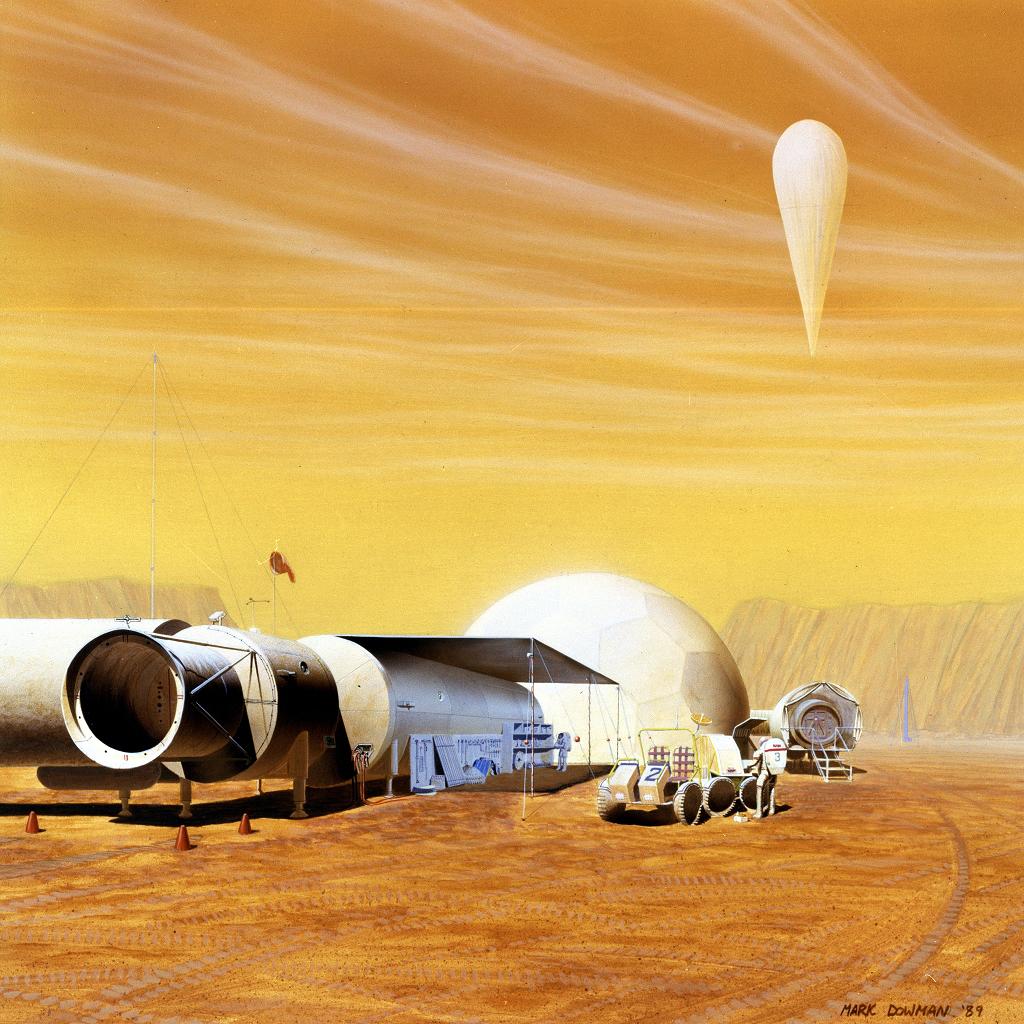
Credits: Mark Dowman


Airships are making a big comeback now as the energy consumption for all modes of transportation is being re-analyzed. Missions with special requirements like surveillance and reconnaissance missions and transportation of heavy payloads to remote outposts are the main driver for the reinvention of the airship.


But Earth is not the only place where airships can be deployed. There are a number of destinations in the solar system that would make a perfect environment for deployment and operation of airships, like Mars, Venus, and Titan – Saturn’s largest moon.


The presence of an atmosphere makes possible the use of vehicles that can fly within atmosphere for planetary exploration. Also, planetary exploration with low-powered vehicles like airships really makes sense considering the fact that energy is always at a premium.


So far, the only extraterrestrial deployment of an airship was performed during the Vega mission to Venus, in 1984. Two balloons were released and they floated 54 km above the planet’s surface for nearly two days.


Lighter-Than-Air (LTA) AERial ROBOTS (AEROBOTS) would present some advantages over their Heavier-Than-Air (HTA) siblings and the traditional planetary scouts, the exploration rovers: they would have long-duration mission and long-distance capabilities, they would not have to deal with obstacle avoidance problems, and they have low-power consumption. However, the environment in which the airship will operate will impose some restrictions on the capabilities of the airship (consider things like atmospheric composition and density, temperature, and the amount of solar radiation available). More on the planetary environments in the solar system and airship evaluations for each one of them can be found here.


NASA has funded a number of projects for solar system exploration that make use of aerobots. The Jet Propulsion Laboratory’s Planetary Aerobot Program is developing balloons to support scientific payloads in the atmosphere of other planets in our solar system. You can find more details about JPL’s Planetary Aerobot Program here.


  • Facebook
  • Google
  • Slashdot
  • Reddit
  • Live
  • TwitThis
09-7-10

How Tough is Life in LEO?

Posted by


Credits: NASA


In a nutshell, it is really tough! The higher you go, more bad things can happen to you… the increasingly rarefied air, freezing temperatures, ionized atoms, radiation, and space debris make life challenging. So, besides thinking of how to place spacecraft in orbit, engineers must consider all of the factors mentioned above (and much more) when designing a spacecraft.


The space environment (the vacuum, the radiation, the space debris, etc.) definitely poses big challenges to spacecraft design engineers. From 1971 to 1989, more than 2,700 spacecraft anomalies related to interactions with the space environment were recorded. These interactions with the space environment are called space environment effects and the changes in the space environment define what is called the space weather. Believe it or not, there are dedicated programs aimed at developing the ability to predict these changes in the same way the weather forecasting does for terrestrial weather. The Space Weather program was formed in the mid-1990s by the National Science Foundation (NSF). The Europeans developed a similar program under the umbrella of the European Space Agency (ESA).


The space environment effects can be grouped into several categories. Such categories include: vacuum, neutral, plasma, radiation, and micrometeorid/orbital debris. So, basically, we can discuss the effects of the vacuum environment, the neutral environment, etc. Each one of these environments interact with the subsystems that comprise a spacecraft: the propulsion system that provides the means of maintaining a certain orbit or attitude, the electrical power system that provides power to the rest of the subsystems onboard, the thermal control system, the attitude and orbital determination and control system, etc.


The vacuum environment imposes challenges when it comes to designing the structure, choosing the materials, and defining a strategy for thermal control. The pressure differential between the inside and the outside of a manned spacecraft is tremendous (around 350 km above the surface of the Earth, the pressure is ten orders of magnitude less). The lack of atmosphere translates into the fact that the spacecraft will have to deal with solar ultraviolet (UV) radiation (the UV radiation is energetic enough to degrade material properties). Also, the spacecraft can only cool itself by conduction or radiation.


Credits: NASA


Even if very rarefied, the neutral atmosphere in low Earth orbit is dense enough to cause a significant atmospheric drag force. The atoms can physically sputter material from surfaces and even cause erosion. All these mechanical and chemical interactions depend on the atmospheric density.


In low Earth orbit, the solar UV radiation ionizes the oxygen and nitrogen atoms. This environment, known as the plasma environment, can give rise to very interesting effects, like spacecraft charging and arcing between regions of differing potentials.


By far, the most dangerous environment in Earth orbit is the radiation environment. In the regions of charged particles, known as trapped radiation belts, particles with energy levels in the order of MeV pass through the surface layer and interact with the materials inside the spacecraft. Present shielding technology cannot protect living organisms inside a spacecraft in these regions.


Micrometeoroids and orbital debris are a cause of great concern to spacecraft design engineers and spacecraft operators as the kinetic energies associated with impacts at orbital velocities are very high. The main effect on spacecraft in this case is the physical damage upon impact. Other effects include surface erosion, ejecta resulted from impacts, changes in thermal control properties, and generation of electro-magnetic impulses (EMIs).


As most of the characteristics of the space environment were determined by remote observations or during short duration missions, one long duration mission was necessary to verify and validate these measurements.


In April 1984, the Space Shuttle Challenger placed into low Earth orbit (LEO) a spacecraft carrying a number of experiments for the purpose of characterizing the low Earth orbit environment. The spacecraft (known as the Long Duration Exposure Facility, or LDEF for short) was a twelve-sided cylindrical structure three-axis stabilized in order to ensure an accurate environmental exposure. The spacecraft was supposed to spend one year in orbit, but just before the planned retrieval, the Space Shuttle fleet was grounded as a result of the Challenger accident on January 28, 1986.


The spacecraft was returned to Earth by the Space Shuttle Columbia in January 1990. After almost six years in low Earth orbit, the results of the experiments onboard the facility contributed a great deal to the understanding of interactions between artificial objects and the environment in low Earth orbit.


You can find all the above in much more detail in Alan Tribble’s book The Space Environment – Implications for Spacecraft Design. Alan Tribble presents an excellent account of the effects the space environment can have on operational spacecraft. The book offers a unique perspective, as it combines the study of the space environment with spacecraft design engineering. .


Alan Tribble spent over ten years designing spacecraft. He is a technical project manager in the International Software Defined Radios group for Rockwell Collins.


  • Facebook
  • Google
  • Slashdot
  • Reddit
  • Live
  • TwitThis


Credits: NASA/CSA


Canadian astronaut Chris Hadfield will take command of the station during the second half of his third space mission. Hadfield will launch aboard a Soyuz rocket in December 2012, and spend six months on the station as part of the crew of Expedition 34/35. He will return to Earth in a Soyuz capsule in June 2013.


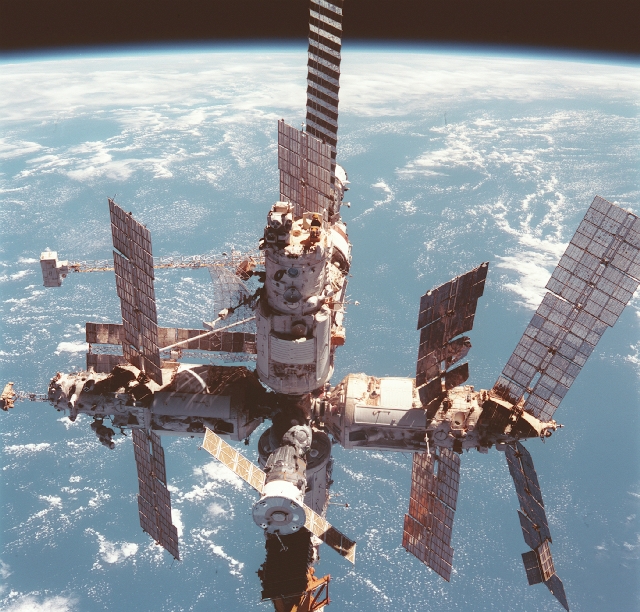
Hadfield is the only Canadian to board the Russian Mir space station, in 1995, during his first space flight, while he served as Mission Specialist 1 on STS-74. He is also the first Canadian mission specialist and the first Canadian to operate the Canadarm in orbit.


His second space flight was onboard STS-100, where he served as Mission Specialist 1. STS-100 was the International Space Station assembly flight 6A, which delivered and installed the Canadarm-2 on the station. During this mission, Hadfield performed two spacewalks.


Chris Hadfield also served as Director of Operations for NASA at the Yuri Gagarin Cosmonaut Training Centre in Star City, Russia; as Chief of Robotics for the NASA Astronaut Office at the Johnson Space Center in Houston, Texas; as Chief of International Space Station Operations; and as the Commander of NEEMO 14, a NASA undersea mission to test exploration concepts living in an underwater facility off the Florida coast.


The official announcement was made by the Canadian Space Agency. Chris Hadfield’s biography is also available here.


  • Facebook
  • Google
  • Slashdot
  • Reddit
  • Live
  • TwitThis


Credits: CNES


Since the launch of Sputnik-1, on October 4, 1957, some 4,600 launches have placed more than 6,000 satellites in orbits around Earth.


All these activities have created a cloud of particles orbiting the Earth, which is referred to as orbital debris.


The majority of these particles are fragments from explosions and collisions (such as the Chinese Fengyun-1 ASAT test in 2007, and the collision between Iridium 33 and Cosmos 2251 in 2009). Some of them are spent rocket stages and defunct satellites. The total mass in orbit has been estimated to 5,800 tons.


As the ejecta generated in explosions and collisions have a wide range of velocities, the evolution of the particle cloud following the event can evolve in ways that are sometimes hard to predict, as some of the particles can disperse into orbits that are dissimilar to the original orbits.


Credits: NASA


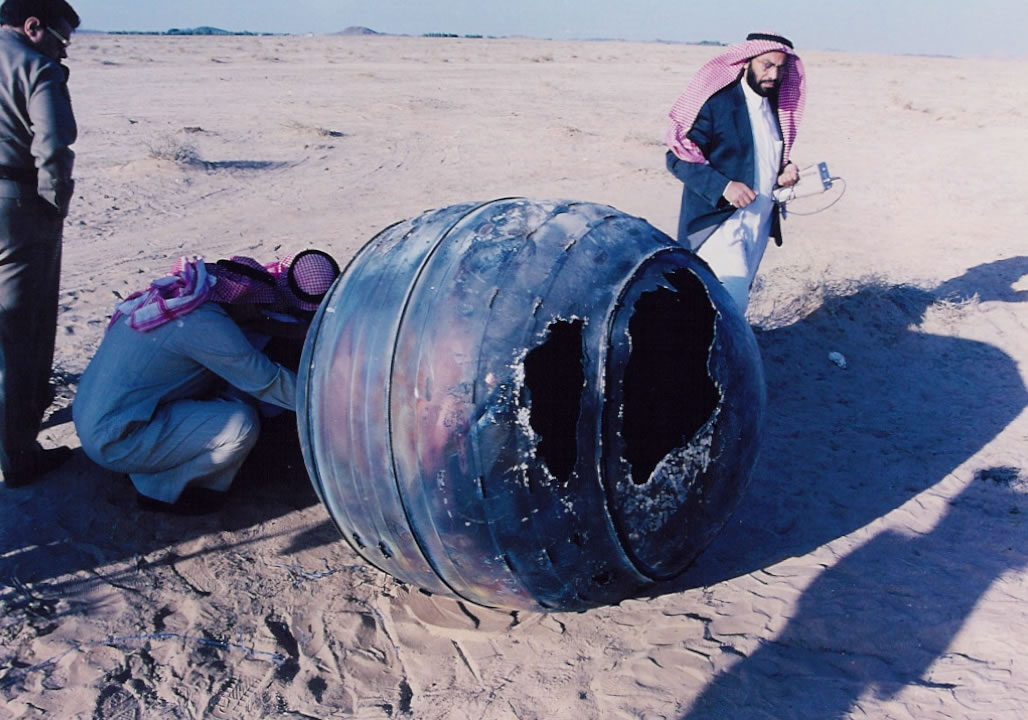
To make things more complicated, the particles comprising the orbital debris environment are quite hard to detect. Some of them are impossible to detect due to technological limitations (present equipment is capable of tracking only objects larger than 1 cm in diameter in low Earth orbit and larger than 50 cm in diameter in geosynchronous orbit) or simply because they have orbits that are out of the range of tracking stations (such as highly elliptical and high inclination orbits with the perigee situated deep in the Southern Hemisphere – the Molniya orbits).


Even if most of the particles orbiting the Earth at velocities in the range of 8-10 km/s (or 28,800-36,000 km/h) are less than 1 cm in size, the kinetic energies associated with impacts at orbital velocities make them a source of great concern.


Just to get a sense of the effects that even small particles with velocities in the order of 10 km/s can have on space structures, if we assume a density of 1 g/cm3, a particle as small as 0.1 mm can cause surface erosion, and a particle 1 mm in size can inflict serious damage. A 3 mm particle moving at 10 km/s has the kinetic energy of a bowling ball moving at 100 km/h. A 1 cm fragment has the kinetic energy of a 180 kg safe. It is easy to visualize the effects of an impact with such an object on an operational satellite or a space station parked in low Earth orbit.


To find out more about orbital debris you can visit the NASA Orbital Debris Program office website.


  • Facebook
  • Google
  • Slashdot
  • Reddit
  • Live
  • TwitThis