OrbitalHub

The place where space exploration, science, and engineering meet

Domain is for sale. $50,000,000.00 USD. Direct any inquiries to contact@orbitalhub.com.

04-19-18

Jupiter’s Dynamo

Posted by


NASA dixit:

“NASA’s Juno mission has provided the first view of the dynamo, or engine, powering Jupiter’s magnetic field. The new global portrait reveals unexpected irregularities and regions of surprising magnetic field intensity. Red areas show where magnetic field lines emerge from the planet, while blue areas show where they return. As Juno continues its mission, it will improve our understanding of Jupiter’s complex magnetic environment.”

Video Credit: NASA Goddard Space Flight Center


  • Facebook
  • Google
  • Slashdot
  • Reddit
  • Live
  • TwitThis


NASA dixit:

“In this animation the viewer is taken low over Jupiter’s north pole to illustrate the 3-D aspects of the region’s central cyclone and the eight cyclones that encircle it. The movie utilizes imagery derived from data collected by the Jovian Infrared Auroral Mapper (JIRAM) instrument aboard NASA’s Juno mission during its fourth pass over the massive planet. Infrared cameras are used to sense the temperature of Jupiter’s atmosphere and provide insight into how the powerful cyclones at Jupiter’s poles work. In the animation, the yellow areas are warmer (or deeper into Jupiter’s atmosphere) and the dark areas are colder (or higher up in Jupiter’s atmosphere). In this picture the highest “brightness temperature” is around 260K (about -13°C) and the lowest around 190K (about -83°C). The “brightness temperature” is a measurement of the radiance, at 5 µm, traveling upward from the top of the atmosphere towards Juno, expressed in units of temperature.”

Video Credit: NASA/JPL-Caltech/SwRI/ASI/INAF/JIRAM


  • Facebook
  • Google
  • Slashdot
  • Reddit
  • Live
  • TwitThis
03-22-18

Juno Update

Posted by


NASA dixit:

“For hundreds of years, this gaseous giant planet appeared shrouded in colorful bands of clouds extending from dusk to dawn, referred to as zones and belts. The bands were thought to be an expression of Jovian weather, related to winds blowing eastward and westward at different speeds.

This animation illustrates a recent discovery by Juno that demonstrates these east-west flows, also known as jet-streams penetrate deep into the planet’s atmosphere, to a depth of about 1,900 miles (3,000 kilometers). Due to Jupiter’s rapid rotation (Jupiter’s day is about 10 hours), these flows extend into the interior parallel to Jupiter’s axis of rotation, in the form of nested cylinders. Below this layer the flows decay, possibly slowed by Jupiter’s strong magnetic field.

The depth of these flows surprised scientists who estimate the total mass involved in these jet streams to be about 1% of Jupiter’s mass (Jupiter’s mass is over 300 times that of Earth). This discovery was revealed by the unprecedented accuracy of Juno’s measurements of the gravity field.”

Video credit: NASA


  • Facebook
  • Google
  • Slashdot
  • Reddit
  • Live
  • TwitThis
07-14-16

Juno Approaches Jupiter

Posted by


NASA dixit:

“NASA’s Juno spacecraft has crossed the boundary of Jupiter’s immense magnetic field. Juno’s Waves instrument recorded the encounter with the bow shock over the course of about two hours on June 24, 2016. “Bow shock” is where the supersonic solar wind is heated and slowed by Jupiter’s magnetosphere. It is analogous to a sonic boom on Earth. The next day, June 25, 2016, the Waves instrument witnessed the crossing of the magnetopause. “Trapped continuum radiation” refers to waves trapped in a low-density cavity in Jupiter’s magnetosphere. […]

After nearly five years traveling through space to its destination, NASA’s Juno spacecraft will arrive in orbit around Jupiter on July 4, 2016. This video shows a peek of what the spacecraft saw as it closed in on its destination. Jupiter is visible along with the four Galilean moons: Callisto, Ganymede, Europa and Io. The images were taken prior to June 30, 2016, when the JunoCam camera and science instruments were turned off to prepare the spacecraft for the daring orbit insertion maneuver.”

Video credit: NASA Jet Propulsion Laboratory


  • Facebook
  • Google
  • Slashdot
  • Reddit
  • Live
  • TwitThis
08-1-11

Juno

Posted by


Credits: NASA/JPL


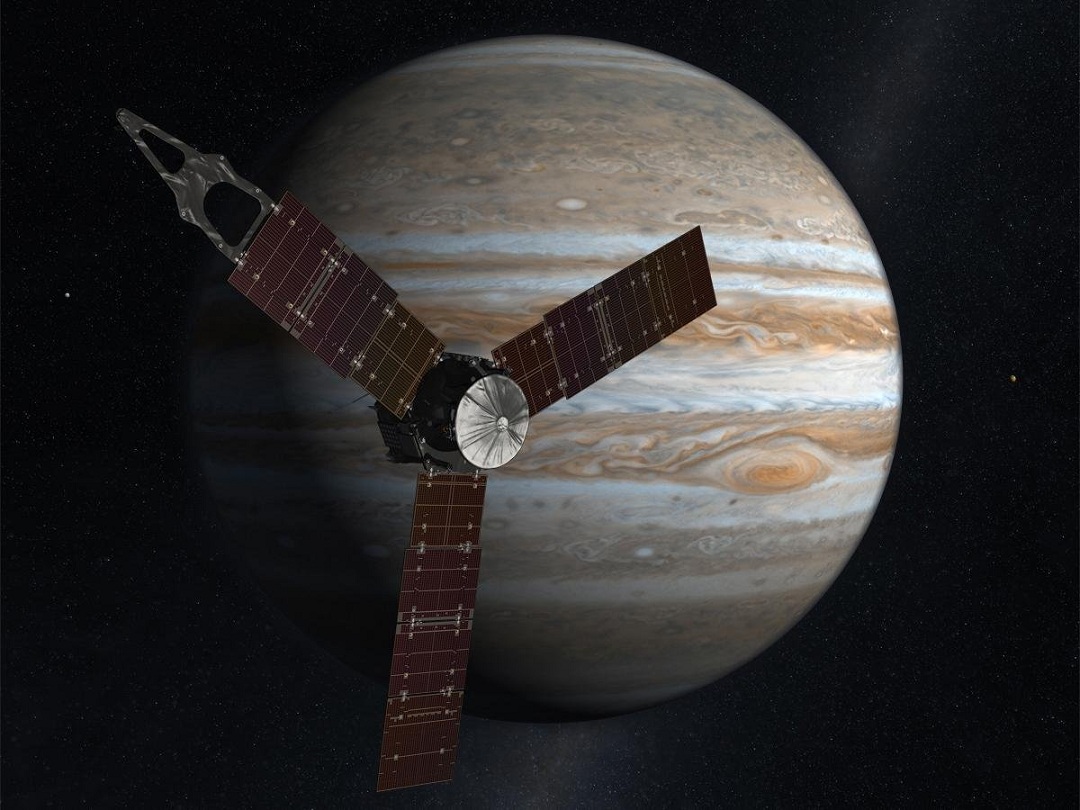
Juno is a NASA spacecraft scheduled to start its journey to Jupiter in a few days. Juno will help scientists understand the origin and evolution of Jupiter. While the dense cover of clouds helps Jupiter keep its secrets away from Earth observers, Juno will get close enough to Jupiter so that fundamental processes and conditions characteristic to the early solar system will be revealed.


First, Juno will try to determine if Jupiter has a solid planetary core. While this is an important piece of the puzzle, it might also help determine how Jupiter’s magnetic field is generated (by the way, scientists are still unclear how Earth’s magnetic field is generated, and there are several theories trying to explain it). Juno will also map Jupiter’s magnetic field, study the auroras, and determine the amount of water and ammonia in the atmosphere.


The launch vehicle to lift off with Juno is the most powerful Atlas rocket ever built, the United Launch Alliance Atlas V 551. In this configuration, an Atlas V launch vehicle can lift 18,810 kg to Low Earth Orbit (LEO) and 8,900 kg to Geosynchronous Transfer Orbit (GTO). However, the Atlas V 551 is not powerful enough to put Juno on a direct trajectory to Jupiter. In order to get as far as Jupiter’s orbit, Juno has to perform a gravity assist maneuver.


Juno will orbit Jupiter in a polar orbit and get as close as 5,000 km above the planet’s top clouds. This will allow the spacecraft to do science below the radiation belt of the planet and allow for a complete coverage of the planet. The low altitude will allow for a detailed analysis of the planet’s atmosphere. The orbit will also allow Juno to take a very close look at the auroras that are forming at the north and south Jovian poles.


The scientific payload carried by Juno includes a gravity/radio science system, a microwave radiometer, a vector magnetometer, particle detectors, ultraviolet and infrared spectrometers, and a color camera to capture images of the Jovian poles.


One interesting feature of the spacecraft is the electronics vault. Even if Juno’s highly elliptical orbit avoids the deadly radiation belts by approaching the planet at the north pole, skimming the clouds below the radiation belts, and exiting over the south pole, as an additional protection measure the onboard electronics are protected by a radiation shielded vault. This will ensure that the computers will not malfunction due to single events, and that the electronics will meet the requirements for the mission lifespan.


While the previous missions to the Jovian system have been powered by Radio Thermal Generators (RTGs), Juno will benefit from advances in solar power cell design. The cells used for Juno’s solar panels are far more efficient and radiation tolerant than the cells available to space systems engineers decades ago. Three solar panels that extend more than 10 meters from the hexagonal body of the spacecraft will provide the power required by the scientific instruments.


The mission is scheduled for launch on August 5, 2011. After coasting for more than two years, in October 2013, Juno will swing by Earth. The gravity assist maneuver will provide the delta V necessary for the spacecraft to reach Jupiter’s orbit. Juno will arrive at Jupiter in July 2016. After performing the Jupiter Orbital Insertion (JOI) maneuver, the spacecraft will start to collect and send back home scientific data.


Juno will send back science and telemetry data through the Deep Space Network (DSN), a network of powerful antennas located in Madrid, Spain; Barstow, California; and Canberra, Australia.


At the end of the mission, planned for October 2017, and after 33 complete revolutions around Jupiter, Juno will fire up its thrusters and decrease its velocity, enter the upper atmosphere of Jupiter, and get incinerated. Why such a tragic end to the Juno mission? Remember the Prime Directive? While the Prime Directive is known only to Star Trek fans… and it might get serious consideration only from Star Fleet officers, the possibility of having Juno crashing on one of the Jovian satellites (especially Europa) has to be eliminated. NASA scientists take contamination of other worlds very seriously.


You can find out more about the Juno mission on NASA’s dedicated web site. The Juno mission is managed by NASA’s Jet Propulsion Laboratory in Pasadena, California. The Principal Investigator for the Juno mission is Dr. Scott Bolton of Southwest Research Institute in San Antonio, Texas. The spacecraft was designed and built by Lockheed Martin of Denver, Colorado.



  • Facebook
  • Google
  • Slashdot
  • Reddit
  • Live
  • TwitThis