OrbitalHub

The place where space exploration, science, and engineering meet

Domain is for sale. $50,000,000.00 USD. Direct any inquiries to contact@orbitalhub.com.

05-16-17

ISS Spacewalk

Posted by


NASA dixit:

“Outside the International Space Station, Expedition 51 Commander Peggy Whitson and Flight Engineer Jack Fischer of NASA conducted a spacewalk May 12 to replace an avionics box responsible for routing power and data commands to experiments on the orbital outpost. In addition to that work, the two spacewalkers installed a data cable for the Alpha Magnetic Spectrometer and a new high definition camera on the station’s truss. The spacewalk was the 200th in support of space station assembly and maintenance since 1998, the ninth for Whitson, who vaulted into third place on the all-time list for most spacewalking hours, and the first for Fischer.”

Video credit: NASA


  • Facebook
  • Google
  • Slashdot
  • Reddit
  • Live
  • TwitThis
05-8-17

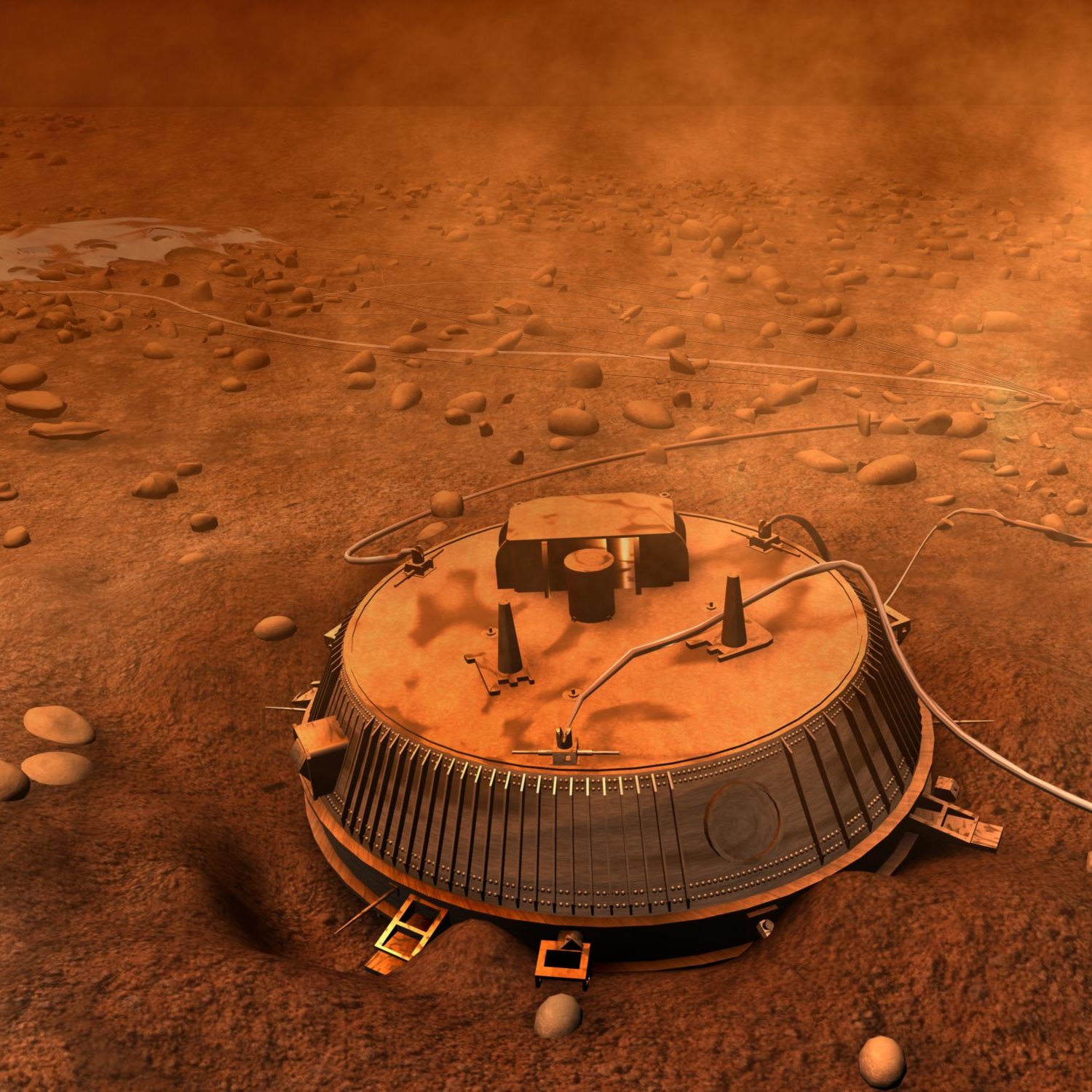
Huygens Landing Site

Posted by


NASA dixit:

“January 14, 2005. This is an artist’s interpretation of the area surrounding the Huygens landing site, based on images and data returned.”

“After almost 20 years in space, NASA’s Cassini spacecraft begins the final chapter of its remarkable story of exploration: its Grand Finale. Between April and September 2017, Cassini will undertake a daring set of orbits that is, in many ways, like a whole new mission. Following a final close flyby of Saturn’s moon Titan, Cassini will leap over the planet’s icy rings and begin a series of 22 weekly dives between the planet and the rings.

No other mission has ever explored this unique region. What we learn from these final orbits will help to improve our understanding of how giant planets – and planetary systems everywhere – form and evolve.

On the final orbit, Cassini will plunge into Saturn’s atmosphere, sending back new and unique science to the very end. After losing contact with Earth, the spacecraft will burn up like a meteor, becoming part of the planet itself.

Cassini’s Grand Finale is about so much more than the spacecraft’s final dive into Saturn. That dramatic event is the capstone of six months of daring exploration and scientific discovery. (And those six months are the thrilling final chapter in a historic 20-year journey.)”

Image credit: NASA


  • Facebook
  • Google
  • Slashdot
  • Reddit
  • Live
  • TwitThis
05-8-17

Arctic Sea Ice Forecast Model

Posted by


NASA dixit:

“Arctic sea ice extent ebbs and flows with the seasons. During the summer months, the ice melts and the edge recedes northward, usually reaching its annual minimum sometime in September. The ice extent is shaped by a variety of factors, including warmer temperatures, storms, and changes in the ocean, which makes it difficult to predict. Sea ice plays an important role in maintaining Earths temperature, so predicting how the ice extent might change helps us understand the warming climate. Scientists have developed a new model to predict the sea ice minimum extent, using historical measurements and real-time satellite data. The model can begin predictions up to six months before the predicted minimum and continue to improve each day.”

Video credit: NASA Goddard


  • Facebook
  • Google
  • Slashdot
  • Reddit
  • Live
  • TwitThis


Wikipedia dixit:

“The Bigelow Expandable Activity Module (BEAM) is an experimental expandable space station module developed by Bigelow Aerospace, under contract to NASA, for testing as a temporary module on the International Space Station (ISS) from 2016 to 2018. It arrived at the ISS on April 10, 2016, was berthed to the station on April 16, and was expanded and pressurized on May 28, 2016.

NASA originally considered the idea of inflatable habitats in the 1960s, and developed the TransHab inflatable module concept in the late 1990s. The TransHab project was cancelled by Congress in 2000, and Bigelow Aerospace purchased the rights to the patents developed by NASA to pursue private space station designs. In 2006 and 2007, Bigelow launched two demonstration modules to Earth orbit, Genesis I and Genesis II.

NASA re-initiated analysis of expandable module technology for a variety of potential missions beginning in early 2010. Various options were considered, including procurement from commercial provider Bigelow Aerospace, for providing what in 2010 was proposed to be a torus-shaped storage module for the International Space Station. One application of the toroidal BEAM design was as a centrifuge demo preceding further developments of the NASA Nautilus-X multi-mission exploration concept vehicle. In January 2011, Bigelow projected that the BEAM module could be built and made flight-ready 24 months after a build contract was secured.

On December 20, 2012, NASA awarded Bigelow Aerospace a US$17.8 million contract to construct the Bigelow Expandable Activity Module under NASA’s Advanced Exploration Systems (AES) Program. Sierra Nevada Corporation built the $2 million Common Berthing Mechanism under a 16-month firm-fixed-price contract awarded in May 2013. NASA plans made public in mid-2013 called for a 2015 delivery of the module to the ISS. During a press event on March 12, 2015, at the Bigelow Aerospace facility in North Las Vegas, the completed ISS flight unit, compacted and with two Canadarm2 grapple fixtures attached, was displayed for the media.

The BEAM is an experimental program in an effort to test and validate expandable habitat technology. If BEAM performs favorably, it could lead to development of expandable habitation structures for future crews traveling in deep space. The two-year demonstration period will: demonstrate launch and deployment of a commercial inflatable module; implement folding and packaging techniques for inflatable shell; implement a venting system for inflatable shell during ascent to ISS; determine radiation protection capability of inflatable structures; demonstrate design performance of commercial inflatable structure like thermal, structural, mechanical durability, long term leak performance, etc.; demonstrate safe deployment and operation of an inflatable structure in a flight mission.

At the end of BEAM’s mission, the plan was to remove it from the ISS and burn up during reentry. On January 18, 2017, however, Bigelow and NASA announced they were discussing the possibility of extending the on-orbit life of BEAM and using it for other purposes.

BEAM is composed of two metal bulkheads, an aluminum structure, and multiple layers of soft fabric with spacing between layers, protecting an internal restraint and bladder system; it has neither windows nor internal power. The module was expanded about a month after being attached to the space station. It was inflated from its packed dimensions of 2.16 m (7.1 ft) long and 2.36 m (7.7 ft) in diameter to its pressurized dimensions of 4.01 m (13.2 ft) long and 3.23 m (10.6 ft) in diameter. The module has a mass of 1,413.0 kg (3,115.1 lb), and its interior pressure is 14.7 pounds per square inch (1 atm), the same as inside of the ISS.

BEAM’s internal dimensions provide 16 m3 (565 cu ft) of volume where a crew member will enter the module three to four times per year to collect sensor data, perform microbial surface sampling, conduct periodic change-out of the radiation area monitors, and inspect the general condition of the module. The hatch to the module will otherwise remain closed. Its interior is described as being “a large closet with padded white walls”, with various equipment and sensors attached to two central supports.”

Video credit: NASA/ESA


  • Facebook
  • Google
  • Slashdot
  • Reddit
  • Live
  • TwitThis
05-3-17

Cassini’s First Dive

Posted by


NASA dixit:

“As NASA’s Cassini spacecraft made its first-ever dive through the gap between Saturn and its rings on April 26, 2017, one of its imaging cameras took a series of rapid-fire images that were used to make this movie sequence. The video begins with a view of the vortex at Saturn’s north pole, then heads past the outer boundary of the planet’s hexagon-shaped jet stream and continues further southward.”

Video credit: NASA Jet Propulsion Laboratory


  • Facebook
  • Google
  • Slashdot
  • Reddit
  • Live
  • TwitThis


NASA dixit:

“NASA’s Cassini spacecraft arrived at Kennedy Space Center 20 years ago to begin processing for launch on a mission that would see it deliver spectacular images and data from the ringed planet Saturn. As the massive spacecraft begins its final chapter, engineers at Kennedy took a look back to how their contributions to the mission began.”

Video credit: NASA


  • Facebook
  • Google
  • Slashdot
  • Reddit
  • Live
  • TwitThis