OrbitalHub

The place where space exploration, science, and engineering meet

Domain is for sale. $50,000,000.00 USD. Direct any inquiries to contact@orbitalhub.com.

12-10-10

Houston, The Cheese Has Landed!

Posted by


Credits: NASA/Tony Gray and Kevin O’Connell


… or to be more exact, the cheese re-entered the Earth’s atmosphere and performed a successful splashdown in the Pacific Ocean onboard SpaceX’s Dragon spacecraft on December 8, 2010. The same day, roughly three and a half hours earlier, the Dragon spacecraft was placed into low Earth orbit by a Falcon 9 launch vehicle, which lifted off from Cape Canaveral Air Force Station Space Launch Complex 40 on COTS Demo Flight 1.


On this flight, several key components of the Dragon spacecraft were tested: the Draco thrusters, which control the spacecraft throughout flight and reentry; the PICA-X heat shield, which is the SpaceX variant of NASA’s phenolic impregnated carbon ablator (PICA) heat shield; avionics; telemetry; and the drogue and main parachutes used for stabilization and landing.


The Dragon spacecraft is capable of fully autonomous rendezvous and docking, can carry over three metric tons in each of the pressurized and unpressurized sections, and it supports five to seven passengers in crew configuration. SpaceX’s primary goal for this demo flight was to collect as much data as possible.


Before the launch, Elon Musk, SpaceX CEO and CTO, made the following statement:

“When Dragon returns, whether on this mission or a future one, it will herald the dawn of an incredibly exciting new era in space travel. This will be the first new American human capable spacecraft to travel to orbit and back since the Space Shuttle took flight three decades ago. The success of the NASA COTS/CRS program shows that it is possible to return to the fast pace of progress that took place during the Apollo era, but using only a tiny fraction of the resources. If COTS/CRS continues to achieve the milestones that many considered impossible, thanks in large part to the skill of the program management team at NASA, it should be recognized as one of the most effective public-private partnerships in history.”


  • Facebook
  • Google
  • Slashdot
  • Reddit
  • Live
  • TwitThis
06-3-10

Best of Luck, SpaceX!

Posted by


Credits: SpaceX


The first test launch attempt for the Falcon 9 launch vehicle is set for Friday, June 4, 2010. A second launch may be attempted on Saturday, June 5, 2010.


From the SpaceX press release:
“It’s important to note that since this is a test launch, our primary goal is to collect as much data as possible, with success being measured as a percentage of how many flight milestones we are able to complete in this first attempt. It would be a great day if we reach orbital velocity, but still a good day if the first stage functions correctly, even if the second stage malfunctions. It would be a bad day if something happens on the launch pad itself and we’re not able to gain any flight data.”


Rocket science is hard.


A webcast of the event will be available starting 20 minutes prior to the opening of the launch window, which is at 11:00 AM Eastern. A user guide of the Falcon 9 launch vehicle is available here.


I wish you the best of luck, SpaceX! I will keep my fingers crossed…


  • Facebook
  • Google
  • Slashdot
  • Reddit
  • Live
  • TwitThis


Credits: SpaceX


The Draco thruster and the Draco propulsion tank completed qualification tests at the SpaceX Test Facility in McGregor, Texas.


The certification test included 42 firings with over 4,600 pulses of varying lengths. The tests are performed in a vacuum test chamber in order to simulate the space environment. The total firing time on a single thruster was over 50 minutes.


“The Draco thrusters allow Dragon to maneuver in close proximity to the ISS in preparation for berthing or docking,” said Tom Mueller VP Propulsion, SpaceX. “Maximum control during these procedures is critical for the safety of the station and its inhabitants.”


The Dragon spacecraft utilizes 18 Draco thrusters for maneuvering, attitude control, and to initiate the return to Earth. One important characteristic of the thrusters is that they are powered by storable propellants with long on-orbit lifetimes. This will allow the Dragon spacecraft to remain berthed at the International Space Station for up to a year.


The inaugural flight of Falcon 9 is scheduled for late 2009 from SpaceX’s launch site in Cape Canaveral, Florida.


  • Facebook
  • Google
  • Slashdot
  • Reddit
  • Live
  • TwitThis


Credits: SpaceX


SpaceX recently reached two major milestones towards the goal of servicing the International Space Station (ISS) after the retirement of the Space Shuttle in September 2010.


The milestones are the successful testing of the heat shield material used for the thermal protective system of the Dragon spacecraft, and a mission-length firing of the Merlin Vacuum engine that powers the second stage of the Falcon 9 launch vehicle.


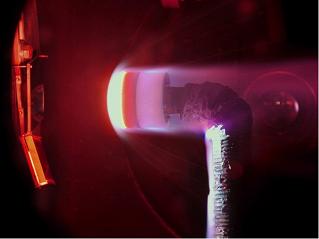
On February 23, 2009, SpaceX announced that the PICA-X high performance heat shield material passed an arc jet testing. During the test that recreates the conditions experienced during an atmospheric reentry, the material was subjected to temperatures as high as 1850 degrees Celsius.


PICA is short for Phenolic Impregnated Carbon Ablator. It is a material used for thermal protection, which was initially developed by NASA. PICA-X is an improved variation of the original PICA and was developed by SpaceX with the assistance of NASA. SpaceX becomes the second commercial source for this high-performance carbon-based material.


“We tested three different variants developed by SpaceX,” said Tom Mueller, VP of Propulsion, SpaceX. “Compared to the PICA heat shield flown successfully on NASA’s Stardust sample return capsule, our SpaceX versions equaled or improved the performance of the heritage material in all cases.”
 

Credits: SpaceX


The arc jet tests were performed at the Arc Jet Complex at NASA Ames Research Center, as the test center is capable of creating the reentry conditions. The Arc Jet Complex has a long history in the development of thermal protective systems.


PICA-X will protect the Dragon spacecraft and the crew during the reentry in the atmosphere from low Earth orbit (LEO).


One remarkable detail that I discovered when reading the press release is that PICA-X will also be used to coat the second stage of the Falcon 9 launch vehicle, as SpaceX plans to reuse the second stage of the launch vehicle as well.


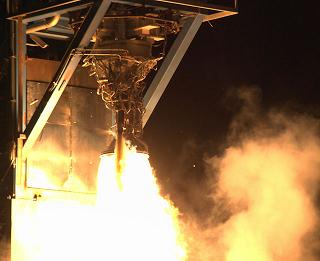
On March 7, 2009, the Merlin Vacuum engine completed a full mission duration firing at the SpaceX Test Facility in McGregor, Texas. During the test that lasted 6 minutes, the engine consumed more than 100,000 pounds of liquid oxygen and rocket grade kerosene.


The Merlin Vacuum engine is a variation of the Merlin 1C engine that powers the Falcon 1 launch vehicle, and it accommodates changes that make it more efficient to fire in the vacuum of space (most notably the shape of the nozzle).
 

Credits: SpaceX


“Specific impulse, or Isp, indicates how efficiently a rocket engine converts propellant into thrust,” said Tom Mueller. “With a vacuum Isp of 342 seconds, the new Merlin Vacuum engine has exceeded our requirements, setting a new standard for American hydrocarbon engine performance in space.”


The engine uses a regeneratively cooled combustion chamber, which means that the propellant is injected into the walls of the combustion chamber and prevents them from melting.


The nozzle is radiatively cooled and much larger, and also has a larger exhaust section than the Merlin 1C. This results in an improved performance of the engine. The engine is capable of multiple restarts and can operate at reduced thrust, which will enable the upper stage to deliver payloads matching a broad range of orbital profiles.


“Falcon 9 was designed from the ground up to provide our customers with breakthrough advances in reliability,” said Elon Musk, CEO and CTO of SpaceX. “In successfully adapting our flight tested first stage engine for use on the second stage, this recent test further validates the architecture of Falcon 9, designed to provide customers with high reliability at a fraction of traditional costs.”


The first flight of the Falcon 9 /Dragon launch system is scheduled for late 2009 from Launch Pad SLC-40 at Cape Canaveral, Florida. For more information about SpaceX and the Falcon 9 /Dragon launch system, you can visit the SpaceX website.

 

  • Facebook
  • Google
  • Slashdot
  • Reddit
  • Live
  • TwitThis


Credits: SpaceX


SpaceX has announced that the Falcon 9 launch vehicle was raised to vertical on its launch pad at Space Launch Complex 40 (SLC-40) in Cape Canaveral, Florida.


SpaceX was awarded a Commercial Resupply Service (CRS) contract in December 2008. The Falcon 9 launch vehicle and the Dragon spacecraft will be used as the primary means of transporting cargo to and from the International Space Station (ISS) after the Space Shuttle is retired by NASA.


The Falcon 9 launch vehicle will provide the lowest cost per kilogram to orbit. The 54.9 m long and 3.6 m wide launcher will be able to lift payloads with a mass of 12,500 kg to a low Earth orbit (LEO) for only $36.75 million. For more details on the pricing of the Falcon 9 missions, you can check out the page dedicated to Falcon 9 on SpaceX’s web site.


“This entire process has helped us validate key interfaces and operations prior to executing our launch campaign with the vehicle in its final flight configuration,” said Elon Musk, CEO and CTO of SpaceX. “We encountered no show-stoppers or significant delays. I am highly confident that we will achieve our goal of being able to go from hangar to liftoff in under 60 minutes, which would be a big leap forward in capability compared with the days to weeks required of other launch vehicles.”


  • Facebook
  • Google
  • Slashdot
  • Reddit
  • Live
  • TwitThis


Credits: SpaceX


NASA has awarded two International Space Station (ISS) Commercial Resupply Services (CRS) contracts to Space Exploration Technologies (SpaceX) and Orbital Sciences Corporation (Orbital).


NASA has ordered eight flights valued at about $1.9 billion from Orbital and twelve flights valued at about $1.6 billion from SpaceX.


The maximum potential value of each contract is roughly $3.1 billion. Based on known requirements, the value of both contracts combined is projected at $3.5 billion.


Credits: Orbital


The awarded contracts are fixed-price indefinite delivery, indefinite quantity contracts. They will begin January 1, 2009, and are effective through December 31, 2016. SpaceX and Orbital each will have to deliver a minimum of twenty metric tons of cargo to the space station, and they will also have to deliver non-standard services in support of the cargo resupply, including analysis and special tasks as the government deems necessary.


SpaceX will service the ISS with its Falcon9/Dragon system.


“The SpaceX team is honored to have been selected by NASA as the winner of the Cargo Resupply Services contract,” said Elon Musk, CEO and CTO, SpaceX. “This is a tremendous responsibility, given the swiftly approaching retirement of the Space Shuttle and the significant future needs of the Space Station. This also demonstrates the success of the NASA COTS program, which has opened a new era for NASA in US Commercial spaceflight.”


Orbital will employ the Taurus IITM medium-lift launch vehicle and the CygnusTM maneuvering space vehicle.


“We are very appreciative of the trust NASA has placed with us to provide commercial cargo transportation services to and from the International Space Station, beginning with our demonstration flight scheduled in late 2010,” said Mr. David W. Thompson, Orbital’s Chairman and Chief Executive Officer. “The CRS program will serve as a showcase for the types of commercial services U.S. space companies can offer NASA, allowing the space agency to devote a greater proportion of its resources for the challenges of human spaceflight, deep space exploration and scientific investigations of our planet and the universe in which we live.”


Both Orbital and SpaceX have issued press releases with more details about the CRS contracts.


  • Facebook
  • Google
  • Slashdot
  • Reddit
  • Live
  • TwitThis