


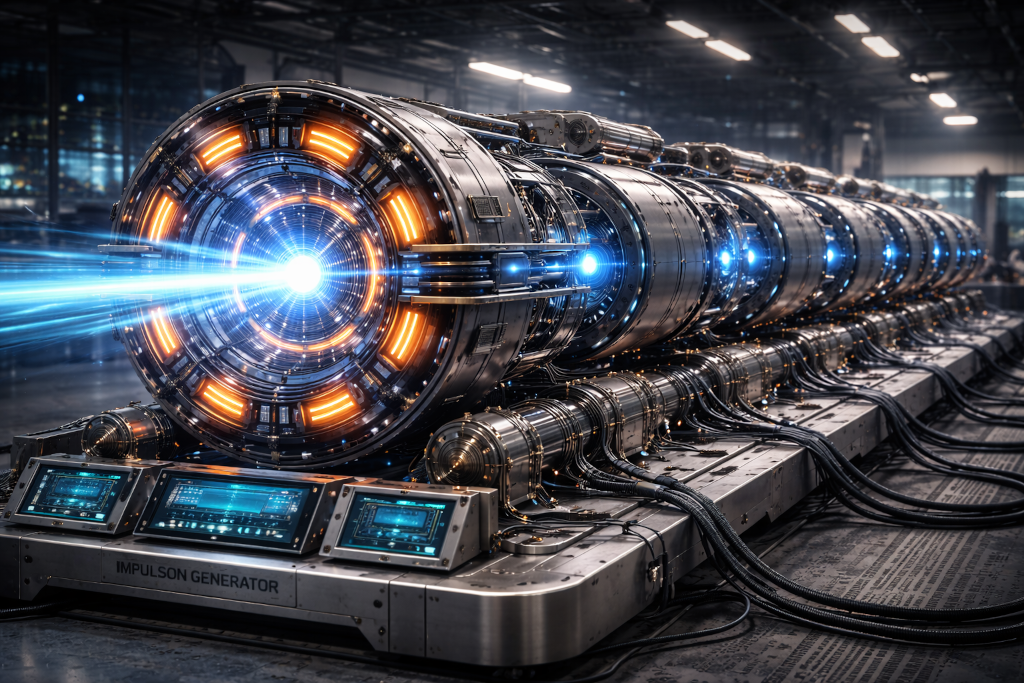
The LASER taught us that energy does not need to explode outward to be useful. It can be channeled. It can be persuaded to exit matter in an orderly way, carrying not just energy but intent—direction, phase, and stability. Once that lesson is fully absorbed, a more radical question emerges naturally: if energy can be converted into coherent light, can it be converted into coherent impulse?
Impulse, unlike light, is inseparable from momentum. To generate thrust is not merely to release energy, but to bias momentum in one direction. Classical propulsion achieves this brutally, by ejecting reaction mass. But the LASER never ejects electrons, atoms, or mirrors. It rearranges internal transitions and extracts a directional effect. The conceptual leap is to imagine a device that does the same for momentum itself.
This blog post explores a speculative but structured idea: an impulse-conversion device that mirrors the physics of a LASER, built not around photons, but around a new, short-lived particle whose decay releases quantized momentum rather than electromagnetic radiation.
Introducing the Impulson
At the heart of this concept lies a hypothetical particle, provisionally named the impulson. Like the photon, the impulson is not imagined as a permanent constituent of matter, but as a transient excitation—a carrier released during a controlled energy transition.
In this model, the impulson emerges when a system transitions between two quantized momentum-coupled energy states. Just as an electron dropping to a lower orbital releases a photon with energy ΔE = hν, the impulson would be emitted when a bound excitation drops to a lower momentum eigenstate, releasing a discrete amount of impulse Δp.
Crucially, this impulse is not random. It is emitted along a preferred axis defined by external field geometry. The impulson does not scatter isotropically. Its defining feature is directional bias.
The impulson is assumed to be extremely short-lived, decaying almost immediately into the surrounding vacuum field or spacetime structure. Its value lies not in persistence, but in the momentum it transfers to the emitting system at the moment of release.
Quantized Momentum Transitions
In conventional quantum mechanics, momentum is continuous while energy is quantized. However, when particles are confined in structured potentials—crystal lattices, waveguides, magnetic traps—momentum states can become discretized through boundary conditions.
The impulse engine concept exploits this principle. Instead of confining electrons in atomic orbitals, it confines collective excitations—possibly quasiparticles, spin-aligned plasma states, or exotic vacuum-coupled modes—within a structured electromagnetic cavity. These excitations possess metastable states with different momentum coupling strengths.
An external electrical input pumps the system into a high-energy, high-momentum-coupled state. When a transition is triggered—analogous to stimulated emission—the excitation drops to a lower state and emits an impulson. Conservation laws are satisfied because the system recoils in the opposite direction, acquiring a minute but real impulse.
Individually, these impulses are negligible. Collectively, if synchronized and amplified, they form thrust.
Stimulated Impulse Emission
The LASER’s power comes from stimulated emission, not spontaneous emission. The same principle applies here. Spontaneous impulse transitions would average out, producing no net thrust. Directionality requires stimulated impulse emission, where an existing momentum bias encourages further transitions to align with it.
This is where magnetic fields play a central role. A strong, structured magnetic field defines a preferred axis and breaks symmetry. Within this field, impulson-emitting transitions are more likely to occur along the field gradient. The magnetic field does not generate thrust directly; it acts as a selection rule, enforcing coherence across many emission events.
The result is an impulse cavity, functionally analogous to an optical resonator. Instead of mirrors reflecting photons, magnetic and electromagnetic boundaries reinforce a specific momentum direction. Impulsons emitted off-axis are suppressed or reabsorbed. Only those aligned with the thrust vector contribute constructively.
Energy Conversion, Not Momentum Creation
As with the LASER, a central misconception must be avoided. The impulse engine does not create momentum from nothing. It converts stored or supplied energy into directed momentum transfer. Electrical energy raises the system into excited states. Controlled transitions release impulse. Losses appear as heat, radiation, or incoherent emissions.
The efficiency challenge is severe. The energy required to produce even micro-newtons of thrust via quantum impulse conversion is enormous. But the LASER faced similar skepticism in its infancy. Early devices were inefficient curiosities. Only after decades of refinement did LASERs become practical power converters.
The impulse engine is not a replacement for chemical rockets. It is a different class of machine altogether—one optimized for continuous, long-duration thrust without reaction mass.
Possible Physical Realizations
How might impulsons arise physically? Several speculative pathways exist, each rooted in known physics but extended into uncharted regimes.
One possibility involves plasma-bound quasiparticles whose dispersion relations couple energy states to directional momentum under strong magnetic confinement. Another explores spin-aligned vacuum excitations, where transitions between polarized vacuum states produce directional recoil. A more radical model invokes curved spacetime micro-couplings, where localized stress-energy fluctuations briefly store and release momentum.
None of these models are proven. All require experimental validation. But they share a common structure: quantized states, controlled transitions, directional selection, and coherent amplification.
The Birth of the Impulse Engine Concept
What matters most is not which model survives, but that the architecture mirrors the LASER’s logic. Energy input creates population inversion. A cavity enforces directionality. Stimulated transitions dominate. Output is coherent—not light, but impulse.
The impulse engine, if realized, would not roar. It would hum. Thrust would emerge not from violence, but from order—billions of microscopic nudges aligned into a macroscopic push.
This reframing of propulsion is subtle and unsettling. It suggests that spaceflight need not rely on throwing mass away, but on persuading energy itself to lean.
In the final chapter of this trilogy, the remaining obstacle is addressed directly. Even the most elegant impulse engine is useless without power. And the power required to bend momentum at scale is staggering.
Fortunately, another long-dismissed idea is finally stepping out of theory and into engineering reality.
 Subscribe to our RSS feed









There are no comments.
Add A Comment