


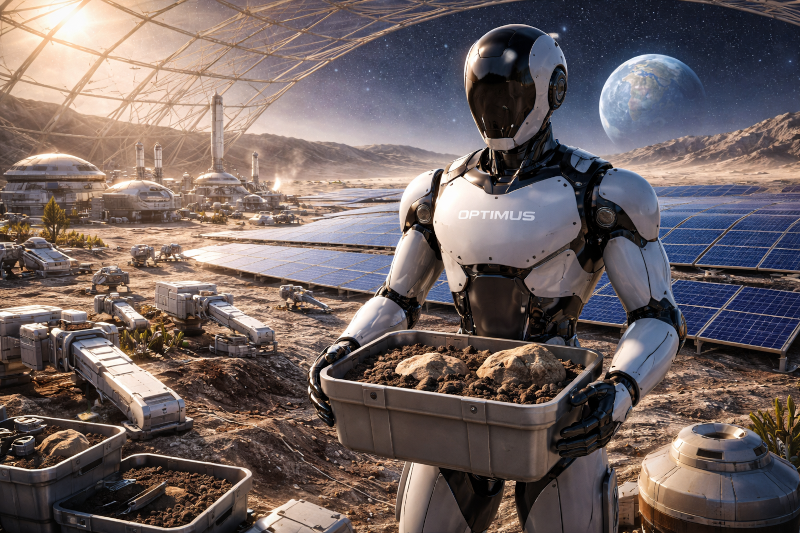
There are moments in the history of technology when an idea appears so simple in form and so vast in implication that it changes how we think about the future. The concept of a self-replicating machine—one that can travel, gather resources, and build copies of itself—belongs to that category. When Elon Musk suggested that a system like “Optimus + PV” could become the first practical Von Neumann probe, he was not just describing a new robot or spacecraft. He was pointing toward a profound shift in how humanity might expand beyond Earth.
The idea itself is not new. It traces back to the mathematician John von Neumann, who explored the theoretical possibility of machines capable of self-replication. In his work, he described systems that could read instructions, gather materials, and construct copies of themselves, including the instructions needed for further replication. In biological terms, this is what life has done for billions of years. DNA encodes information, cells interpret it, and organisms reproduce. The Von Neumann probe is an attempt to translate that biological principle into engineering.
At its core, the concept is deceptively straightforward. A spacecraft travels to a new location—an asteroid, a moon, or another planet. Once there, it uses local materials to construct a copy of itself. That copy then travels outward and repeats the process. Over time, a single probe could give rise to an expanding network of machines, spreading through the Solar System and beyond without requiring constant support from Earth. The implications are enormous. Exploration, resource extraction, and even the construction of infrastructure in space could proceed exponentially rather than linearly.
Yet turning this idea into reality requires solving some of the most difficult problems in science and engineering.
The first challenge is perception and manipulation. A self-replicating machine must be able to understand its environment in detail. It must identify raw materials, distinguish between useful and unusable resources, and manipulate those materials with precision. This requires advanced robotics, combining machine vision, tactile sensing, and dexterous control. NASA’s robotic systems on Mars have demonstrated aspects of this capability, but they are still far from the autonomy required for full self-replication.
The second challenge is materials processing. On Earth, manufacturing depends on highly specialized supply chains and controlled environments. A Von Neumann probe cannot rely on such infrastructure. It must extract metals, refine them, and fabricate components using whatever resources are available locally. This could involve melting regolith, separating elements through chemical or electrochemical processes, and using additive manufacturing techniques to build structural and mechanical parts. In space, these processes must operate in vacuum, under microgravity or low-gravity conditions, and with limited energy.
Energy itself is the third major challenge. Any self-replicating system must generate enough power to sustain its operations. This is where the “PV” component—presumably referring to photovoltaic systems—becomes critical. Solar energy is abundant in space, especially near the Sun, and photovoltaic arrays can convert sunlight into electricity with increasing efficiency. A self-replicating probe would likely deploy solar panels, use them to power its manufacturing processes, and then construct additional panels as part of its replication cycle. In this sense, energy generation becomes part of the replication process itself.
The fourth challenge is information. A machine cannot replicate itself unless it carries a complete description of its own structure and function. In biology, this role is played by DNA. In a Von Neumann probe, it would be a digital blueprint—a comprehensive dataset containing everything needed to build the machine from raw materials. This blueprint must be robust, error-resistant, and adaptable. It must also include the software required to interpret the instructions, control the manufacturing processes, and respond to unexpected conditions.
This brings us to autonomy. A self-replicating probe cannot rely on real-time control from Earth, especially as it moves farther into space. Communication delays, which can range from minutes to hours, make direct control impractical. The probe must make decisions independently, guided by artificial intelligence capable of planning, problem-solving, and learning. It must handle uncertainties, recover from errors, and adapt to environments that may differ significantly from those it was designed for.
When Musk refers to a system like “Optimus + PV,” he is implicitly combining several of these elements. Optimus, as a humanoid robotic platform, represents the manipulation and interaction capability—the ability to move, handle tools, and perform complex tasks. Photovoltaic systems provide the energy backbone. Together, they suggest a modular architecture in which a robotic workforce, powered by solar energy, carries out the processes needed for replication.
But even this is only a starting point. A true Von Neumann probe would require not just one robot, but an ecosystem of machines working together. Some would specialize in mining, others in processing materials, others in fabrication and assembly. The system would resemble a self-contained industrial base, capable of producing everything from structural components to electronic systems.
Electronics, in particular, present a unique challenge. While metals and structural materials can be extracted from many planetary surfaces, the fabrication of advanced semiconductors requires extreme precision and controlled environments. Building a fully self-sufficient probe may require simplifying electronics, developing new manufacturing techniques, or designing systems that can tolerate a degree of imperfection.
Despite these challenges, progress in multiple fields is converging toward the possibility of self-replication. Advances in robotics are making machines more capable and adaptable. Additive manufacturing is enabling the production of complex components with fewer steps and less infrastructure. Artificial intelligence is improving the ability of systems to operate autonomously. And space missions are expanding our understanding of how to work with extraterrestrial materials.
The potential impact of a functioning Von Neumann probe is difficult to overstate. Instead of launching every spacecraft from Earth at enormous cost, humanity could send a small number of seed systems that grow into large-scale infrastructure in space. Asteroid mining operations could expand naturally. Habitats could be constructed using local materials. Exploration could proceed outward at an accelerating pace, limited more by physics than by resources.
At the same time, the concept raises important questions. A system capable of self-replication must be carefully controlled to prevent unintended consequences. Safeguards would need to ensure that replication occurs only under defined conditions and does not continue indefinitely. The idea of machines multiplying beyond human oversight is not just a technical issue, but an ethical one.
In the end, the vision of a Von Neumann probe is both a continuation of a long tradition and a step into something entirely new. Humanity has always built tools to extend its reach, from ships crossing oceans to spacecraft exploring other worlds. A self-replicating machine would extend that reach in a fundamentally different way, allowing exploration to scale in ways that were previously unimaginable.
If such a system is ever realized, it will not arrive as a single breakthrough, but as the result of many incremental advances brought together into a coherent whole. It will be a machine that carries within it the ability not just to act, but to reproduce its own capability. And in doing so, it may mark the moment when exploration becomes not just something we do, but something we set in motion.


 Subscribe to our RSS feed













There are no comments.
Add A Comment