


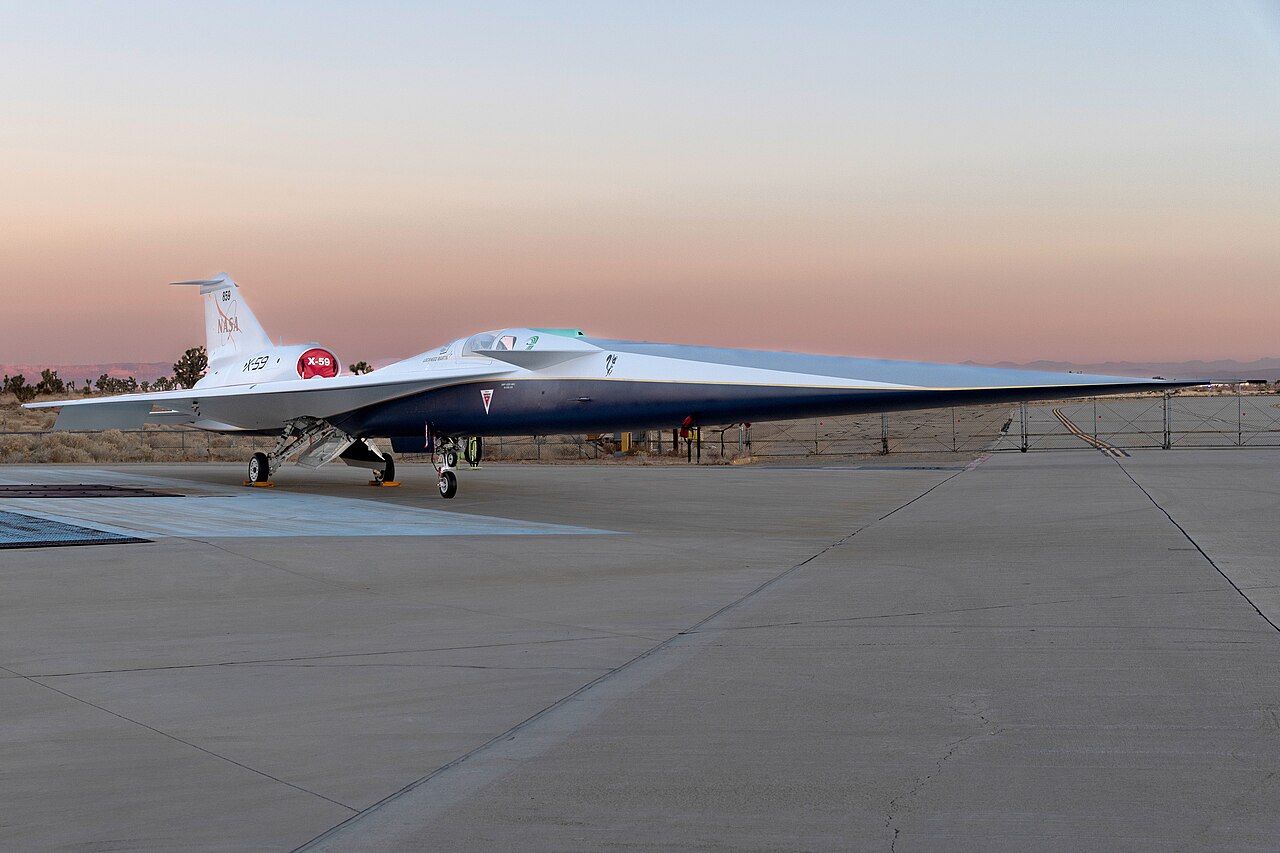
For as long as humans have pushed aircraft beyond the speed of sound, there has been a cost to that achievement—an invisible but unmistakable shockwave that ripples across the sky and crashes into the ground as a sonic boom. It is a sound that has fascinated engineers and frustrated communities in equal measure. For decades, it has been the reason supersonic flight over land has remained largely forbidden, a technological triumph constrained by its own consequences. Now, with NASA’s X-59 experimental aircraft, that story may be about to change.
The X-59 is not just another aircraft. It is the centerpiece of NASA’s Quesst mission, an ambitious effort to rewrite one of the fundamental limitations of high-speed flight. Instead of accepting the sonic boom as inevitable, engineers have asked a different question: can the physics of supersonic flight be reshaped so that the boom itself becomes something softer, something more like a distant thump than a disruptive crack?
The journey toward answering that question reached a major milestone on October 28, 2025, when the X-59 completed its first flight with NASA test pilot Nils Larson at the controls. That flight marked the transition from theory and design into reality. Since then, the aircraft has undergone meticulous inspection and maintenance, with engineers removing and reinstalling critical components—from the engine to structural panels—to ensure that every system performs exactly as intended. This careful process reflects the precision required for an aircraft that is not just flying faster than sound, but redefining how that speed interacts with the world below.
To understand what makes the X-59 different, one must first understand the physics of the sonic boom. When an aircraft travels slower than sound, pressure waves generated by its motion propagate outward in all directions. But once the aircraft exceeds the speed of sound, those waves can no longer outrun the vehicle. Instead, they compress and merge into powerful shockwaves that trail behind the aircraft in a cone-shaped pattern. When those shockwaves reach the ground, they are heard as a sudden, explosive boom.
Traditional supersonic aircraft, such as the Concorde, produced a distinctive “N-wave” pressure signature, characterized by a sharp rise in pressure, a gradual drop, and then another sharp rise. This pressure profile translates into the loud, disruptive sound associated with sonic booms. The challenge for NASA’s engineers has been to reshape that pressure signature entirely.
The X-59 approaches this challenge through geometry. Its long, slender fuselage stretches nearly 100 feet, tapering gradually from nose to tail. This shape is not aesthetic—it is aerodynamic in the most fundamental sense. By carefully controlling how air is compressed and displaced along the aircraft’s body, engineers can prevent shockwaves from coalescing into a single, powerful disturbance. Instead, the pressure changes are distributed along the length of the aircraft, resulting in a series of smaller, weaker shockwaves.
As these softened shockwaves travel toward the ground, they combine into what NASA calls a “low-boom” signature. Rather than the sharp crack of a traditional sonic boom, the sound becomes a quieter, more diffuse “thump.” The difference is subtle in terms of physics but profound in its implications. If the boom can be reduced to a level that is acceptable to people on the ground, the long-standing restrictions on supersonic flight over land could be reconsidered.
Achieving this outcome requires more than just shaping the aircraft’s exterior. The X-59 incorporates advanced computational fluid dynamics, allowing engineers to simulate airflow and shockwave behavior with extraordinary precision. Decades of research have gone into refining these models, ensuring that the aircraft’s design produces the desired pressure distribution under real-world conditions.
The engineering challenges extend into the cockpit as well. Because of its elongated nose, the X-59 does not have a traditional forward-facing window. Instead, the pilot relies on an external vision system, combining high-resolution cameras and displays to provide a synthetic view of the environment ahead. This system represents a significant departure from conventional aircraft design, requiring careful integration of imaging technology, flight controls, and pilot interface systems.
Behind the scenes, the aircraft’s propulsion system must also operate seamlessly within this carefully balanced aerodynamic environment. The engine is positioned on top of the fuselage to minimize its contribution to shockwave formation, reducing the impact of exhaust flow on the aircraft’s overall pressure signature. Every aspect of the design—from wing shape to engine placement—has been optimized to serve the same goal: controlling how the aircraft disturbs the air around it.
As the X-59 moves into expanded flight testing in 2026, NASA will push the aircraft to higher speeds and altitudes, validating its performance under a range of conditions. These tests are not simply about proving that the aircraft can fly supersonically—they are about confirming that it can do so quietly, consistently, and safely. Data collected during these flights will be used to refine models, verify predictions, and ensure that the low-boom concept holds true outside of simulations.
Perhaps the most unique phase of the mission will come after the technical validation is complete. NASA plans to fly the X-59 over selected communities, gathering data not just from instruments, but from people. Residents will be asked to describe what they hear, how noticeable it is, and whether it is disruptive. This human response will play a crucial role in shaping future regulations for supersonic flight.
The significance of the X-59 extends far beyond a single aircraft. If successful, it could open the door to a new generation of commercial supersonic travel, cutting flight times dramatically without the environmental and social constraints that have limited previous efforts. Flights across continents could become faster, more efficient, and more practical, transforming the way people and goods move around the world.
At its core, the story of the X-59 is one of refinement rather than revolution. The physics of supersonic flight has been understood for decades. What has changed is our ability to shape those physics with precision, to take something once considered unavoidable and redesign it from the ground up.
The sonic boom, once a defining feature of supersonic travel, may soon become a relic of the past—not eliminated, but transformed into something quieter, something more acceptable, something that allows speed and harmony to coexist. And in that transformation lies the true achievement of the X-59: not just flying faster than sound, but learning how to do so without shouting to the world below.


 Subscribe to our RSS feed













There are no comments.
Add A Comment