OrbitalHub

The place where space exploration, science, and engineering meet

Domain is for sale. $50,000,000.00 USD. Direct any inquiries to contact@orbitalhub.com.

Archive for June, 2017

June 18, 2017

Bursting at the Seams

Posted by


NASA dixit:

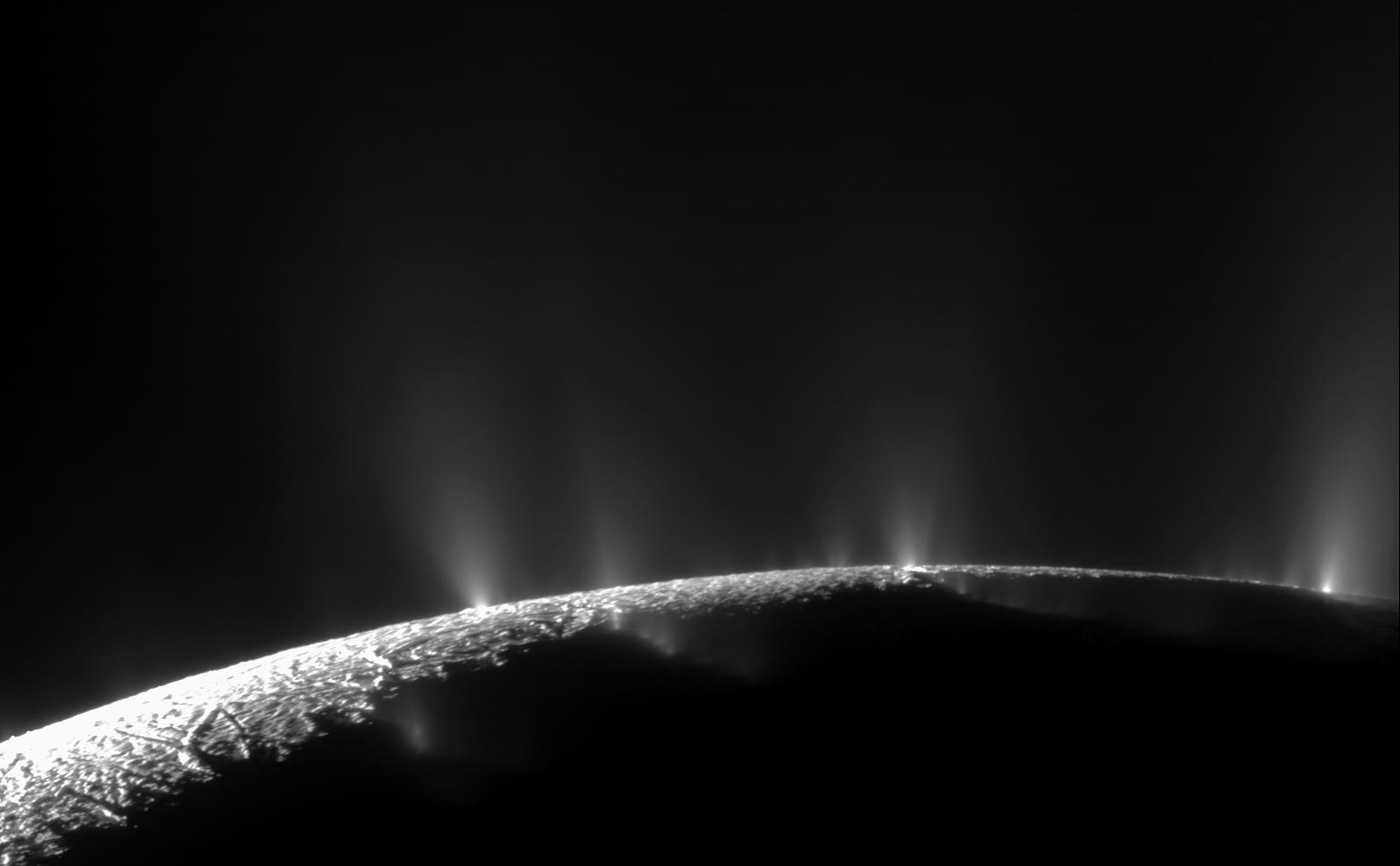
“November 21, 2009. Dramatic plumes, both large and small, spray water ice and vapor from many locations along the famed “tiger stripes” near the south pole of Saturn’s moon Enceladus. The tiger stripes are four prominent, approximately 84-mile- (135-kilometer-) long fractures that cross the moon’s south polar terrain. This two-image mosaic is one of the highest resolution views acquired by Cassini during its imaging survey of the geyser basin capping the southern hemisphere of Saturn’s moon Enceladus. It clearly shows the curvilinear arrangement of geysers, erupting from the fractures. From left to right, the fractures are Alexandria, Cairo, Baghdad, and Damascus.

As a result of this survey, 101 geysers were discovered: 100 have been located on one of the tiger stripes, and the three-dimensional configurations of 98 of these geysers have also been determined. The source location of the remaining geyser could not be definitively established. These results, together with those of other Cassini instruments, now strongly suggest that the geysers have their origins in the sea known to exist beneath the ice underlying the south polar terrain.”

“After almost 20 years in space, NASA’s Cassini spacecraft begins the final chapter of its remarkable story of exploration: its Grand Finale. Between April and September 2017, Cassini will undertake a daring set of orbits that is, in many ways, like a whole new mission. Following a final close flyby of Saturn’s moon Titan, Cassini will leap over the planet’s icy rings and begin a series of 22 weekly dives between the planet and the rings.

No other mission has ever explored this unique region. What we learn from these final orbits will help to improve our understanding of how giant planets – and planetary systems everywhere – form and evolve.

On the final orbit, Cassini will plunge into Saturn’s atmosphere, sending back new and unique science to the very end. After losing contact with Earth, the spacecraft will burn up like a meteor, becoming part of the planet itself.

Cassini’s Grand Finale is about so much more than the spacecraft’s final dive into Saturn. That dramatic event is the capstone of six months of daring exploration and scientific discovery. And those six months are the thrilling final chapter in a historic 20-year journey.”

Image credit: NASA


  • Facebook
  • Google
  • Slashdot
  • Reddit
  • Live
  • TwitThis
June 18, 2017

Reiner Gamma

Posted by


Wikipedia dixit:

“Reiner Gamma (γ) is a geographical feature of the Moon known as a lunar swirl. It is one of the most visible lunar swirls from Earth, visible from most telescopes. It was originally thought to be a lunar highland, but scientists eventually realized that it cast no shadow on the moon. Until recently, Reiner Gamma’s origin was a mystery. Historically, it was not associated with any particular irregularities in the surface. Recently, similar features were discovered in Mare Ingenii and Mare Marginis by orbiting spacecraft. The feature on Mare Ingenii is located at the lunar opposite point from the center of Mare Imbrium. Likewise the feature on Mare Marginis is opposite the midpoint of Mare Orientale. Thus scientists believe that the feature resulted from seismic energies generated by the impacts that created these maria. Unfortunately there is no such lunar mare formation on the opposite surface of the Moon (although the large crater Tsiolkovskiy lies within one crater diameter).

Reiner Gamma is located on the Oceanus Procellarum, west of the crater Reiner. Its center is located at selenographic coordinates 7.5°N 59.0°W. It has an overall dimension of about 70 kilometres. The feature has a higher albedo than the relatively dark mare surface, with a diffuse appearance and a distinctive swirling, concentric oval shape. Related albedo features continue across the surface to the east and southwest, forming loop-like patterns over the mare. The central feature of Reiner Gamma resembles the dipolar formation created by iron filings on a surface with a bar magnet on the underside. Low-orbiting spacecraft have observed a relatively strong magnetic field associated with each of these albedo markings. Some have speculated that this magnetic field and the patterns were created by cometary impacts. However the true cause remains uncertain.

Reiner Gamma’s magnetic field strength is approximately 15 nT, measured from an altitude of 28 km. This is one of the strongest localized magnetic anomalies on the Moon. The surface field strength of this feature is sufficient to form a mini-magnetosphere that spans 360 km at the surface, forming a 300 km thick region of enhanced plasma where the solar wind flows around the field. As the particles in the solar wind are known to darken the lunar surface, the magnetic field at this site may account for the survival of this albedo feature.

In early lunar maps by Francesco Maria Grimaldi, this feature was incorrectly identified as a crater. His colleague Giovanni Riccioli then named it Galilaeus, after Galileo Galilei. The name was later transferred northwest to the current crater Galilaei.”

Video credit: NASA Goddard


  • Facebook
  • Google
  • Slashdot
  • Reddit
  • Live
  • TwitThis
June 17, 2017

Progress MS-06 Arrives at the Station

Posted by


NASA dixit:

“The unpiloted Russian ISS Progress 67 cargo ship automatically docked to the rear port of the station’s Zvezda Service Module on June 16, completing a two-day journey following its launch atop a Soyuz booster from the Baikonur Cosmodrome in Kazakhstan on June 14. The new Progress is delivering three tons of food, fuel and supplies to the residents of the station and will remain attached to the outpost through December.”

Video credit: NASA


  • Facebook
  • Google
  • Slashdot
  • Reddit
  • Live
  • TwitThis
June 14, 2017

Mimas and Pan

Posted by


NASA dixit:

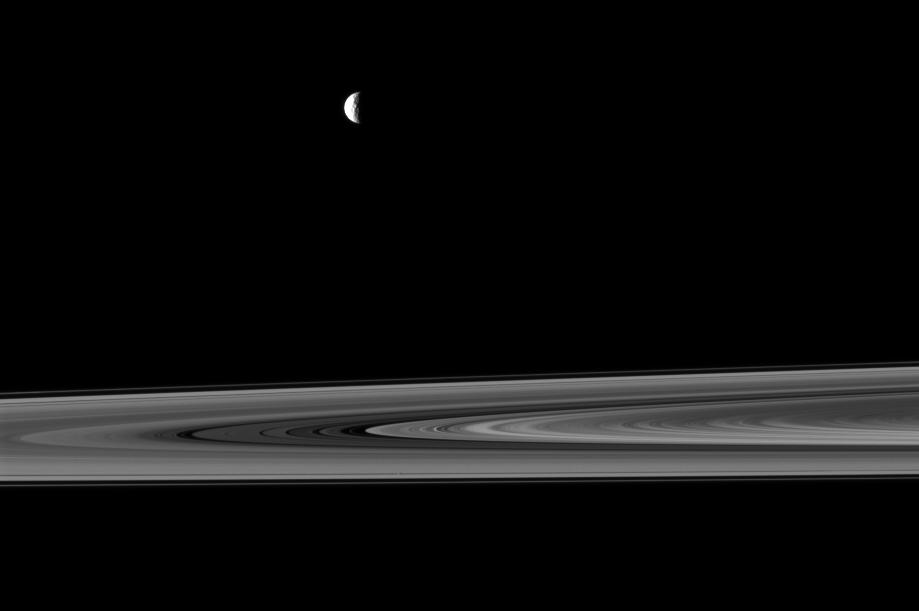
“October 19, 2009. The Cassini spacecraft captures a couple of small moons in this image taken while the spacecraft was nearly in the plane of Saturn’s rings. Near the top of this image, a crescent Mimas (396 kilometers, or 246 miles across) is closer to Cassini than the rings are. Pan (28 kilometers, or 17 miles across) is visible as a tiny dot in the Encke Gap of the A ring near the middle of the bottom of the image. This view looks toward the northern, sunlit side of the rings from just above the ringplane.

The image was taken in visible light with the Cassini spacecraft narrow-angle camera. The view was obtained at a distance of approximately 2.1 million kilometers (1.3 million miles) from Pan. Image scale is 13 kilometers (8 miles) per pixel.”

“After almost 20 years in space, NASA’s Cassini spacecraft begins the final chapter of its remarkable story of exploration: its Grand Finale. Between April and September 2017, Cassini will undertake a daring set of orbits that is, in many ways, like a whole new mission. Following a final close flyby of Saturn’s moon Titan, Cassini will leap over the planet’s icy rings and begin a series of 22 weekly dives between the planet and the rings.

No other mission has ever explored this unique region. What we learn from these final orbits will help to improve our understanding of how giant planets – and planetary systems everywhere – form and evolve.

On the final orbit, Cassini will plunge into Saturn’s atmosphere, sending back new and unique science to the very end. After losing contact with Earth, the spacecraft will burn up like a meteor, becoming part of the planet itself.

Cassini’s Grand Finale is about so much more than the spacecraft’s final dive into Saturn. That dramatic event is the capstone of six months of daring exploration and scientific discovery. And those six months are the thrilling final chapter in a historic 20-year journey.”

Image credit: NASA


  • Facebook
  • Google
  • Slashdot
  • Reddit
  • Live
  • TwitThis
June 14, 2017

Progress MS-06 Rollout and Launch

Posted by


NASA dixit:

“The unpiloted Russian ISS Progress 67 cargo ship launched atop a Soyuz booster June 14 from the Baikonur Cosmodrome in Kazakhstan on a two-day journey to the International Space Station. The new Progress, which is carrying three tons of food, fuel and supplies for the residents of the orbital complex, is scheduled to automatically dock to the rear port of the station’s Zvezda Service Module on June 16. It will remain attached to the station through December.”

Video credit: NASA/Roscosmos


  • Facebook
  • Google
  • Slashdot
  • Reddit
  • Live
  • TwitThis
June 13, 2017

Lithospheric Magnetic Field

Posted by


ESA dixit:

“ESA’s Swarm satellites are seeing fine details in one of the most difficult layers of Earth’s magnetic field to unpick – as well as our planet’s magnetic history imprinted on Earth’s crust. Earth’s magnetic field can be thought of as a huge cocoon, protecting us from cosmic radiation and charged particles that bombard our planet in solar wind. Without it, life as we know it would not exist. Most of the field is generated at depths greater than 3000 km by the movement of molten iron in the outer core. The remaining 6% is partly due to electrical currents in space surrounding Earth, and partly due to magnetised rocks in the upper lithosphere – the rigid outer part of Earth, consisting of the crust and upper mantle.

Although this ‘lithospheric magnetic field’ is very weak and therefore difficult to detect from space, the Swarm trio is able to map its magnetic signals. After three years of collecting data, the highest resolution map of this field from space to date has been released.

“By combining Swarm measurements with historical data from the German CHAMP satellite, and using a new modelling technique, it was possible to extract the tiny magnetic signals of crustal magnetisation,†explained Nils Olsen from the Technical University of Denmark, one of the scientists behind the new map. ESA’s Swarm mission manager, Rune Floberghagen, added: “Understanding the crust of our home planet is no easy feat. We can’t simply drill through it to measure its structure, composition and history. “Measurements from space have great value as they offer a sharp global view on the magnetic structure of our planet’s rigid outer shell.â€

The magnetic field is in a permanent state of flux. Magnetic north wanders, and every few hundred thousand years the polarity flips so that a compass would point south instead of north. When new crust is generated through volcanic activity, mainly along the ocean floor, iron-rich minerals in the solidifying magma are oriented towards magnetic north, thus capturing a ‘snapshot’ of the magnetic field in the state it was in when the rocks cooled. Since magnetic poles flip back and forth over time, the solidified minerals form ‘stripes’ on the seafloor and provide a record of Earth’s magnetic history.”

Video credit: ESA


  • Facebook
  • Google
  • Slashdot
  • Reddit
  • Live
  • TwitThis