


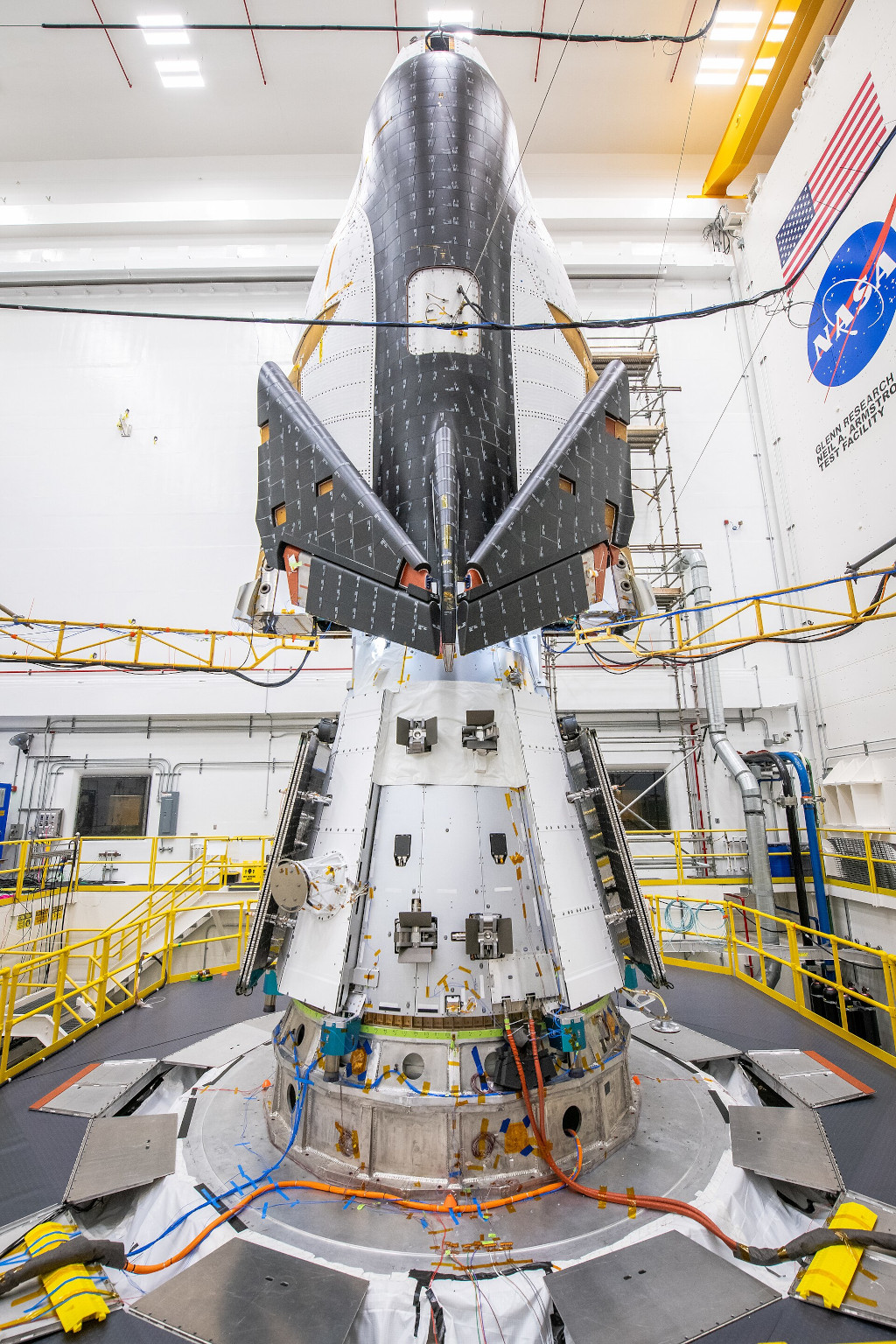
Sierra Space’s Dream Chaser cargo spaceplane continues its path toward first flight, with the demonstration mission currently targeted for late 2026. The spacecraft recently completed important pre-flight milestones at NASA’s Neil Armstrong Test Facility in Ohio, where it underwent vibration testing to simulate launch and re-entry conditions.
The Dream Chaser system consists of two main components: the reusable lifting-body spacecraft and the disposable Shooting Star cargo module. Together, the stack stands approximately 55 feet tall. Testing confirmed the vehicle’s structural integrity under the dynamic conditions experienced during launch and atmospheric re-entry.
Recent updates to the mission profile have changed the original plan. The demonstration flight will no longer dock with the International Space Station as originally planned. Instead, the mission will launch to low Earth orbit and return to Earth with a runway landing at Vandenberg Space Force Base in California. The change allows the mission to proceed without some of the complex docking systems that required additional development time.
NASA announced the modification in September 2025, noting that propulsion system and software certification remained in progress. The revised plan demonstrates the flexibility required in developing new spacecraft systems. The demonstration mission will still validate the vehicle’s core capabilities including launch, orbital flight, re-entry, and landing.
The CRS-2 contract with NASA tasks Dream Chaser with resupplying the International Space Station. Once operational, the spacecraft will be able to return sensitive cargo to Earth rather than disposing of it in the atmosphere as other cargo vehicles do. This capability addresses a longstanding gap in commercial resupply services.
The lifting-body design provides significant advantages during re-entry. Unlike capsule vehicles that splash down in the ocean, Dream Chaser can land on conventional runways. This approach enables faster payload recovery and eliminates the complexity of ocean recovery operations. The design also allows the vehicle to perform a controlled approach with greater maneuverability than capsule-shaped vehicles.
Testing at NASA’s facilities has included comprehensive evaluations of the integrated system. The vibration testing simulated the mechanical stresses of launch, orbital flight, and re-entry. Additional tests will evaluate thermal protection performance and systems integration before the vehicle is cleared for flight.
Sierra Space has invested heavily in developing manufacturing capabilities for the spacecraft. Production facilities in Colorado and Wisconsin support the build process for the reusable vehicle structure and the disposable cargo module. The company has established supplier relationships for specialized components including the heat shield tiles and propulsion systems.
If the demonstration mission succeeds, operational cargo flights could begin in 2027. The Dream Chaser will join SpaceX’s Dragon capsule and Northrop Grumman’s Cygnus vehicle in NASA’s commercial resupply portfolio. The addition of a runway-landable vehicle provides redundancy and expanded capabilities for station resupply operations.
The late 2026 launch window provides adequate time to complete remaining certification activities. Mission planners will select a specific date based on orbital mechanics and station logistics. The demonstration flight will carry a combination of NASA cargo and partner payloads to validate the vehicle’s performance in representative mission scenarios.


 Subscribe to our RSS feed













There are no comments.
Add A Comment