OrbitalHub

The place where space exploration, science, and engineering meet

Domain is for sale. $50,000,000.00 USD. Direct any inquiries to contact@orbitalhub.com.

Archive for March, 2009

March 7, 2009

Kepler Launch

Posted by


United Launch Alliance\’s Delta II launch vehicle, carrying Kepler, lifted off from Space Launch Complex 17B at Cape Canaveral Air Force Station on Friday, March 6, 2009, at 10:49 PM EST.

Kepler is the first NASA mission capable of finding terrestrial exo-planets. Of particular interest are the planets orbiting in the so-called habitable zone, where conditions are met so that liquid water can exist on the surface of the planet.

Read more about Kepler…


  • Facebook
  • Google
  • Slashdot
  • Reddit
  • Live
  • TwitThis
March 5, 2009

HTV

Posted by


Credits: JAXA


HTV stands for H-II Transfer Vehicle. HTV is an unmanned spacecraft designed and built in Japan. HTV is designed to deliver supplies to the International Space Station (ISS).


The typical mission for HTV starts at the Tanegashima Space Center (TKSC) near Tsukuba, in Japan.


A H-IIB launch vehicle will inject the HTV on a low Earth orbit (LEO). After the separation from the H-IIB second stage, the transfer vehicle is able to navigate independently.


It will take approximately three days for HTV to reach the proximity of the ISS. During this time, it will maintain contact with the Control Center at TKSC (designated as HTV-CC) through the Tracking and Data Relay Satellite System (TDRSS). TDRSS is a network of satellites that allow a spacecraft in LEO to maintain permanent contact with the control center on the ground. HTV will use GPS to position itself at 7 km behind the ISS.


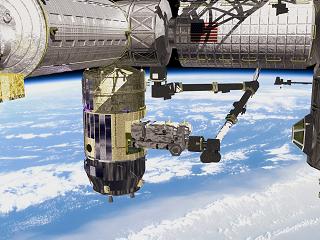
At this point, the berthing phase of the mission starts. HTV will approach the ISS within 500 m and use the Rendezvous Sensor (RVS) to move closer to the ISS. Reflectors that are installed on Kibo will allow HTV to maintain a distance of 10 m below the ISS.
 

Credits: JAXA


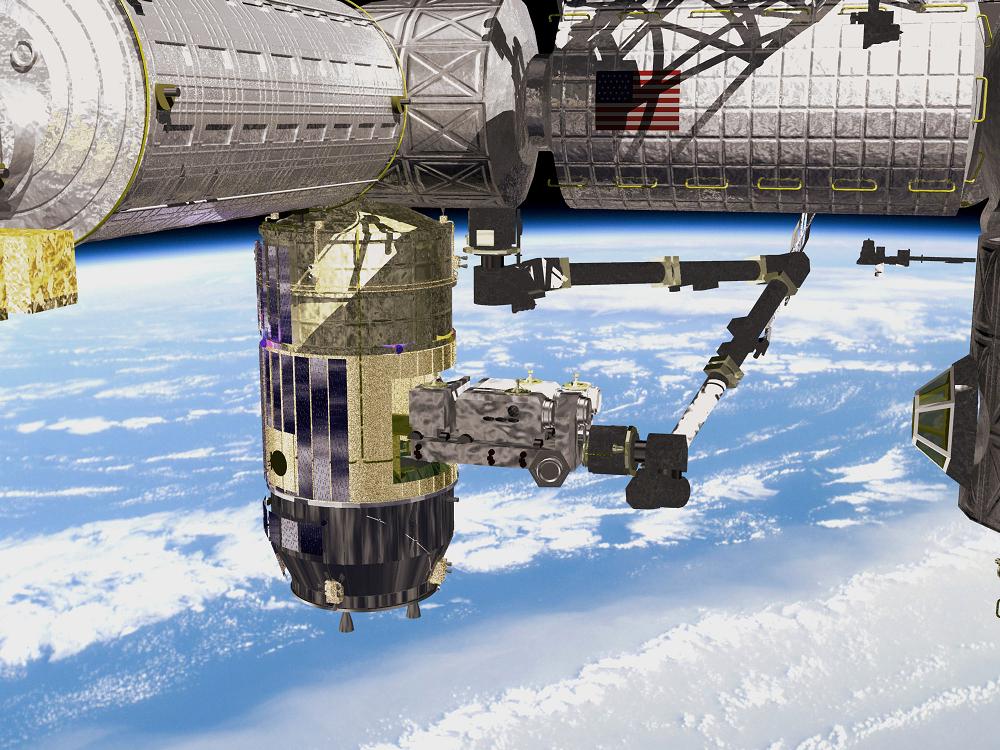
HTV does not have the capability to dock on its own to the ISS (as opposed to the European ATV), so the Canadarm2 robotic arm will be used to grab the transfer vehicle and berth it to the nadir side of the Node 2 module.


While the HTV is berthed to the ISS, supplies from the HTV’s pressurized section are transferred to the space station by the crew, and waste will be loaded from the ISS.


The cargo from the un-pressurized section will be unloaded using the robotic arm and attached either to the Exposed Facility of the Japanese Experiment Module (JEM) or the ISS Mobile Base System.


The HTV mission will end in a similar way to the European ATV: a destructive re-entry above the Pacific Ocean.


Here is some more background information about the HTV. The spacecraft is a cylinder-shaped structure 10 m long and 4.4 m in diameter. It has a total mass of 10,500 kg, of which 6,000 kg is cargo (divided into 4,500 kg pressurized cargo and 1,500 kg un-pressurized cargo). HTV can carry 6,000 kg of waste during the re-entry.


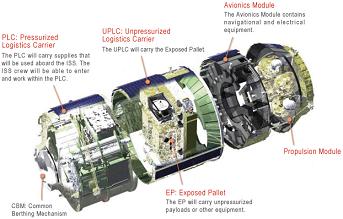
HTV consists of four modules: the Pressurized Logistics Carrier (PLC), the Unpressurized Logistics Carrier (UPLC), the Avionics Module, and the Propulsion Module. The UPLC carries the Exposed Pallet (EP), which can accommodate unpressurized payloads.
 

Credits: JAXA


The PLC is equipped with a Common Berthing Mechanism (CBM). This will allow the crew present on the station to enter the module in order to unload the supplies and load waste material.


The EP carried by the UPLC can be either Type I or Type III Exposed Pallets. The Type I EPs will carry payloads for the Kibo’s Exposed Facility (EF), while the Type III EPs will be used to deliver the Orbital Replacement Units (ORUs) to the ISS.


The systems in the avionics module enable HTV to execute the autonomous flight to the space station. The module also contains communication and power systems. The thirty-two thrusters installed on the propulsion module provide HTV with the capability to execute orbital adjustments and control the attitude during the mission.


HTV will add to the existing fleet of transfer vehicles that includes the Russian Soyuz and Progress spacecraft, as well as the European ATV. The first HTV mission is scheduled for late 2009.


For more information about HTV, you can visit the H-II Transfer Vehicle page on the JAXA web site.

 

  • Facebook
  • Google
  • Slashdot
  • Reddit
  • Live
  • TwitThis
March 2, 2009

Carnival of Space #92

Posted by


Credits: NASA/JPL


Carnival of Space #92 is hosted at The Launch Pad.


This week covers a diverse range of topics, including OCO, lunar rovers, new generation space suits, the MERs, Chandrayaan, Luna Glob, and much more.


  • Facebook
  • Google
  • Slashdot
  • Reddit
  • Live
  • TwitThis


Credits: Donna Coveney/MIT


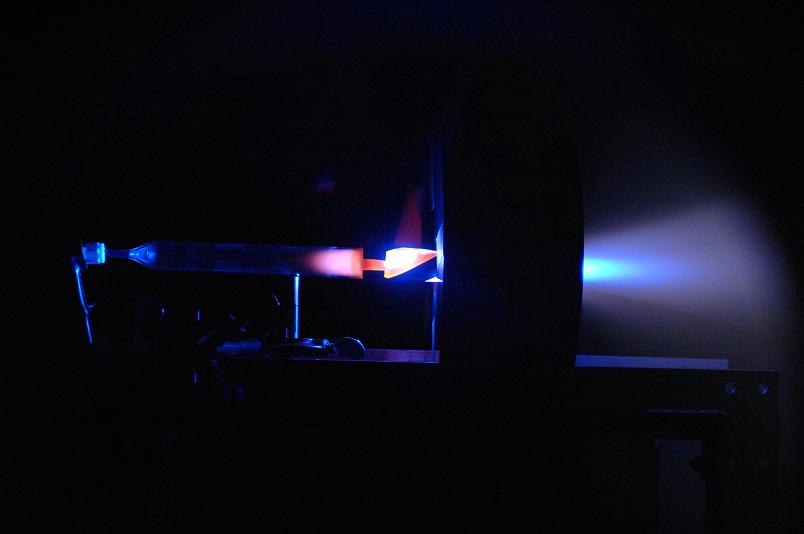
MIT is developing an ion propulsion system that uses nitrogen as propellant. The new system is called Mini-Helicon Plasma Thruster.


Research and development of the Mini-Helicon is taking place at MIT’s Space Propulsion Laboratory (SPL).


“The Mini-Helicon is one exciting example of the sorts of thrusters one can devise using external electrical energy instead of the locked-in chemical energy. Others we in the SPL work on include Hall thrusters and Electrospray thrusters. This area tends to attract students with a strong physics background, because it sits at the intersection of physics and engineering, with ample room for invention,” said Manuel Martinez-Sanchez, director of the SPL and a professor in the Department of Aeronautics and Astronautics.


The Mini-Helicon has a simple design: a quartz tube wrapped by a coiled antenna, surrounded by magnets. The gas used as propellant is pumped into the quartz tube, where it is turned into plasma. The magnets confine, guide, and accelerate the plasma into an exhaust beam, which creates the thrust.


The Mini-Helicon design has its roots in a larger and more powerful propulsion system developed in collaboration with former NASA astronaut Franklin Chang-Diaz. A team led by Oleg Batishchev, principal research scientist in the Department of Aeronautics and Astronautics, did a theoretical analysis showing that components of the larger system could be used for different applications. The idea “was that a rocket based on the first stage [of Chang-Diaz’s system] could be small and simple, for more economical applications,” said Batishchev, who noted that the team’s prototype would fit in a large shoe box.


Batishchev notes that it could be years before the technology can be used commercially, in part due to certification policies through NASA and other agencies.


For more information about MIT’s Mini-Helicon, check out the MIT News Office website.


  • Facebook
  • Google
  • Slashdot
  • Reddit
  • Live
  • TwitThis
March 1, 2009

Kepler – preparations for launch

Posted by


Kepler is the first NASA mission capable of finding terrestrial exo-planets. Of particular interest are the planets orbiting in the so-called habitable zone, where conditions are met so that liquid water can exist on the surface of the planet.

The Kepler mission, part of NASA’s Discovery Program, is designed to survey a portion of our region of the Milky Way. Kepler will survey a large number of stars, and explore the structure and diversity of many planetary systems.

Read more about Kepler…


  • Facebook
  • Google
  • Slashdot
  • Reddit
  • Live
  • TwitThis