OrbitalHub

The place where space exploration, science, and engineering meet

Domain is for sale. $50,000,000.00 USD. Direct any inquiries to contact@orbitalhub.com.

Archive for the Astronomy category

May 24, 2017

Solar Eruption

Posted by


NASA Goddard dixit:

“From long, tapered jets to massive explosions of solar material and energy, eruptions on the sun come in many shapes and sizes. Since they erupt at such vastly different scales, jets and the massive clouds — called coronal mass ejections, or CMEs — were previously thought to be driven by different processes.

Scientists from Durham University in the United Kingdom and NASA now propose that a universal mechanism can explain the whole spectrum of solar eruptions. They used 3-D computer simulations to demonstrate that a variety of eruptions can theoretically be thought of as the same kind of event, only in different sizes and manifested in different ways.

The study was motivated by high-resolution observations of filaments from NASA’s Solar Dynamics Observatory, or SDO, and the joint Japan Aerospace Exploration Agency/NASA Hinode satellite. Filaments are dark, serpentine structures that are suspended above the sun’s surface and consist of dense, cold solar material. The onset of CME eruptions had long been known to be associated with filaments, but improved observations have recently shown that jets have similar filament-like structures before eruption too. So the scientists set out to see if they could get their computer simulations to link filaments to jet eruptions as well.

Solar scientists can use computer models like this to help round out their understanding of the observations they see through space telescopes. The models can be used to test different theories, essentially creating simulated experiments that cannot, of course, be performed on an actual star in real life.

The scientists call their proposed mechanism for how these filaments lead to eruptions the breakout model, for the way the stressed filament pushes relentlessly at — and ultimately breaks through — its magnetic restraints into space. They previously used this model to describe CMEs; in this study, the scientists adapted the model to smaller events and were able to reproduce jets in the computer simulations that match the SDO and Hinode observations. Such simulations provide additional confirmation to support the observations that first suggested coronal jets and CMEs are caused in the same way.”

Video credit: NASA’s Goddard Space Flight Center/Genna Duberstein


  • Facebook
  • Google
  • Slashdot
  • Reddit
  • Live
  • TwitThis
May 21, 2017

Crater View

Posted by


NASA dixit:

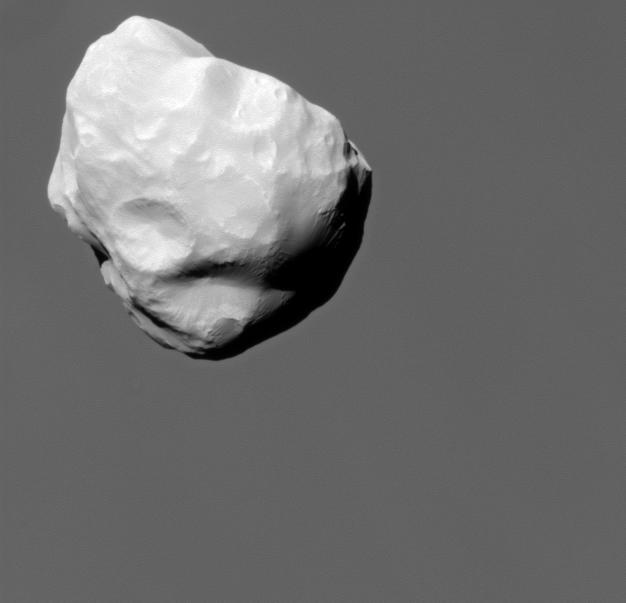
“July 26, 2009. The Cassini spacecraft eyes a prominent crater on the moon Janus. The south pole lies on the terminator at the bottom left of the image. This view is centered on terrain at 16 degrees south latitude, 64 degrees west longitude. This view looks toward the leading hemisphere of Janus (179 kilometers, or 111 miles across). North on Janus is up and rotated 31 degrees to the right. The image was taken in visible light with the Cassini spacecraft narrow-angle camera. The view was acquired at a distance of approximately 98,000 kilometers (61,000 miles) from Janus and at a Sun-Janus-spacecraft, or phase, angle of 58 degrees. Image scale is 586 meters (1,922 feet) per pixel.”

“After almost 20 years in space, NASA’s Cassini spacecraft begins the final chapter of its remarkable story of exploration: its Grand Finale. Between April and September 2017, Cassini will undertake a daring set of orbits that is, in many ways, like a whole new mission. Following a final close flyby of Saturn’s moon Titan, Cassini will leap over the planet’s icy rings and begin a series of 22 weekly dives between the planet and the rings.

No other mission has ever explored this unique region. What we learn from these final orbits will help to improve our understanding of how giant planets – and planetary systems everywhere – form and evolve.

On the final orbit, Cassini will plunge into Saturn’s atmosphere, sending back new and unique science to the very end. After losing contact with Earth, the spacecraft will burn up like a meteor, becoming part of the planet itself.

Cassini’s Grand Finale is about so much more than the spacecraft’s final dive into Saturn. That dramatic event is the capstone of six months of daring exploration and scientific discovery. And those six months are the thrilling final chapter in a historic 20-year journey.”

Image credit: NASA


  • Facebook
  • Google
  • Slashdot
  • Reddit
  • Live
  • TwitThis
May 20, 2017

Gamma-ray Puzzle from M31

Posted by


NASA dixit:

“NASA’s Fermi Gamma-ray Space Telescope has found a signal at the center of the neighboring Andromeda galaxy that could indicate the presence of the mysterious stuff known as dark matter. The gamma-ray signal is similar to one seen by Fermi at the center of our own Milky Way galaxy. Gamma rays are the highest-energy form of light, produced by the universe’s most energetic phenomena. They’re common in galaxies like the Milky Way because cosmic rays, particles moving near the speed of light, produce gamma rays when they interact with interstellar gas clouds and starlight. Surprisingly, the latest Fermi data shows the gamma rays in Andromeda, also known as M31, are confined to the galaxy’s center instead of spread throughout. To explain this unusual distribution, scientists are proposing that the emission may come from several undetermined sources. One of them could be dark matter, an unknown substance that makes up most of the universe.”

Video credit: NASA’s Goddard Space Flight Center/Scott Wiessinger


  • Facebook
  • Google
  • Slashdot
  • Reddit
  • Live
  • TwitThis
May 14, 2017

Rhea Transits Saturn

Posted by


NASA dixit:

“June 21, 2006. The slim crescent of the moon Rhea glides silently onto the featureless, golden face of Saturn in this mesmerizing color image. In an interplay of contrast and shadow, the moon goes dark against the planet, and then its crescent suddenly brightens as it slips in front of Saturn’s night side. This view looks down onto the unlit side of Saturn’s rings, which cast soft, linear shadows onto the planet’s northern hemisphere. The images were acquired by the Cassini spacecraft wide-angle camera on March 21, 2006, at a distance of approximately 221,000 kilometers (137,000 miles) from Rhea. The image scale is approximately 13 kilometers (8 miles) per pixel.”

“After almost 20 years in space, NASA’s Cassini spacecraft begins the final chapter of its remarkable story of exploration: its Grand Finale. Between April and September 2017, Cassini will undertake a daring set of orbits that is, in many ways, like a whole new mission. Following a final close flyby of Saturn’s moon Titan, Cassini will leap over the planet’s icy rings and begin a series of 22 weekly dives between the planet and the rings.

No other mission has ever explored this unique region. What we learn from these final orbits will help to improve our understanding of how giant planets – and planetary systems everywhere – form and evolve.

On the final orbit, Cassini will plunge into Saturn’s atmosphere, sending back new and unique science to the very end. After losing contact with Earth, the spacecraft will burn up like a meteor, becoming part of the planet itself.

Cassini’s Grand Finale is about so much more than the spacecraft’s final dive into Saturn. That dramatic event is the capstone of six months of daring exploration and scientific discovery. And those six months are the thrilling final chapter in a historic 20-year journey.”

Image credit: NASA


  • Facebook
  • Google
  • Slashdot
  • Reddit
  • Live
  • TwitThis
May 14, 2017

Gaia Science

Posted by


ESA dixit:

“The motion of two million stars is traced 5 million years into the future using data from the Tycho-Gaia Astrometric Solution, one of the products of the first Gaia data release. This provides a preview of the stellar motions that will be revealed in Gaia’s future data releases, which will enable scientists to investigate the formation history of our Galaxy.

Stars move through our Galaxy, the Milky Way, although the changes in their positions on the sky are too small and slow to be appreciated with the naked eye over human timescales. These changes were first discovered in the eighteenth century by Edmond Halley, who compared stellar catalogues from his time to a catalogue compiled by the astronomer Hipparchus some two thousand years before. Nowadays, stellar motions can be detected with a few years’ worth of high-precision astrometric observations, and ESA’s Gaia satellite is currently leading the effort to pin them down at unprecedented accuracy.

A star’s velocity through space is described by the proper motion, which can be measured by monitoring the movement of a star across the sky, and the radial velocity, which quantifies the star’s motion towards or away from us. The latter can be inferred from the shift towards blue or red wavelengths of certain features – absorption lines – in the star’s spectrum.

Launched in 2013, Gaia started scientific operations in July 2014, scanning the sky repeatedly to obtain the most detailed 3D map of our Galaxy ever made. The first data release, published in September 2016, was based on data collected during Gaia’s first 14 months of observations and comprised a list of 2D positions – on the plane of the sky – for more than one billion stars, as well as distances and proper motions for a subset of more than two million stars in the combined Tycho–Gaia Astrometric Solution, or TGAS.
The TGAS dataset consists of stars in common between Gaia’s first year and the earlier Hipparcos and Tycho-2 Catalogues, both derived from ESA’s Hipparcos mission, which charted the sky more than two decades ago.

This video shows the 2 057 050 stars from the TGAS sample, with the addition of 24 320 bright stars from the Hipparcos Catalogue that are not included in Gaia’s first data release. The stars are plotted in Galactic coordinates and using a rectangular projection: in this, the plane of the Milky Way stands out as the horizontal band with greater density of stars. Brighter stars are shown as larger circles, and an indication of the true colour of each star is also provided; information about brightness and colour is based on the Tycho-2 catalogue from the Hipparcos mission.

The video starts from the positions of stars as measured by Gaia between 2014 and 2015, and shows how these positions are expected to evolve in the future, based on the proper motions from TGAS. The frames in the video are separated by 750 years, and the overall sequence covers 5 million years. The stripes visible in the early frames reflect the way Gaia scans the sky and the preliminary nature of the first data release; these artefacts are gradually washed out in the video as stars move across the sky.”

Video credit: ESA


  • Facebook
  • Google
  • Slashdot
  • Reddit
  • Live
  • TwitThis
April 17, 2017

April 2017 Solar Flares

Posted by


NASA dixit:

“The sun emitted a trio of mid-level solar flares on April 2-3, 2017. NASA’s Solar Dynamics Observatory, which watches the sun constantly, captured images of the three events.”

Video credit: NASA’s Goddard Space Flight Center/Genna Duberstein

Music credit: A Waltz into Darkness by Joseph Bennie


  • Facebook
  • Google
  • Slashdot
  • Reddit
  • Live
  • TwitThis