OrbitalHub

The place where space exploration, science, and engineering meet

Domain is for sale. $50,000,000.00 USD. Direct any inquiries to contact@orbitalhub.com.

03-30-17

Sentinel-2B

Posted by


ESA dixit:

“Each of the SENTINEL-2 satellites weighs approximately 1.2 tonnes, and is designed to be compatible with small launchers like VEGA and ROCKOT. The satellite lifespan is 7.25 years, which includes a 3 month in-orbit commissioning phase. Batteries and propellants have been provided to accommodate 12 years of operations, including end of life de-orbiting manoeuvres.

Two identical SENTINEL-2 satellites will operate simultaneously, phased at 180° to each other, in a sun-synchronous orbit at a mean altitude of 786 km. The position of each SENTINEL-2 satellite in its orbit will be measured by a dual-frequency Global Navigation Satellite System (GNSS) receiver. Orbital accuracy will be maintained by a dedicated propulsion system.

The SENTINEL-2 satellite system is being developed by an industrial consortium led by Astrium GmbH (Germany). Astrium SAS (France) is responsible for the MultiSpectral Instrument (MSI).

The MSI works passively, by collecting sunlight reflected from the Earth. New data is acquired at the instrument as the satellite moves along its orbital path. The incoming light beam is split at a filter and focused onto two separate focal plane assemblies within the instrument; one for Visible and Near-Infra-Red (VNIR) bands and one for Short Wave Infra-Red (SWIR) bands . The spectral separation of each band into individual wavelengths is accomplished by stripe filters mounted on top of the detectors.”

Video credit: ESA


  • Facebook
  • Google
  • Slashdot
  • Reddit
  • Live
  • TwitThis
11-18-15

Sentinel-2

Posted by


Wikipedia dixit:

“Sentinel-2 will serve a wide range of applications related to Earth’s land surface and coastal zones. The mission will mainly provide information for agricultural and forestry practices and for helping manage food security. Satellite images will be used to determine various plant indices such as leaf area chlorophyll and water content indexes. This is particularly important for effective yield prediction and applications related to Earth’s vegetation. As well as monitoring plant growth, Sentinel-2 can be used to map changes in land cover and to monitor the world’s forests. It will also provide information on pollution in lakes and coastal waters. Images of floods, volcanic eruptions and landslides contribute to disaster mapping and help humanitarian relief efforts.

Examples for applications include: monitoring land cover change for environmental monitoring; agricultural applications, such as crop monitoring and management to help food security; detailed vegetation and forest monitoring and parameter generation (e.g. leaf area index, chlorophyll concentration, carbon mass estimations); observation of coastal zones (marine environmental monitoring, coastal zone mapping); inland water monitoring; glacier monitoring, ice extent mapping, snow cover monitoring; flood mapping & management (risk analysis, loss assessment, disaster management during floods).”

Video credit: ESA


  • Facebook
  • Google
  • Slashdot
  • Reddit
  • Live
  • TwitThis
01-17-10

Sentinel

Posted by


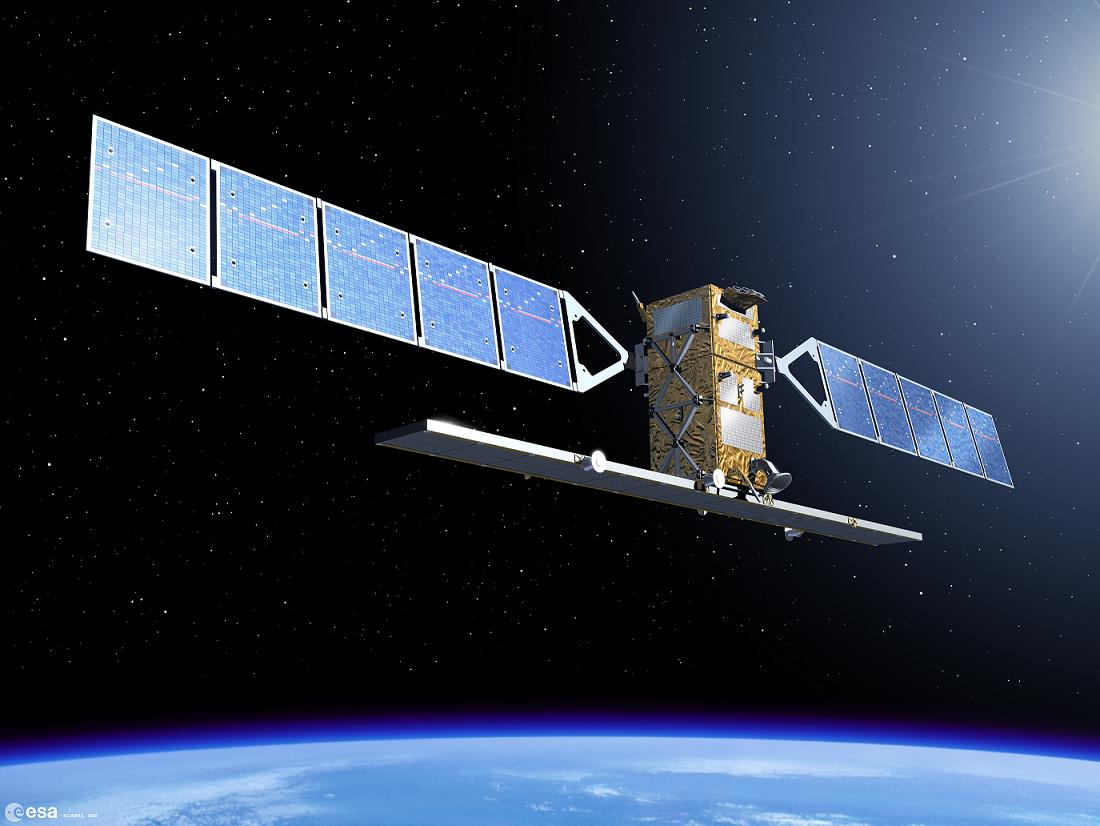
Credits: ESA – P.Carril


The European Union’s Global Monitoring for Environment and Security (GMES) initiative was born as the result of a growing need for accurate and accessible information about the environment, the effects of climate change, and civil security. GMES uses as its main information feed the data collected by satellites developed by ESA. Data is also collected by instruments carried by aircraft, floating in the ocean, or located on the ground.


GMES provides services that can be grouped into five main categories: land management, marine environment, atmosphere, aid emergency response, and security.


There are five Sentinel missions designed as components of the GMES initiative. These missions will complement the national initiatives of the EU members involved. The missions will collect data for land and ocean monitoring, and atmospheric composition monitoring, making use of all-weather radar and optical imaging. Each of the Sentinel missions is based on a constellation of two satellites.


Sentinel-1 is an all-weather radar-imaging mission. The satellites will have polar orbits and collect data for the GMES land and ocean services. The first satellite is scheduled for launch in 2012. Sentinel-1 will ensure the continuity of Synthetic Aperture Radar (SAR) applications, taking over from systems carried by ERS-1, ERS-2, Envisat, and Radarsat. Sentinel-1 satellites will be carried to orbit by Soyuz launch vehicles lifting off from Kourou.


Sentinel-2 will provide high-resolution multi-spectral imagery of vegetation, soil, and water, and will cover inland waterways and coastal areas. Sentinel-2 is designed for the data continuity of missions like Landsat or SPOT (Satellite Pour l’Observation de la Terre). Each satellite will carry a Multi-Spectral Imager (MSI) that can ‘see’ in thirteen spectral bands spanning from the visible and near infrared (VNIR) to the shortwave infrared (SWIR). The first Sentinel-2 is planned to launch in 2013. Vega will provide launch services for Sentinel-2 missions.


Credits: ESA – P.Carril


Sentinel-3 will determine parameters such as sea-surface topography and sea and land surface temperature. It will also determine ocean and land colour with high accuracy. The first Sentinel-3 satellite is expected to reach orbit in 2013. The spacecraft bus has a three-meter accuracy real-time orbit determination capability based on GPS and Kalman filtering.


Sentinel-4 is devoted to atmospheric monitoring and it will consist of payloads carried by Meteosat Third Generation (MTG) satellites that are planned to launch in 2017 and 2024. Sentinel-5 will be used for atmospheric monitoring as well. The payload will be carried by a post-EUMETSAT Polar System (EPS) spacecraft, planned to launch in 2020. A Sentinel-5 precursor will ensure that no data gap will exist between the Envisat missions and Sentinel-5.


You can find out more about the GMES initiative and the Sentinel missions on a dedicated page on ESA’s website.


  • Facebook
  • Google
  • Slashdot
  • Reddit
  • Live
  • TwitThis