OrbitalHub

The place where space exploration, science, and engineering meet

Domain is for sale. $50,000,000.00 USD. Direct any inquiries to contact@orbitalhub.com.


Credits: NASA


Forty years ago, on January 16, 1969, two Russian spacecraft (Soyuz 4 and Soyuz 5) carried out the first docking between two manned spacecraft and transfer of crew between the craft.


The Soyuz 4/5 mission was a critical milestone for the future of manned space missions, the rendezvous and docking of manned spacecraft being essential for the development of space stations.


Soyuz 4 was launched on January 14, 1969, with cosmonaut Vladimir Shatalov on board. Soyuz 5 was launched one day later. Soyuz 5 had three cosmonauts on board: Boris Volynov, Alexei Yeliseyev, and Yevgeny Khrunov. During the mission, Soyuz 5 acted as the passive ship, while Soyuz 4 was the active chaser craft.


The two spacecraft docked at 0820 UT over the Soviet territory. The docking mechanism did not connect the pressurized modules of the Soyuz spacecraft and two of the cosmonauts on board Soyuz 5, Yevgeny Khrunov and Alexei Yeliseyev, performed EVAs in order to transfer to Soyuz 4.


Credits: NASA/R.F.Gibbons


Soyuz 4 and 5 undocked after three hours and thirty-five minutes.


Soyuz 4 fired its retro-rockets on January 17 and landed somewhere near Karaganda, in Kazakhstan.


Soyuz 5 had an eventful landing. After the retro-fire, the instrument module failed to separate from the descent module, and the landing could have been catastrophic due to the fact that the heat shield was not oriented properly.


However, the re-entry heat caused the propellant tanks in the instrument module to explode and the two modules eventually separated. The parachute had problems deploying properly and a failure of the soft-landing rockets occurred, so the landing was much harder than usual. Apparently, the landing shock was so great that Boris Volynov was thrown across the cabin and broke some of his front teeth.


Volynov landed far off course, in the Ural Mountains near Orenburg, in Russia. The event was kept secret and it eventually came to light in 1997, when an official history book mentioned the incident.


Forty years later, the Soyuz spacecraft is still the workhorse of the Russian space program, and continues to this day to serve as a transfer vehicle to and from the International Space Station (ISS), performing rendezvous and docking maneuvers on each mission.


  • Facebook
  • Google
  • Slashdot
  • Reddit
  • Live
  • TwitThis


Credits: ESA/CNES/ARIANESPACE-Service Optique CSG 2002


Arianespace accounted for 50 percent of all commercial launches to geostationary transfer orbit during 2008 and retained its strong market share, which represented 72 percent of the orders booked in 2008.


Arianespace was founded in 1980. Among its 23 shareholders are the French space agency CNES with thirty-four percent and EADS Astrium with thirty percent. With only around 300 employees, the company has generated sales of about one billion euros in 2008.


2009 will be the year of the launcher family for Arianespace, as Arianespace Chairman and CEO Jean-Yves Le Gall pointed out during the company’s New Year’s press conference in Paris. The development of the Vega launcher is being finalized, the maiden launch of the medium-lift Soyuz launcher from Kourou in French Guiana will take place this year, and more than six missions are scheduled for Ariane 5.


“As a result of our launcher family strategy, Arianespace has a sustained agility that allows us to be ever more responsive to our customers,” Le Gall told the journalists. “The agility has been demonstrated with our 28 consecutive mission successes for Ariane 5 and the 21 for Soyuz – and is underscored by launches that are on target, and on time.”


With a full range of payload lift capabilities, including Vega, Soyuz, and Ariane 5, Arianespace is able to meet the changing trends in satellite weights, orbiting everything from light weight scientific payloads to heavy telecommunication relay platforms.


  • Facebook
  • Google
  • Slashdot
  • Reddit
  • Live
  • TwitThis
01-8-09

Taurus II and Cygnus

Posted by


Credits: NASA


Orbital will employ its Taurus II medium-lift launch vehicle and the Cygnus spacecraft in order to service the International Space Station (ISS) under the Commercial Resupply Services (CRS) contract.


Orbital is one of the two companies awarded CRS contracts under the Commercial Orbital Transportation Services Project (COTS).


NASA announced the COTS project on January 18, 2006. The purpose of the program is to stimulate the development of access to low Earth orbit (LEO) in the private sector. At the time, with the imminent retirement of the Space Shuttle fleet, NASA was faced with the option of buying orbital transportation services on foreign launch systems: the Russian Soyuz / Progress, the European Ariane 5 / ATV, or the Japanese H-II / HTV.


Another factor taken into consideration by NASA was that competition in the free market could lead to the development of more efficient and affordable launch systems compared to launch systems that a government agency could build and operate.


Credits: Orbital


Orbital relies on proven experience in launch vehicle technology. Taurus II is designed to provide low-cost and reliable access to space, and it uses systems from other members of Orbital’s family of successful launchers: Pegasus, Taurus, and Minotaur.


Taurus II is a two-stage launch vehicle that can use an additional third stage for achieving higher orbits. The payloads handled by Taurus II can have a mass of up to 5,400 kg.


Orbital is responsible for overall development and integration of the first stage. The two AJ26-62, designed and produced by Aerojet and Orbital, are powered by liquid oxygen and kerosene. The core design is driven by NPO Yuzhnoye, the designer of the Zenit launchers.


The AJ26-62 engines are basically the NK-33 engines designed by the Kuznetsov Design Bureau for the Russian N-1 launch vehicle, and remarketed by Aerojet under a new designation.


The second stage uses an ATK Castor-30 solid motor with thrust vectoring. This stage evolved from the Castor-120 solid stage.


The optional third stage is developed by Orbital. The stage was dubbed the Orbit Raising Kit (ORK) and it uses a helium pressure regulated bi-propellant propulsion system powered by nitrogen tetroxide and hydrazine. ORK evolved from the Orbital STAR Bus. Because it is a hypergolic stage, it allows several burns to be performed in orbit, and can be used for high-precision injections using various orbital profiles.


Credits: Orbital


Cygnus will only have cargo capability and will be able to deliver up to 2,300 kg of pressurized or un-pressurized cargo to the ISS. The spacecraft will also be able to return up to 1,200 kg of cargo from ISS to Earth.


The two components of the Cygnus spacecraft will be the service module and the cargo module.


The service module is based on the Orbital STAR bus (like the ORK stage), and will use two solar arrays for producing electrical power for the navigation systems onboard.


The pressurized cargo module is based on the Italian-built Multi-Purpose Logistics Module (MPLM). The un-pressurized cargo module is based on NASA’s ExPRESS Logistics Carrier.


Cygnus will not dock to the ISS in the same manner as the European ATV, but it will be able to maneuver close to the ISS where the Canadarm 2 robotic arm will be used to capture it and berth it to the Node 2 module, similar to the Japanese HTV or SpaceX’s Dragon spacecraft.


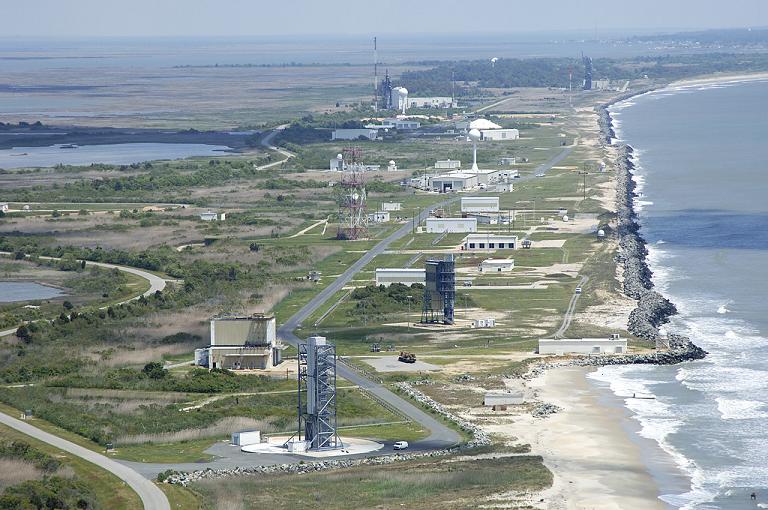
The Mid-Atlantic Regional Spaceport (MARS), located at NASA’s Wallops Island Flight Facility on Virginia’s Eastern shore, was chosen by Orbital to serve as the base of operations for the Taurus II launch vehicle.


MARS has two FAA licensed launch pads for LEO access. MARS also offers access to suborbital launchers, vehicle and payload storage, and processing and launch facilities.


Credits: NASA


Due to the location of the spaceport, latitude 37.8 degrees N, longitude 75.5 degrees W, optimal orbital inclinations for the launches performed at MARS are between 38 and 60 degrees. Polar and retrograde orbits can also be serviced with additional in-flight maneuvering.


The first flight of Orbital’s new Taurus II / Cygnus launch system under COTS is scheduled for late 2010.


  • Facebook
  • Google
  • Slashdot
  • Reddit
  • Live
  • TwitThis


Credits: ESA – S. Corvaja 2007


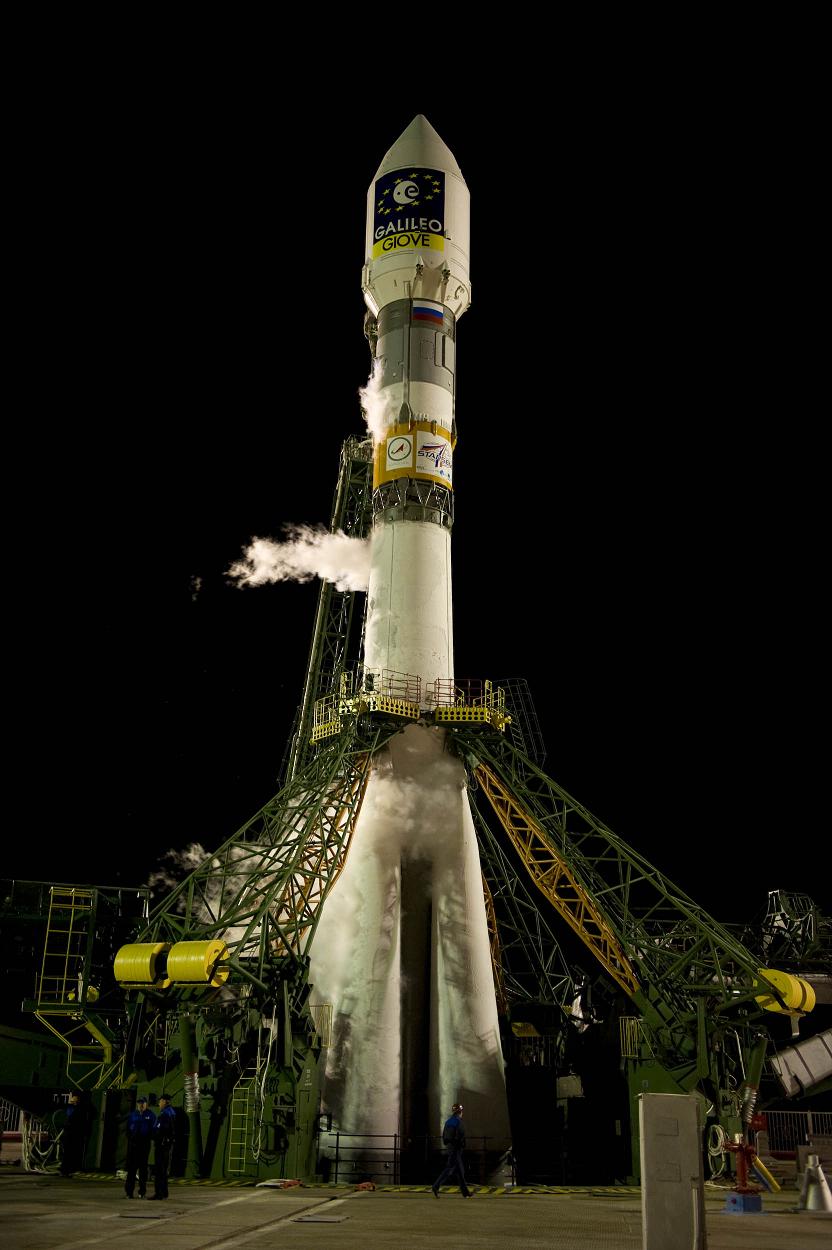
CNES and ESA signed the development contract to build the launch facilities for Soyuz at the Guiana Space Centre on July 19, 2005. The Soyuz launcher will give Europe medium-lift capability and will complete the range of launchers operated by Arianespace, which includes the Ariane 5 heavy-lift launcher and the Vega small launcher.


The Soyuz launchers that will liftoff from Kourou have a number of improvements: an updated digital flight control system, an increased-performance third stage, and the larger Soyuz ST payload fairing.


The launcher has a length of 46.2 meters, a diameter of 10.3 meters, and a liftoff mass of 308 tons. Due to the position of the launch site, close to the equator, the payload capacity of the launcher has increased significantly: 3,150 kg to a geostationary orbit, and 4,900 kg to a sun-synchronous orbit, with a circular altitude of 820 km.


Soyuz is a reliable, four-stage launch vehicle, which has been in production since 1957 and has accounted for more than 1,700 missions to date.


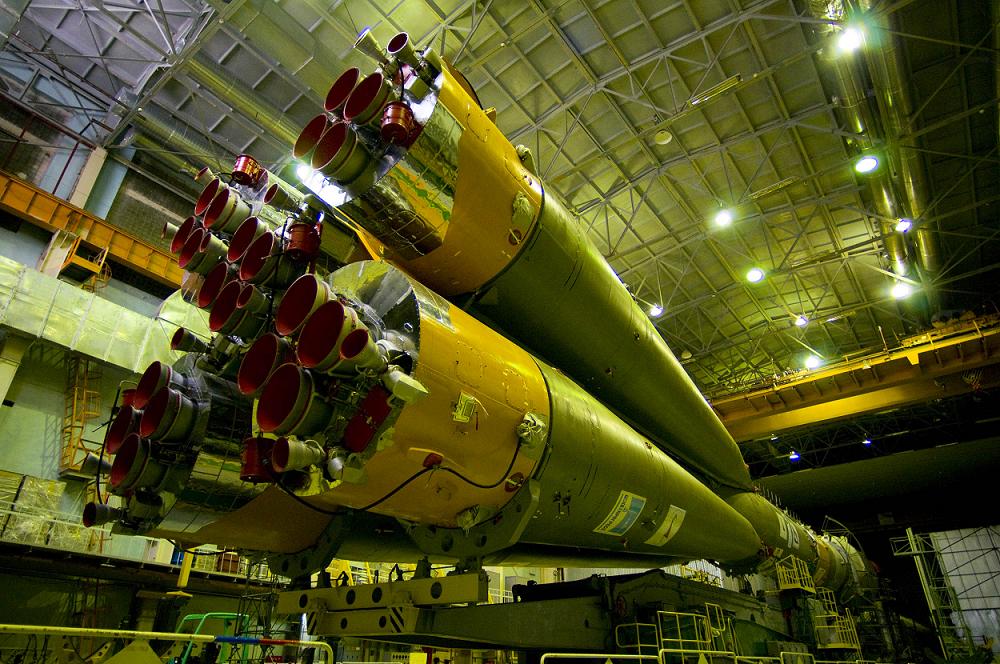
The first stage is composed of the four boosters that are assembled around the central core of the launcher. The RD-107A engines installed on the boosters use liquid oxygen and kerosene as propellant combination. Each engine has four combustion chambers and four nozzles. One aerofin and two movable vernier thrusters per engine are used for the three-axis flight control.


Credits: ESA – S. Corvaja 2008


The second stage consists of the central core surrounded by the boosters. It uses the same propellant combination for powering the RD-108A engine with four combustion chambers and nozzles.


Four vernier thrusters are used for three-axis flight control, after the boosters of the first stage are jettisoned during flight.


The engines of the first two stages are ignited 20 seconds before liftoff. The reason for this is that the launch procedures include monitoring the engine health parameters just before liftoff, while the engines are operating at an intermediate level of thrust. This reminds me of the SpaceX Falcon 1 booster launch procedures. SpaceX engineers perform a similar monitoring procedure for the Merlin engine just before the Falcon 1 liftoff.


The third stage utilizes a RD-0124 engine, also powered by liquid oxygen and kerosene. The liquid oxygen and kerosene tanks are pressurized using helium stored in vessels located in the liquid oxygen tank. The avionics module of the launcher is carried by this stage. The new flight control system improves the accuracy and the control capability for the launcher, as additional flight control authority is needed for the enlarged payload fairing.


Credits: ESA – S. Corvaja 2008


The upper stage of the Soyuz launcher is called Fregat. Fregat is an autonomous and flexible upper stage with its own guidance, navigation, control, tracking, and telemetry systems. It was designed to operate as an orbital vehicle, and it extends the launch capabilities of the Soyuz launcher to medium-Earth orbits, Sun-synchronous orbits, geostationary transfer orbits, and Earth escape trajectories.


The Fregat stage can be restarted up to 20 times in flight, it can provide three-axis stabilization, and perform a spin-up of the spacecraft payload. Fregat uses a bi-propellant propulsion system: UDMH (unsymmetrical dimethylhydrazine) and NTO (nitrogen tetroxide).


The payload fairing is the most visible change to the Soyuz launcher. The new Soyuz fairing has a diameter of 4.11 meters and a length of 11.4 meters. The fairing is based on the configuration used for Ariane 4 vehicles.


The construction of the Soyuz launch base in French Guiana started in early 2007. At the groundbreaking ceremony on February 26, 2007, a number of European space industry officials were present: Jean-Jacques Dordain – ESA Director General, Yannick d’Escatha – President of CNES, Jean-Yves Le Gall – Director General of Arianespace, and Anatoly Perminov – Head of Roscosmos.


In 2007, Arianespace ordered four Soyuz launchers for the early launch missions that are scheduled for the second half of 2009. A contract was also signed in September 2008 for 10 more Soyuz launch vehicles.


The Soyuz launch missions that are scheduled for 2009 signal the beginning of a new chapter in ESA-Russian relations. Stay tuned for more information about the Soyuz launches from French Guiana!


  • Facebook
  • Google
  • Slashdot
  • Reddit
  • Live
  • TwitThis