OrbitalHub

The place where space exploration, science, and engineering meet

Domain is for sale. $50,000,000.00 USD. Direct any inquiries to contact@orbitalhub.com.


Credits: SpaceX


NASA has awarded two International Space Station (ISS) Commercial Resupply Services (CRS) contracts to Space Exploration Technologies (SpaceX) and Orbital Sciences Corporation (Orbital).


NASA has ordered eight flights valued at about $1.9 billion from Orbital and twelve flights valued at about $1.6 billion from SpaceX.


The maximum potential value of each contract is roughly $3.1 billion. Based on known requirements, the value of both contracts combined is projected at $3.5 billion.


Credits: Orbital


The awarded contracts are fixed-price indefinite delivery, indefinite quantity contracts. They will begin January 1, 2009, and are effective through December 31, 2016. SpaceX and Orbital each will have to deliver a minimum of twenty metric tons of cargo to the space station, and they will also have to deliver non-standard services in support of the cargo resupply, including analysis and special tasks as the government deems necessary.


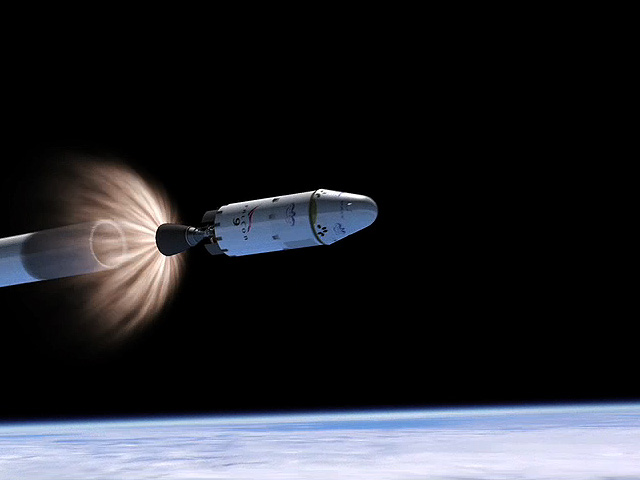
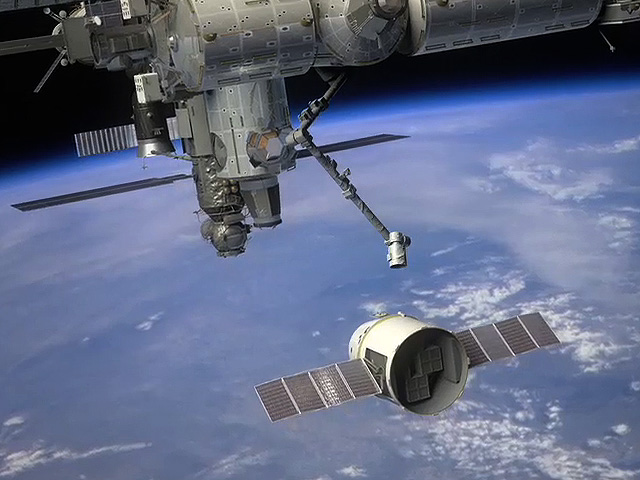
SpaceX will service the ISS with its Falcon9/Dragon system.


“The SpaceX team is honored to have been selected by NASA as the winner of the Cargo Resupply Services contract,” said Elon Musk, CEO and CTO, SpaceX. “This is a tremendous responsibility, given the swiftly approaching retirement of the Space Shuttle and the significant future needs of the Space Station. This also demonstrates the success of the NASA COTS program, which has opened a new era for NASA in US Commercial spaceflight.”


Orbital will employ the Taurus IITM medium-lift launch vehicle and the CygnusTM maneuvering space vehicle.


“We are very appreciative of the trust NASA has placed with us to provide commercial cargo transportation services to and from the International Space Station, beginning with our demonstration flight scheduled in late 2010,” said Mr. David W. Thompson, Orbital’s Chairman and Chief Executive Officer. “The CRS program will serve as a showcase for the types of commercial services U.S. space companies can offer NASA, allowing the space agency to devote a greater proportion of its resources for the challenges of human spaceflight, deep space exploration and scientific investigations of our planet and the universe in which we live.”


Both Orbital and SpaceX have issued press releases with more details about the CRS contracts.


  • Facebook
  • Google
  • Slashdot
  • Reddit
  • Live
  • TwitThis


Credits: SpaceX


Another critical milestone has been reached by SpaceX with the arrival of Falcon 9 hardware at Cape Canaveral.


After the full mission-length firing test of the Falcon 9 first stage engines and the firing test of the Dragon maneuvering thruster, the arrival of the Falcon 9 first stage fuel tank fulfills SpaceX’s commitment to having Falcon 9 hardware at Cape Canaveral by year-end.


“Christmas has arrived a few days early for our team at the Cape,” said Brian Mosdell, Director of Florida Launch Operations for SpaceX. “The packages measure extra large this year, and they will keep everyone busy in the coming weeks.”


All of the Falcon 9 elements and the ground support hardware have already left the SpaceX manufacturing facility in Hawthorne, California. The hardware will make its way to the launch site at Cape Canaveral over the next two weeks. The Falcon 9 will then be assembled on horizontal and raised to vertical on the custom built erector.


Credits: SpaceX


There are four Falcon 9 launches scheduled for 2009. Two of these launches are demonstration flights with the Dragon spacecraft as part of the NASA Commercial Orbital Transportation Services (COTS) competition. A total of three flights of the Falcon 9/Dragon launch system will be conducted under the agreement, in order to demonstrate cargo delivery capability to the International Space Station (ISS).


NASA’s agreement with SpaceX can be extended to include demonstrating transport of crew to and from the ISS.


“2008 has been a year of rapid progress for SpaceX,” said Elon Musk, CEO and CTO of SpaceX. “The delivery of the Falcon 9 to the Cape is a major milestone in designing and deploying the most reliable, cost-efficient fleet of launch vehicles in the world. I applaud our SpaceX team who has worked 24/7 to make this happen.”


SpaceX has made available a video of Elon Musk giving a tour of the SpaceX Falcon 9 launch site at Space Launch Complex 40, Cape Canaveral AFS, Florida.


  • Facebook
  • Google
  • Slashdot
  • Reddit
  • Live
  • TwitThis


Credits: NASA


The propulsion division of SpaceX has performed another important test. After the test of the Falcon 9’s first stage Merlin engines, the smallest engine of the SpaceX family, Draco, has been put to test.


During the test, the thruster fired for ten minutes, paused for ten minutes, and then was restarted for an additional minute.


The test was performed on a new vacuum test stand built by SpaceX, and put into operation in March 2008 at the SpaceX Test Facility outside McGregor, Texas.


“Draco performed perfectly during the entire test, with expected temperatures and excellent performance,” said David Giger, Propulsion Manager, SpaceX. “We also broke the SpaceX record for longest continuous burn previously held by Kestrel, the Falcon 1 second stage engine.”


The Dragon spacecraft uses eighteen Draco thrusters for orbital maneuvering, attitude control, and to initiate the atmospheric re-entry. Each Draco thruster can deliver up to 400N of force. The thruster is powered by a combination of mono methyl hydrazine (MMH) and nitrogen tetroxide (NTO), which is the same bipropellant used by the orbital maneuvering system (OMS) of the Space Shuttle.


Credits: NASA


MMH and NTO are used as propellants because they have long on-orbit lifetimes. This will allow the Dragon spacecraft to perform longer missions to the International Space Station (ISS). The goal is to use the spacecraft as an emergency escape capsule for the crew working on the ISS.


SpaceX has released a video of the Draco thruster vacuum firing.


  • Facebook
  • Google
  • Slashdot
  • Reddit
  • Live
  • TwitThis


Credits: SpaceX


The nine Merlin engines that power the first stage of the Falcon 9 launcher have been successfully tested. At the McGregor Test Facility in Texas, a full mission-length firing test of the first stage of the launcher was conducted on November 22, 2008. The engines, fired for 178 seconds, consumed over half a million pounds of propellant.


During the last eighteen seconds of the test, two of the engines were shut down in order to test the ability of the first stage to complete a mission in the event of an engine being lost during flight.


According to SpaceX CEO, Elon Musk, the first liftoff of a Falcon 9 launcher from Cape Canaveral will occur in 2009.


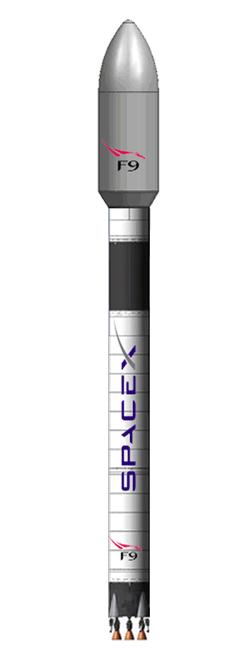
Falcon 9 is a two-stage launch vehicle. It is powered by liquid oxygen and rocket grade kerosene. Nine Merlin engines power the first stage of the launcher. The second stage of the Falcon 9 launcher is powered by one Merlin engine.


Falcon 9 has a length of 54.9 m, a diameter of 3.6 m, and can have a mass of 333,400 kg for a low Earth orbit (LEO) mission, and 332,800 kg for a geosynchronous transfer orbit (GTO) mission. It can inject 12,500 kg payloads into LEO (200 km) and 4,640 kg payloads into GTO (185×35,788 km). SpaceX will charge $36.75M for a LEO mission, and $46.75M for a trans-lunar injection (TLI) mission. For GTO missions, the price ranges from $36.75M to $57.75M.


For more details about the Falcon 9 launcher, you can visit the Falcon 9 overview web page on the SpaceX web site.


Check out the video with the 3 minute test of the Merlin engines on the SpaceX web site.


  • Facebook
  • Google
  • Slashdot
  • Reddit
  • Live
  • TwitThis