OrbitalHub

The place where space exploration, science, and engineering meet

Domain is for sale. $50,000,000.00 USD. Direct any inquiries to contact@orbitalhub.com.

11-4-14

Antares Explosion Updates

Posted by
Credits: NASA/Joel Kowsky


Orbital’s statement regarding the ORB-3 launch mishap:

(Dulles, VA 28 October 2014) – Orbital Sciences Corporation (NYSE: ORB), one of the world’s leading space technology companies, confirms that today’s Antares rocket launch from NASA’s Wallops Flight Facility was not successful. Shortly after lift-off from the Mid-Atlantic Regional Spaceport Pad 0A at 6:22 p.m. (EDT), the vehicle suffered a catastrophic failure. According to NASA’s emergency operations officials, there were no casualties and property damage was limited to the south end of Wallops Island. Orbital has formed an anomaly investigation board, which will work in close coordination with all appropriate government agencies, to determine the cause of today’s mishap.


“It is far too early to know the details of what happened,” said Mr. Frank Culbertson, Orbital’s Executive Vice President and General Manager of its Advanced Programs Group. “As we begin to gather information, our primary concern lies with the ongoing safety and security of those involved in our response and recovery operations. We will conduct a thorough investigation immediately to determine the cause of this failure and what steps can be taken to avoid a repeat of this incident. As soon as we understand the cause we will begin the necessary work to return to flight to support our customers and the nation’s space program.”


Orbital will provide more information as it becomes available and is verified.


Orbital’s update on October 29:

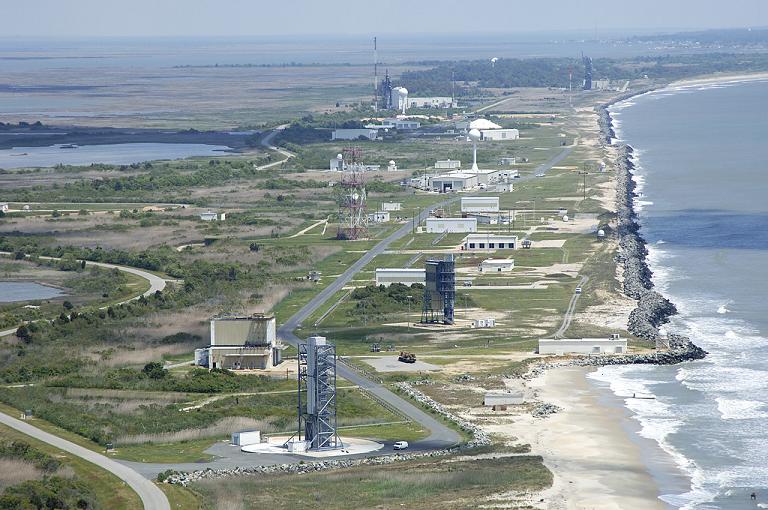
Early this morning, range officials performed an aerial survey of the launch facilities and surrounding areas at NASA’s Wallops Flight Facility where yesterday’s failure of the Antares rocket occurred after it lifted off from the Mid-Atlantic Regional Spaceport’s Pad 0A. Shortly after, a team of representatives from NASA, MARS and Orbital entered the launch site to perform a preliminary assessment of the launch complex and related facilities. The overall findings indicate the major elements of the launch complex infrastructure, such as the pad and fuel tanks, avoided serious damage, although some repairs will be necessary. However, until the facility is inspected in greater detail in the coming days, the full extent of necessary repairs or how long they will take to accomplish will not be known.


NASA has posted aerial views of the launch pad taken earlier today here.


Also today, Orbital made progress forming a permanent Accident Investigation Board (AIB) comprised of company officials, along with representatives from NASA and the NTSB, with the FAA providing overall oversight of the process. Initially, Mr. Rich Straka, Senior Vice President and Deputy General Manager of Orbital’s Launch Systems Group, served as the interim chairman to begin the investigation process immediately after the launch mishap. Today, Orbital appointed Mr. Dave Steffy, Senior Vice President and Chief Engineer of the company’s Advanced Programs Group, a highly experienced engineer well-versed in launch vehicle engineering and operations, to serve as the permanent chairman of the AIB.


No follow-on press conferences are planned at this time. Further updates on the situation and the progress of the ongoing investigation will be provided as they are available.


Orbital’s update on October 30:

Launch Site Status:

Based on initial sweeps conducted by an Orbital safety team, it appears a significant amount of debris remains on the site and it is likely substantial hardware evidence will be available to aid in determining root cause of the Antares launch failure. Some of the Cygnus cargo has also been found and will be retrieved as soon as we have clearance to do so to see if any survived intact. After up close visual inspections by the safety team, it still appears the launch site itself avoided major damage. There is some evidence of damage to piping that runs between the fuel and commodity storage vessels and the launch mount, but no evidence of significant damage to either the storage vessels or launch mount. Detailed evaluations by MARS and their engineering team will occur in the next couple of days. An Orbital-led team has begun cataloging and documenting the location of all pieces of debris over the next several days after which the debris will be relocated to storage bays on the island for further evaluation.


Antares Data Review:

Telemetry data has been released to Orbital and our engineers presented a very quick look assessment to the Accident Investigation Board at the end of the day. It appears the Antares vehicle had a nominal pre-launch and launch sequence with no issues noted. All systems appeared to be performing nominally until approximately T+15 seconds at which point the failure occurred. Evidence suggests the failure initiated in the first stage after which the vehicle lost its propulsive capability and fell back to the ground impacting near, but not on, the launch pad. Prior to impacting the ground, the rocket’s Flight Termination System was engaged by the designated official in the Wallops Range Control Center.


Orbital’s update on November 3:

Over the weekend, Orbital confirmed the participation of the following individuals who will serve on the Antares launch failure Accident Investigation Board (AIB), which is being led by Orbital under the oversight of the Federal Aviation Administration (FAA). The composition of the AIB is as follows:

Chairman: David Steffy, Chief Engineer of Orbital’s Advanced Programs Group.

Members: David Swanson, Senior Director of Safety and Mission Assurance for Orbital’s Technical Operations organization; Wayne Hale, Independent Consultant and Former NASA Space Shuttle Program Manager; David Cooper, Member of Orbital’s Independent Readiness Review Team for the company’s Launch Systems Group; Eric Wood, Director of Propulsion Engineering for Orbital’s Launch Systems Group; Tom Costello, Launch Vehicle Assessment Manager in the International Space Station Program at NASA’s Johnson Space Center; Matt Lacey, Senior Vehicle Systems Engineer for NASA’s Launch Services Program.

FAA Oversight Team: Michael S. Kelly, Chief Engineer, FAA Office of Commercial Space Transportation; Marcus Ward, Mishap Response Coordinator, FAA Office of Commercial Space Transportation.


Antares Data Review:

The AIB is initially focused on developing a “fault tree” and a timeline of the important events during the launch sequence. Due to the large amount of data available, the AIB is able to work with a rich source of information about the launch. One of the initial tasks for the AIB is to reconcile the data from multiple sources, a process that is now underway, to help create the launch sequence timeline.


Launch Site Status:

Over the weekend, Orbital’s Wallops-based Antares personnel continued to identify, catalogue, secure and geolocate debris found at the launch site in order to preserve physical evidence and provide a record of the launch site following the mishap that will be useful for the AIB’s analysis and determination of what caused the Antares launch failure. The debris is being taken to a NASA facility on Wallops Island for secure and weather resistant storage.


  • Facebook
  • Google
  • Slashdot
  • Reddit
  • Live
  • TwitThis


NASA dixit:

“Carrying more than 3,000 pounds of food, supplies, spare parts and experiments, Orbital Sciences Corporation’s Cygnus cargo ship arrived at the International Space Station July 16, where it was grappled by Expedition 40 Commander Steve Swanson backed up by European Space Agency Flight Engineer Alexander Gerst. The pair operated the Canadarm2 robotic arm from the station’s cupola to snag Cygnus before robotic ground controllers admission control in Houston initiated its installation onto the Earth-facing port of the Harmony module where it would be bolted in place for a month-long stay. Cygnus was launched July 13 atop Orbital’s Antares rocket from the Mid-Atlantic Regional Spaceport’s Launch Pad 0A at Wallops Flight Facility, Virginia for the second contracted commercial resupply flight for the U.S. firm.”

Credit: NASA


  • Facebook
  • Google
  • Slashdot
  • Reddit
  • Live
  • TwitThis
03-8-10

Kepler Anniversary

Posted by


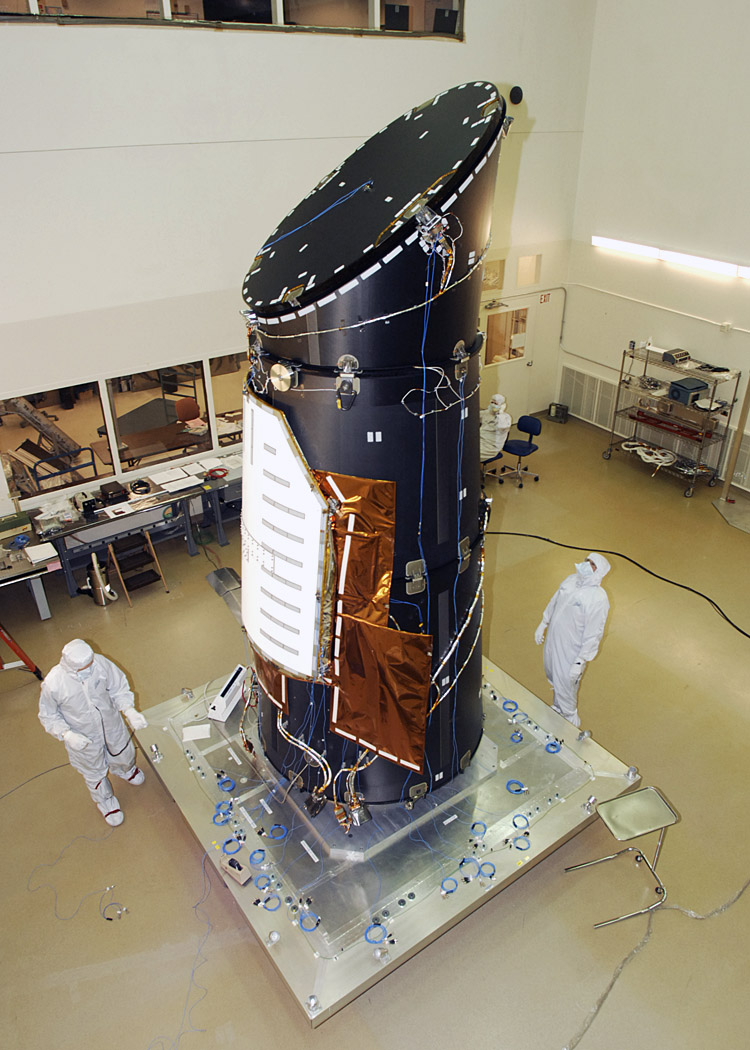
Credits: NASA/Kim Shiflett


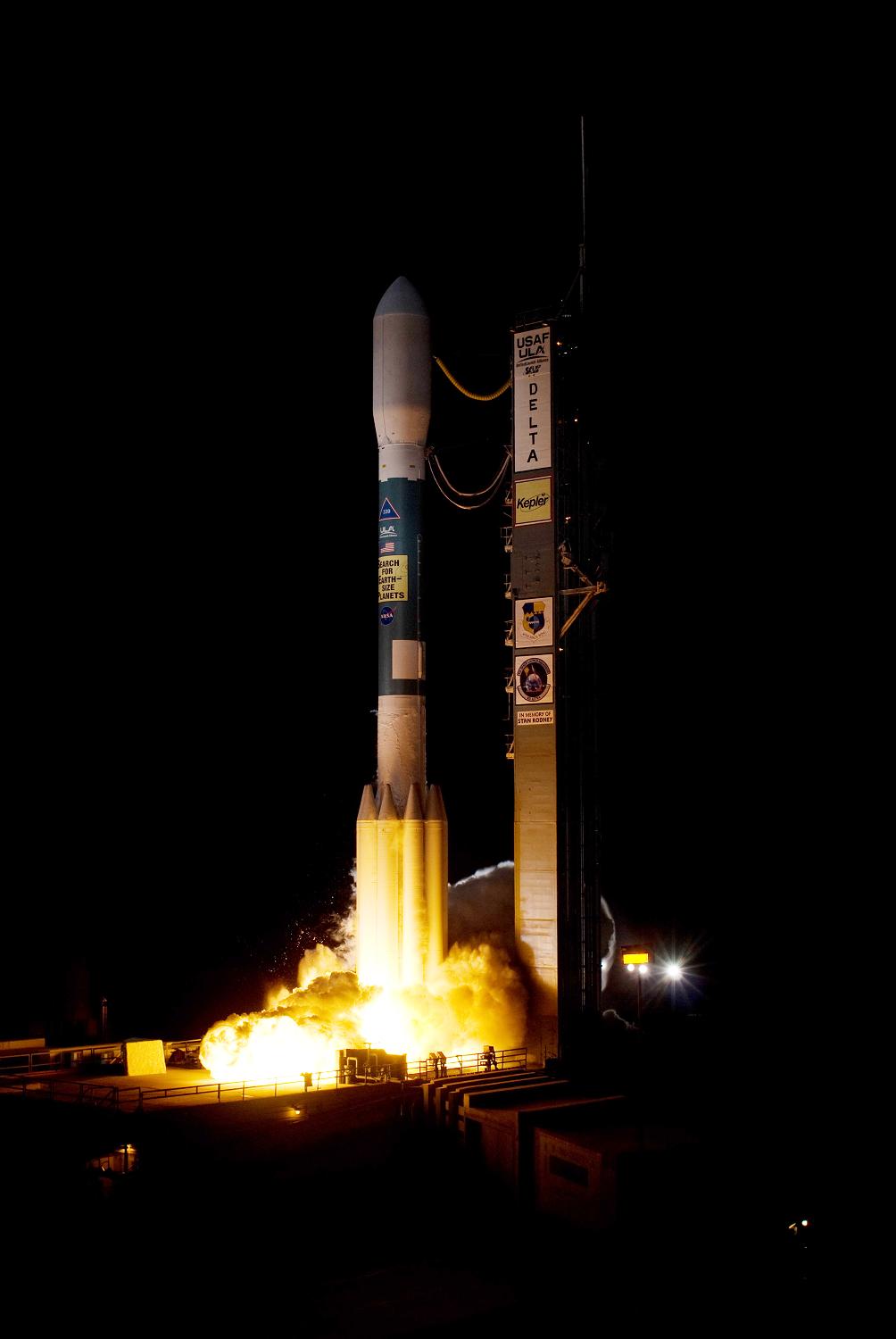
On March 6, 2009, the Delta II launch vehicle carrying the Kepler spacecraft lifted off from Launch Complex 17-B at Cape Canaveral Air Force Station in Florida.


In May 2009, Kepler started to hunt for other Earth-like planets in our galaxy. The technique used by Kepler to discover exo-planets is called transits. The large field of view of the Kepler telescope simultaneously captures the light of a very large number of stars in the Cygnus and Lyra constellations.


Kepler scientists already announced the discovery of five exoplanets named Kepler 4b, 5b, 6b, 7b, and 8b. The data collected by Kepler was also used to detect the atmosphere of the HAT-P-7b giant gas planet.


Kepler is expected to be operational until at least November 2012. Scientists hope to discover exo-planets in the habitable zone of other stars. The habitable zone is a region around a star where water can exist in liquid form on the surface of a planet. You can find more information about Kepler on NASA’s Kepler Mission website.


  • Facebook
  • Google
  • Slashdot
  • Reddit
  • Live
  • TwitThis


Credits: NASA


Kepler is the first NASA mission capable of finding terrestrial exo-planets. Of particular interest are the planets orbiting in the so-called habitable zone, where conditions are met so that liquid water can exist on the surface of the planet.


The observations made so far have brought clear evidence that planets orbiting around other stars are a common thing, rather than the exception to the rule. Due to the limitations of present technology, only gas giants, hot-super Earths in short period orbits, and ice giants have been discovered.


The Kepler mission, part of NASA’s Discovery Program, is designed to survey a portion of our region of the Milky Way. Kepler will survey a large number of stars, and explore the structure and diversity of many planetary systems.


The scientific objectives of the mission are very ambitious: determine the fraction of terrestrial planets in or near the habitable zone, determine the distribution of sizes and the orbits of exo-planets in the surveyed planetary systems, determine reflectivity, size, and density of short-period giant planets, estimate how many planets are in multiple-star systems, and determine the characteristics of the stars that have planets orbiting around them. Scientists hope to discover additional members of the planetary systems surveyed using other indirect techniques.


Credits: NASA/Ball Aerospace


The duration of the mission must be selected to allow the detection and confirm the periodic nature of the planet transits in or near the habitable zone. Due to the characteristics of orbits of such planets, a lifetime of three and a half years (as currently envisioned) would allow a four-transit detection of most orbits up to one year in length and a three-transit detection of orbits of length up to 1.75 years.


The mission lifetime will be extendible to at least six years. The extension will permit the detection of planets smaller than Earth with two-year orbits.


Kepler will be inserted in an Earth-trailing heliocentric orbit, then the spacecraft will slowly drift away from Earth. The selected orbit offers a very stable pointing attitude, and it avoids the high radiation dosage associated with an Earth orbit. However, Kepler will be exposed occasionally to solar flares.


The communication protocol with the spacecraft includes establishing contact twice a week for commanding, health, and status, and science data downlink contact once a month.


Credits: Jon Lomberg


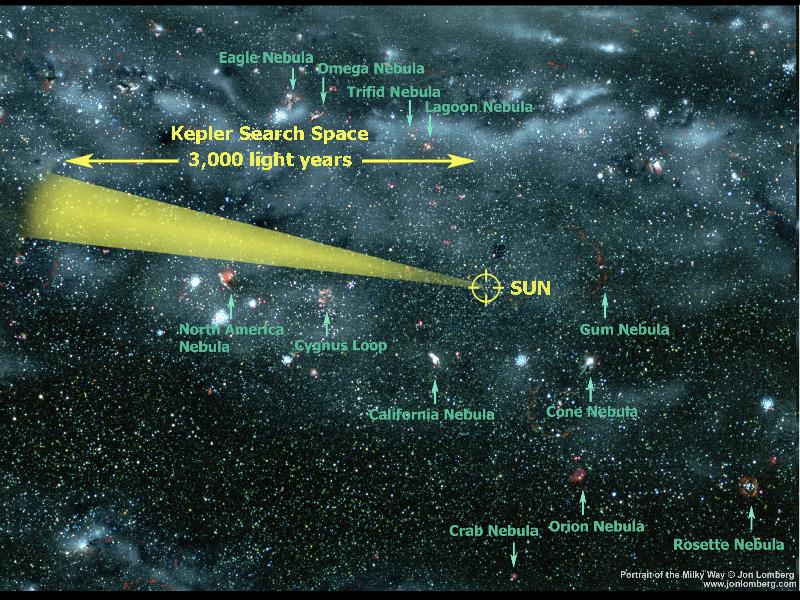
There are two requirements that dictated the selection of the target field. The first requirement is the ability to monitor continuously the stars surveyed because transits last only a fraction of a day. This can be achieved by having the field of view out of the ecliptic plane, so the Sun will not interfere with the observations at any time during the year. The second requirement is to have the largest possible number of stars in the field of view.


To meet both requirements, a region in the Cygnus and Lyra constellations of our galaxy has been selected as the field of view.


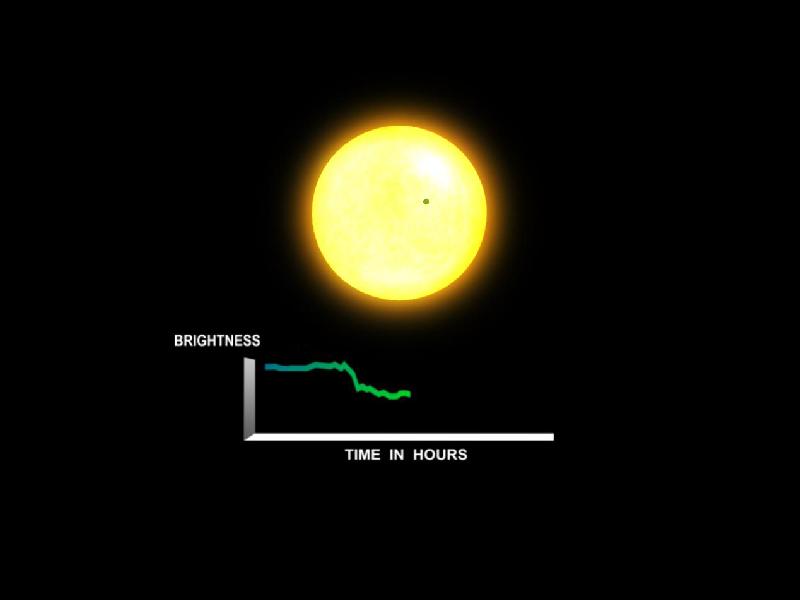
Kepler will use the transit method for detecting exo-planets. The sensitivity of the photometer will allow the discovery of terrestrial exo-planets (planets comparable in size and composition to Earth that are orbiting other stars).


The transit occurs when a planet passes in front of its star as viewed by an observer. Depending on the size of the planet, the change in the brightness of the star has different amplitudes. Transits of terrestrial planets cause a change in the star’s brightness of about 1/10,000, and they last from two to sixteen hours.


Credits: NASA


Changes in star brightness that are produced by a planet transit must be periodic, and all transits produced by the same planet must cause the same variation of brightness and last the same amount of time.


Of course, the case when two or more planets are in transit at the same time must be considered, and this can make the detection method a little bit more complicated.


The method allows for the calculation of the orbit, the mass, and the characteristic temperature of the exo-planet. Once we know the characteristic temperature of an exo-planet, the question of whether or not the planet is habitable (by our standards) can be answered.


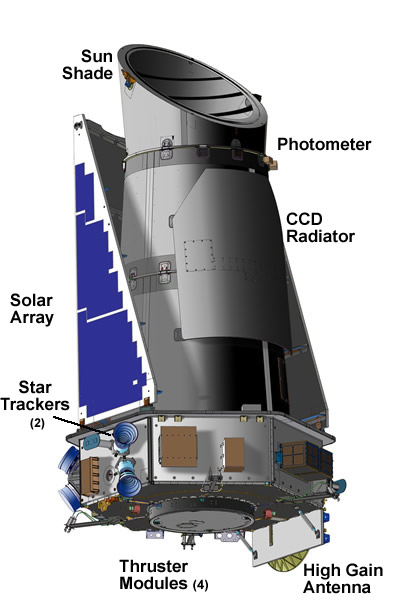
The Kepler instrument is a special telescope called photometer or light meter. The telescope has a very large field of view for an astronomical telescope, 105 square degrees. The primary mirror of the telescope is 0.95 m in diameter. The telescope needs a large field of view because it has to continuously monitor the brightness of more than 100,000 stars for the duration of the mission.


Credits: Ball Aerospace


The photometer is composed of one instrument, which is an array of charge-coupled devices (CCD), 42 in total. Each CCD is 50mm x 25mm and has 2200 x 1024 pixels. Data from the individual pixels that make up each star are recorded continuously and simultaneously.


The primary mirror of the photometer was coated with enhanced silver, which allows more light to reach the telescope’s detectors.


The spacecraft provides power, attitude control, and telemetry for the photometer. The mission requirements contributed to the simple design of the spacecraft. The only moving parts are the reaction wheels used to control the attitude of the spacecraft.


The launcher selected for the mission is Delta II. Delta II is a versatile launcher, and can be configured in two or three-stage vehicles in order to accommodate a variety of requirements.


Ball Aerospace is the prime contractor for the Kepler mission, building the photometer and the spacecraft, as well as managing the system integration and testing of the spacecraft. The Jet Propulsion Laboratory is managing mission development, while NASA Ames Research Center is responsible for ground system development, mission operations, and science data analysis.


Once the first observation results are downloaded from Kepler and made available to scientists, we will be able to place our solar system within the context of planetary systems in our galaxy.


The launch of Kepler is planned for March 5, 2009. For more information about the Kepler mission, you can visit the Kepler mission web page.


  • Facebook
  • Google
  • Slashdot
  • Reddit
  • Live
  • TwitThis
01-8-09

Taurus II and Cygnus

Posted by


Credits: NASA


Orbital will employ its Taurus II medium-lift launch vehicle and the Cygnus spacecraft in order to service the International Space Station (ISS) under the Commercial Resupply Services (CRS) contract.


Orbital is one of the two companies awarded CRS contracts under the Commercial Orbital Transportation Services Project (COTS).


NASA announced the COTS project on January 18, 2006. The purpose of the program is to stimulate the development of access to low Earth orbit (LEO) in the private sector. At the time, with the imminent retirement of the Space Shuttle fleet, NASA was faced with the option of buying orbital transportation services on foreign launch systems: the Russian Soyuz / Progress, the European Ariane 5 / ATV, or the Japanese H-II / HTV.


Another factor taken into consideration by NASA was that competition in the free market could lead to the development of more efficient and affordable launch systems compared to launch systems that a government agency could build and operate.


Credits: Orbital


Orbital relies on proven experience in launch vehicle technology. Taurus II is designed to provide low-cost and reliable access to space, and it uses systems from other members of Orbital’s family of successful launchers: Pegasus, Taurus, and Minotaur.


Taurus II is a two-stage launch vehicle that can use an additional third stage for achieving higher orbits. The payloads handled by Taurus II can have a mass of up to 5,400 kg.


Orbital is responsible for overall development and integration of the first stage. The two AJ26-62, designed and produced by Aerojet and Orbital, are powered by liquid oxygen and kerosene. The core design is driven by NPO Yuzhnoye, the designer of the Zenit launchers.


The AJ26-62 engines are basically the NK-33 engines designed by the Kuznetsov Design Bureau for the Russian N-1 launch vehicle, and remarketed by Aerojet under a new designation.


The second stage uses an ATK Castor-30 solid motor with thrust vectoring. This stage evolved from the Castor-120 solid stage.


The optional third stage is developed by Orbital. The stage was dubbed the Orbit Raising Kit (ORK) and it uses a helium pressure regulated bi-propellant propulsion system powered by nitrogen tetroxide and hydrazine. ORK evolved from the Orbital STAR Bus. Because it is a hypergolic stage, it allows several burns to be performed in orbit, and can be used for high-precision injections using various orbital profiles.


Credits: Orbital


Cygnus will only have cargo capability and will be able to deliver up to 2,300 kg of pressurized or un-pressurized cargo to the ISS. The spacecraft will also be able to return up to 1,200 kg of cargo from ISS to Earth.


The two components of the Cygnus spacecraft will be the service module and the cargo module.


The service module is based on the Orbital STAR bus (like the ORK stage), and will use two solar arrays for producing electrical power for the navigation systems onboard.


The pressurized cargo module is based on the Italian-built Multi-Purpose Logistics Module (MPLM). The un-pressurized cargo module is based on NASA’s ExPRESS Logistics Carrier.


Cygnus will not dock to the ISS in the same manner as the European ATV, but it will be able to maneuver close to the ISS where the Canadarm 2 robotic arm will be used to capture it and berth it to the Node 2 module, similar to the Japanese HTV or SpaceX’s Dragon spacecraft.


The Mid-Atlantic Regional Spaceport (MARS), located at NASA’s Wallops Island Flight Facility on Virginia’s Eastern shore, was chosen by Orbital to serve as the base of operations for the Taurus II launch vehicle.


MARS has two FAA licensed launch pads for LEO access. MARS also offers access to suborbital launchers, vehicle and payload storage, and processing and launch facilities.


Credits: NASA


Due to the location of the spaceport, latitude 37.8 degrees N, longitude 75.5 degrees W, optimal orbital inclinations for the launches performed at MARS are between 38 and 60 degrees. Polar and retrograde orbits can also be serviced with additional in-flight maneuvering.


The first flight of Orbital’s new Taurus II / Cygnus launch system under COTS is scheduled for late 2010.


  • Facebook
  • Google
  • Slashdot
  • Reddit
  • Live
  • TwitThis


Credits: SpaceX


NASA has awarded two International Space Station (ISS) Commercial Resupply Services (CRS) contracts to Space Exploration Technologies (SpaceX) and Orbital Sciences Corporation (Orbital).


NASA has ordered eight flights valued at about $1.9 billion from Orbital and twelve flights valued at about $1.6 billion from SpaceX.


The maximum potential value of each contract is roughly $3.1 billion. Based on known requirements, the value of both contracts combined is projected at $3.5 billion.


Credits: Orbital


The awarded contracts are fixed-price indefinite delivery, indefinite quantity contracts. They will begin January 1, 2009, and are effective through December 31, 2016. SpaceX and Orbital each will have to deliver a minimum of twenty metric tons of cargo to the space station, and they will also have to deliver non-standard services in support of the cargo resupply, including analysis and special tasks as the government deems necessary.


SpaceX will service the ISS with its Falcon9/Dragon system.


“The SpaceX team is honored to have been selected by NASA as the winner of the Cargo Resupply Services contract,” said Elon Musk, CEO and CTO, SpaceX. “This is a tremendous responsibility, given the swiftly approaching retirement of the Space Shuttle and the significant future needs of the Space Station. This also demonstrates the success of the NASA COTS program, which has opened a new era for NASA in US Commercial spaceflight.”


Orbital will employ the Taurus IITM medium-lift launch vehicle and the CygnusTM maneuvering space vehicle.


“We are very appreciative of the trust NASA has placed with us to provide commercial cargo transportation services to and from the International Space Station, beginning with our demonstration flight scheduled in late 2010,” said Mr. David W. Thompson, Orbital’s Chairman and Chief Executive Officer. “The CRS program will serve as a showcase for the types of commercial services U.S. space companies can offer NASA, allowing the space agency to devote a greater proportion of its resources for the challenges of human spaceflight, deep space exploration and scientific investigations of our planet and the universe in which we live.”


Both Orbital and SpaceX have issued press releases with more details about the CRS contracts.


  • Facebook
  • Google
  • Slashdot
  • Reddit
  • Live
  • TwitThis