OrbitalHub

The place where space exploration, science, and engineering meet

Domain is for sale. $50,000,000.00 USD. Direct any inquiries to contact@orbitalhub.com.

01-17-10

Sentinel

Posted by


Credits: ESA – P.Carril


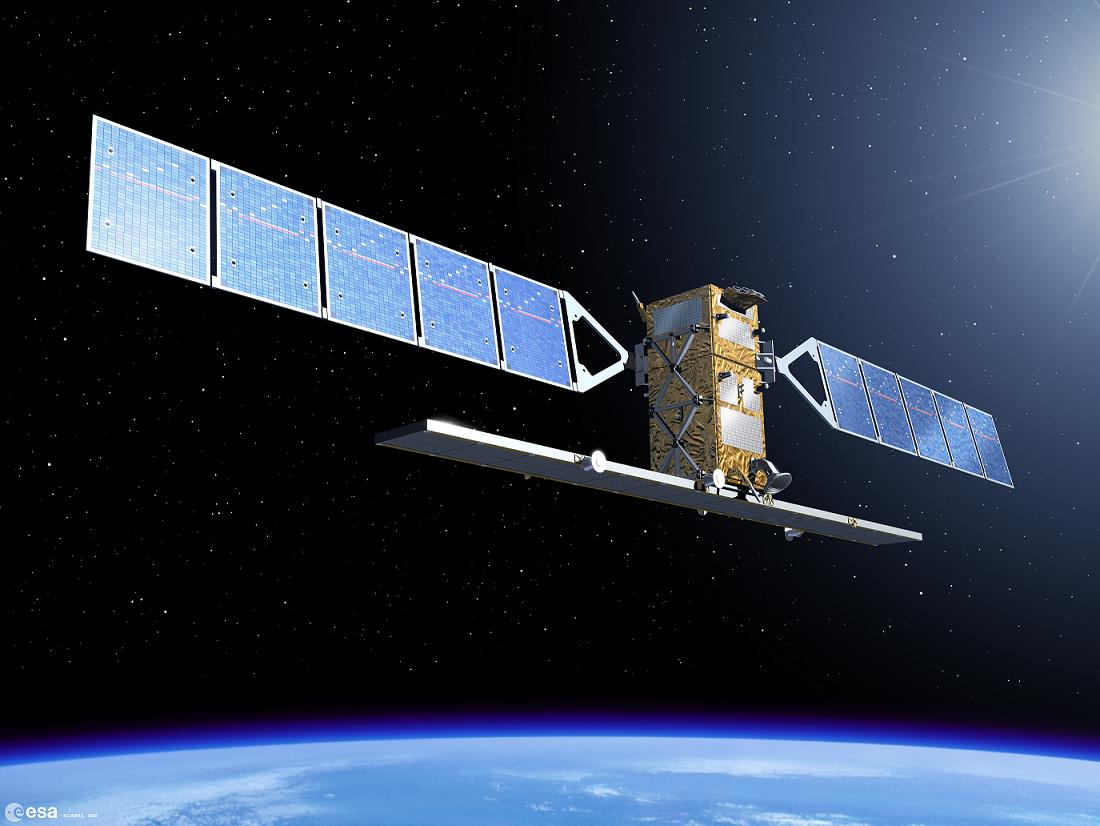
The European Union’s Global Monitoring for Environment and Security (GMES) initiative was born as the result of a growing need for accurate and accessible information about the environment, the effects of climate change, and civil security. GMES uses as its main information feed the data collected by satellites developed by ESA. Data is also collected by instruments carried by aircraft, floating in the ocean, or located on the ground.


GMES provides services that can be grouped into five main categories: land management, marine environment, atmosphere, aid emergency response, and security.


There are five Sentinel missions designed as components of the GMES initiative. These missions will complement the national initiatives of the EU members involved. The missions will collect data for land and ocean monitoring, and atmospheric composition monitoring, making use of all-weather radar and optical imaging. Each of the Sentinel missions is based on a constellation of two satellites.


Sentinel-1 is an all-weather radar-imaging mission. The satellites will have polar orbits and collect data for the GMES land and ocean services. The first satellite is scheduled for launch in 2012. Sentinel-1 will ensure the continuity of Synthetic Aperture Radar (SAR) applications, taking over from systems carried by ERS-1, ERS-2, Envisat, and Radarsat. Sentinel-1 satellites will be carried to orbit by Soyuz launch vehicles lifting off from Kourou.


Sentinel-2 will provide high-resolution multi-spectral imagery of vegetation, soil, and water, and will cover inland waterways and coastal areas. Sentinel-2 is designed for the data continuity of missions like Landsat or SPOT (Satellite Pour l’Observation de la Terre). Each satellite will carry a Multi-Spectral Imager (MSI) that can ‘see’ in thirteen spectral bands spanning from the visible and near infrared (VNIR) to the shortwave infrared (SWIR). The first Sentinel-2 is planned to launch in 2013. Vega will provide launch services for Sentinel-2 missions.


Credits: ESA – P.Carril


Sentinel-3 will determine parameters such as sea-surface topography and sea and land surface temperature. It will also determine ocean and land colour with high accuracy. The first Sentinel-3 satellite is expected to reach orbit in 2013. The spacecraft bus has a three-meter accuracy real-time orbit determination capability based on GPS and Kalman filtering.


Sentinel-4 is devoted to atmospheric monitoring and it will consist of payloads carried by Meteosat Third Generation (MTG) satellites that are planned to launch in 2017 and 2024. Sentinel-5 will be used for atmospheric monitoring as well. The payload will be carried by a post-EUMETSAT Polar System (EPS) spacecraft, planned to launch in 2020. A Sentinel-5 precursor will ensure that no data gap will exist between the Envisat missions and Sentinel-5.


You can find out more about the GMES initiative and the Sentinel missions on a dedicated page on ESA’s website.


  • Facebook
  • Google
  • Slashdot
  • Reddit
  • Live
  • TwitThis
01-10-10

Arianespace 30th Anniversary

Posted by


Credits: ESA/CNES/Arianespace – Optique vidéo du CSG, L. Boyer


Arianespace was founded in 1980. With twenty-four shareholders from ten European countries (among which CNES holds 34% and EADS 30%), Arianespace is the world’s first commercial space transportation company.


The workhorse of Arianespace has been the Ariane launch vehicle.


Five versions of Ariane have served the company so far: Ariane 1, with the first successful launch on December 24, 1979, Ariane 2, launched for the first time on November 20, 1987, Ariane 3, starting its service on August 4, 1984, Ariane 4, launched on June 15, 1988, and Ariane 5, with the first successful flight on October 30, 1997.


The first launch of Ariane 5, a.k.a. Flight 501, ended with the vehicle being destroyed by its automated self-destruct system, after the high accelerations caused the inertial guidance system to crash. The crash was caused by, I quote, one of the most infamous computer bugs in history. If you like, you can take a look at the Ada code that caused the malfunction. But enough with the dark memories, this is an anniversary after all…


Since its inception, Arianespace has signed over 300 contracts that resulted in more than 277 satellite launches. According to Arianespace, Ariane launchers have delivered more than half of all commercial satellites now in service. The year 2009 was a very successful year for Ariane 5. The launcher orbited nine commercial satellites, the Herschel space telescope, the Planck scientific observatory, and the Helios 2B observation satellite. Ariane 5 has proven to be a versatile launch vehicle, capable of handling a wide range of missions.


The challenges for 2010 are many, as Arianespace is planning up to seven Ariane 5 launches. Two new launch vehicles will join Ariane 5 as part of the Arianespace family of launchers: the Vega small launcher and the Soyuz medium launcher.


You can read more about Arianespace, its mission, and the solutions provided to customers around the world on the Arianespace website.


  • Facebook
  • Google
  • Slashdot
  • Reddit
  • Live
  • TwitThis


Credits: Arianespace


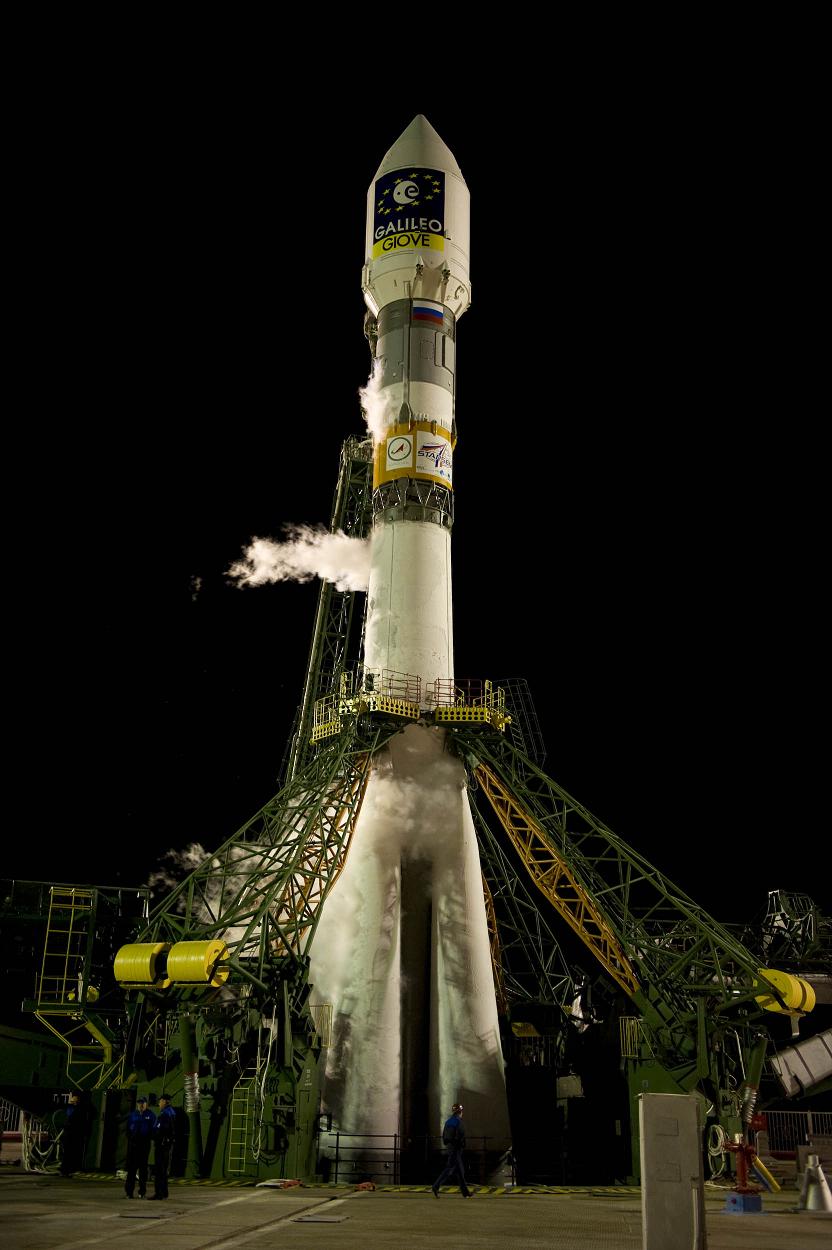
An updated version of the Soyuz launch vehicle will liftoff at the end of the year from the European Spaceport at Kourou in French Guyana.


Soyuz will complete the range of launchers operated by Arianespace, which already includes the Ariane 5, with the Vega small launcher soon to come.


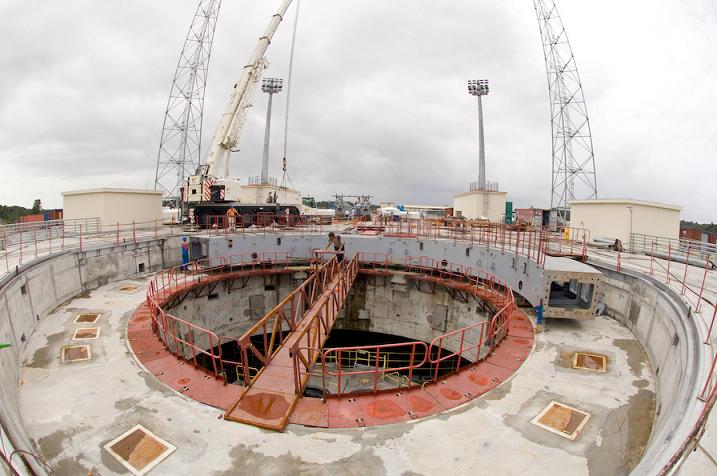
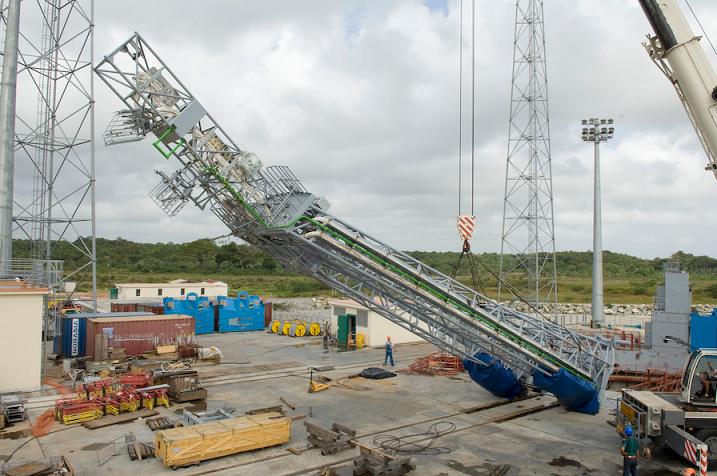
The construction of the Soyuz site in Guyana has reached a major milestone: the construction of the launch system has begun. The launch system supports and services the launch vehicle when it is erected for liftoff.


The concrete launch pad supports a multi-segment steel ring inset (known as the support crown). Two umbilical masts have also been positioned on top of the support crown. The masts, together with four support booms, will keep the launch vehicle in position on the launch pad. The two towers visible at the launch site will protect the Soyuz vehicle from lightning strikes.


Credits: Arianespace


One interesting detail about the launch site is that the support crown is fixed on the launch pad, in contrast to the launch pads built for Soyuz in Russia and Kazakhstan, as the updated Soyuz operated from Kourou is able to manage the launch azimuth during ascent.


You can read more about the Kourou Spaceport on the Arianespace website.


  • Facebook
  • Google
  • Slashdot
  • Reddit
  • Live
  • TwitThis


Credits: ESA/CNES/ARIANESPACE-Service Optique CSG 2002


Arianespace accounted for 50 percent of all commercial launches to geostationary transfer orbit during 2008 and retained its strong market share, which represented 72 percent of the orders booked in 2008.


Arianespace was founded in 1980. Among its 23 shareholders are the French space agency CNES with thirty-four percent and EADS Astrium with thirty percent. With only around 300 employees, the company has generated sales of about one billion euros in 2008.


2009 will be the year of the launcher family for Arianespace, as Arianespace Chairman and CEO Jean-Yves Le Gall pointed out during the company’s New Year’s press conference in Paris. The development of the Vega launcher is being finalized, the maiden launch of the medium-lift Soyuz launcher from Kourou in French Guiana will take place this year, and more than six missions are scheduled for Ariane 5.


“As a result of our launcher family strategy, Arianespace has a sustained agility that allows us to be ever more responsive to our customers,” Le Gall told the journalists. “The agility has been demonstrated with our 28 consecutive mission successes for Ariane 5 and the 21 for Soyuz – and is underscored by launches that are on target, and on time.”


With a full range of payload lift capabilities, including Vega, Soyuz, and Ariane 5, Arianespace is able to meet the changing trends in satellite weights, orbiting everything from light weight scientific payloads to heavy telecommunication relay platforms.


  • Facebook
  • Google
  • Slashdot
  • Reddit
  • Live
  • TwitThis


Credits: ESA – S. Corvaja 2007


CNES and ESA signed the development contract to build the launch facilities for Soyuz at the Guiana Space Centre on July 19, 2005. The Soyuz launcher will give Europe medium-lift capability and will complete the range of launchers operated by Arianespace, which includes the Ariane 5 heavy-lift launcher and the Vega small launcher.


The Soyuz launchers that will liftoff from Kourou have a number of improvements: an updated digital flight control system, an increased-performance third stage, and the larger Soyuz ST payload fairing.


The launcher has a length of 46.2 meters, a diameter of 10.3 meters, and a liftoff mass of 308 tons. Due to the position of the launch site, close to the equator, the payload capacity of the launcher has increased significantly: 3,150 kg to a geostationary orbit, and 4,900 kg to a sun-synchronous orbit, with a circular altitude of 820 km.


Soyuz is a reliable, four-stage launch vehicle, which has been in production since 1957 and has accounted for more than 1,700 missions to date.


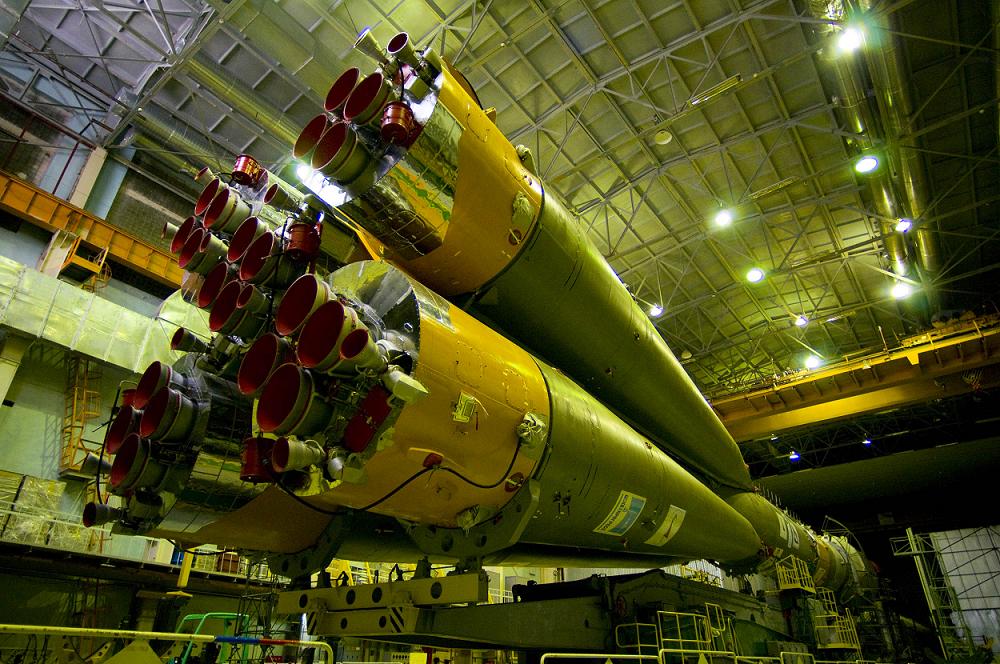
The first stage is composed of the four boosters that are assembled around the central core of the launcher. The RD-107A engines installed on the boosters use liquid oxygen and kerosene as propellant combination. Each engine has four combustion chambers and four nozzles. One aerofin and two movable vernier thrusters per engine are used for the three-axis flight control.


Credits: ESA – S. Corvaja 2008


The second stage consists of the central core surrounded by the boosters. It uses the same propellant combination for powering the RD-108A engine with four combustion chambers and nozzles.


Four vernier thrusters are used for three-axis flight control, after the boosters of the first stage are jettisoned during flight.


The engines of the first two stages are ignited 20 seconds before liftoff. The reason for this is that the launch procedures include monitoring the engine health parameters just before liftoff, while the engines are operating at an intermediate level of thrust. This reminds me of the SpaceX Falcon 1 booster launch procedures. SpaceX engineers perform a similar monitoring procedure for the Merlin engine just before the Falcon 1 liftoff.


The third stage utilizes a RD-0124 engine, also powered by liquid oxygen and kerosene. The liquid oxygen and kerosene tanks are pressurized using helium stored in vessels located in the liquid oxygen tank. The avionics module of the launcher is carried by this stage. The new flight control system improves the accuracy and the control capability for the launcher, as additional flight control authority is needed for the enlarged payload fairing.


Credits: ESA – S. Corvaja 2008


The upper stage of the Soyuz launcher is called Fregat. Fregat is an autonomous and flexible upper stage with its own guidance, navigation, control, tracking, and telemetry systems. It was designed to operate as an orbital vehicle, and it extends the launch capabilities of the Soyuz launcher to medium-Earth orbits, Sun-synchronous orbits, geostationary transfer orbits, and Earth escape trajectories.


The Fregat stage can be restarted up to 20 times in flight, it can provide three-axis stabilization, and perform a spin-up of the spacecraft payload. Fregat uses a bi-propellant propulsion system: UDMH (unsymmetrical dimethylhydrazine) and NTO (nitrogen tetroxide).


The payload fairing is the most visible change to the Soyuz launcher. The new Soyuz fairing has a diameter of 4.11 meters and a length of 11.4 meters. The fairing is based on the configuration used for Ariane 4 vehicles.


The construction of the Soyuz launch base in French Guiana started in early 2007. At the groundbreaking ceremony on February 26, 2007, a number of European space industry officials were present: Jean-Jacques Dordain – ESA Director General, Yannick d’Escatha – President of CNES, Jean-Yves Le Gall – Director General of Arianespace, and Anatoly Perminov – Head of Roscosmos.


In 2007, Arianespace ordered four Soyuz launchers for the early launch missions that are scheduled for the second half of 2009. A contract was also signed in September 2008 for 10 more Soyuz launch vehicles.


The Soyuz launch missions that are scheduled for 2009 signal the beginning of a new chapter in ESA-Russian relations. Stay tuned for more information about the Soyuz launches from French Guiana!


  • Facebook
  • Google
  • Slashdot
  • Reddit
  • Live
  • TwitThis


Credits: ESA – J. Huart


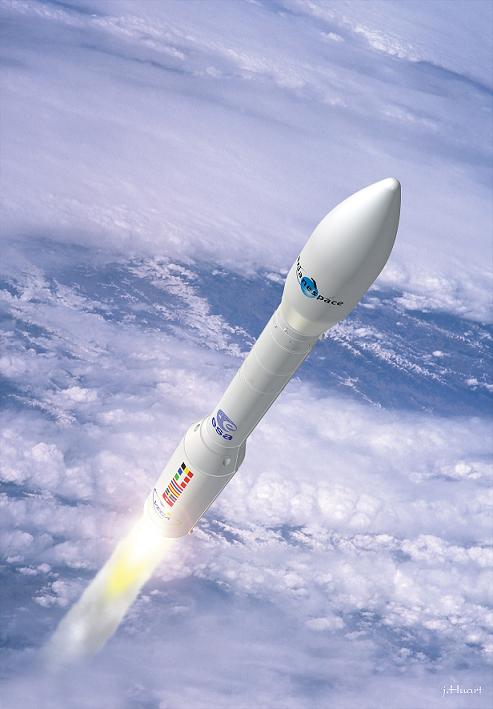
The small-payload market is rapidly expanding. Institutional programs (mostly Earth observation and scientific missions) drive this emerging market. In order to meet the demands of the small-payload market, ESA has transformed the small launcher program initiated by the Italian Space Agency (ASI) in the 1990s into Vega, a co-operative project with other Member States within the ESA framework.


The small-payload market consists of satellites up to 3,000 kg and it stands at around five missions per year. There are many classifications for the satellites in this market, so we will present just one classification for informational purposes. The satellites in this class are divided into three categories: micro-satellites (up to 300 kg), mini-satellites (from 300 kg to 1,000 kg), and small satellites (from 1,000 kg to 3,000 kg).


The orbits required for the deployment of these satellites are mainly Sun Synchronous Orbits (SSO) and Low Earth Orbits (LEO). Vega’s in-orbit launch capability benchmark is 1,500 kg into a 700 km altitude polar orbit. Being designed to cope with a wide range of missions, Vega will address the various market requirements for this class of satellites.


Credits: ESA


Vega is a single-body launcher composed of four stages. The first three stages are solid propellant stages, while the fourth stage has a liquid propellant engine. Vega is 30 meters high, has a maximum diameter of three meters and a total of 137 tons at lift-off.


There are three main sections: the Lower Composite, the Restartable Upper Module and the Payload Composite.


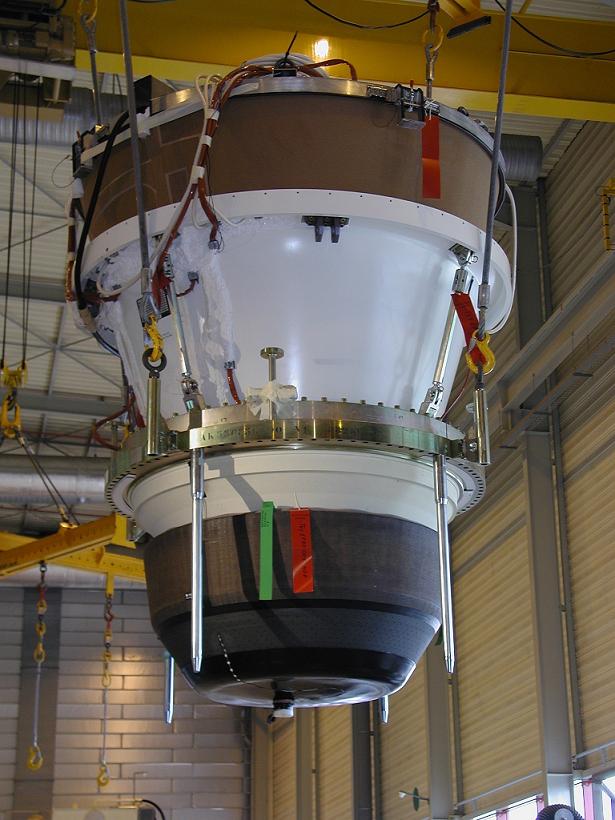
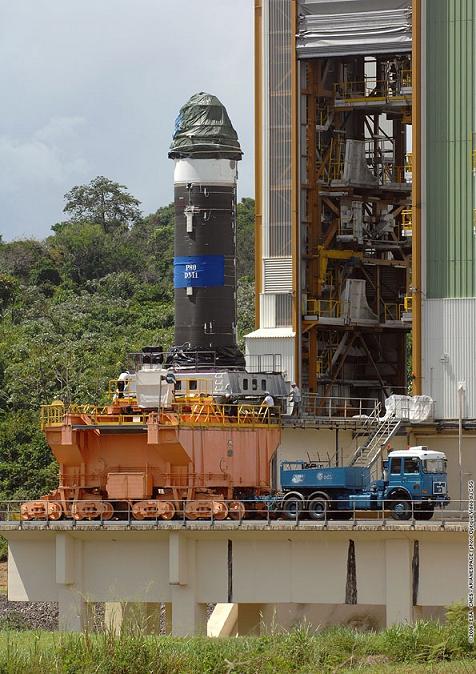
The Lower Composite section consists of the first three stages (the solid propellant stages). The first stage is equipped with a P80-FW motor containing 88 tons of propellant. The second stage contains a Zefiro 23 motor with 23 tons of propellant. The third stage consists of a Zefiro 9 motor with 10 tons of propellant and the stage-interfacing structures.


The technology for the three solid-propellant stages (P80, Z23, Z9) is derived from the Zefiro 16 rocket motor. These motors benefit from the experience acquired by Europe in the field of solid propulsion. Each motor is composed of a thermal-insulated carbon-epoxy monolithic case, the solid propellant HTPB 1912, a nozzle, a thrust vector control system driven by two electro-actuators that operate the movable nozzle, and a control unit that provides pitch and yaw control during the flight. Each stage also includes an ignition subsystem, a safety subsystem, and the interfaces to the other stages.


Credits: ESA/CNES-SOV


The P80 engine was designed for the Vega small launcher, and it helps validate technologies applicable to a new generation of solid boosters for the Ariane 5 launch vehicle. This new design was driven by the goal of minimizing recurring costs, a significant reduction being made with respect to the current metal case boosters.


The Restartable Upper Module is the fourth stage of the launcher. It is also known as the Altitude and Vernier Upper Module (AVUM). The AVUM consists of two modules: the AVUM Propulsion Module and the AVUM Avionics Module.


The propulsion system uses NTO (Nitrogen Tetroxide) and UDMH (Unsymmetrical dimethyl hydrazine) as propellants. The propellants are stored in two identical titanium tanks pressurized by helium. Depending on the mission, the propellant load can be between 250 kg and 500 kg.


The avionics system is largely adapted from existing hardware and/or components already under development (namely subsystems already in use by the Ariane 5 launch vehicle).


The Payload Composite section is composed of the fairing and the payload/launcher interface structure. The fairing is composed of two shells that are jettisoned during flight after the separation of the second stage. The payload/launcher interface is an Adaptor 937, which is a standard interface used on the European launchers. Additional payload adapters can be added for multi-payload missions.


Credits: ESA – J. Huart


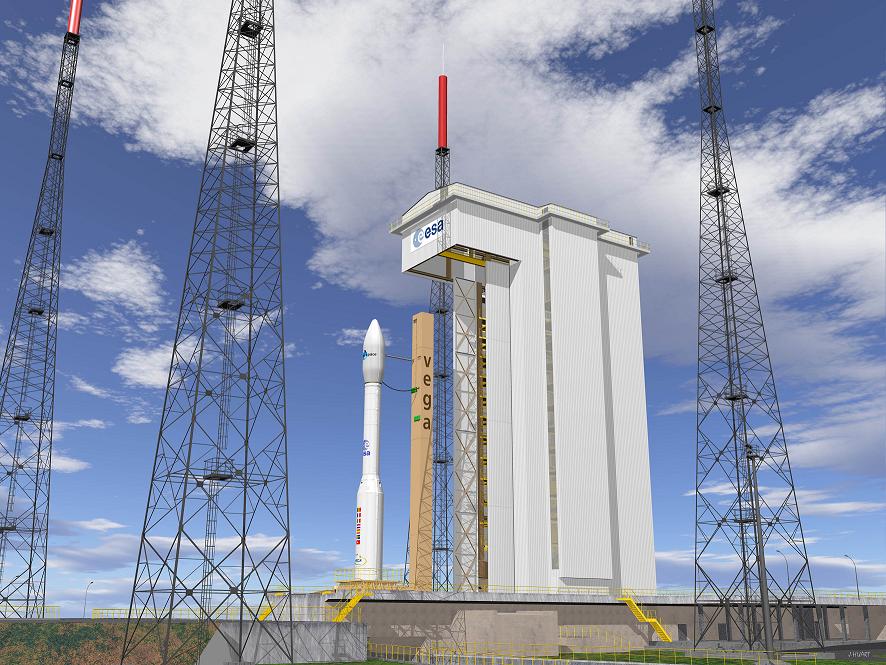
The dedicated Ground Segment for the Vega launcher comprises of the Launch Zone (ZLV – Zone de Lancement Vega) and the Operational Control Center, all located at the European Spaceport at Kourou, in French Guiana. ESA also built a Payload Preparation Complex that will be used for satellite and equipment unpacking, mechanical inspections, the checkout of the payloads, and the final integration of the payload composite before mounting it on top of the launcher.


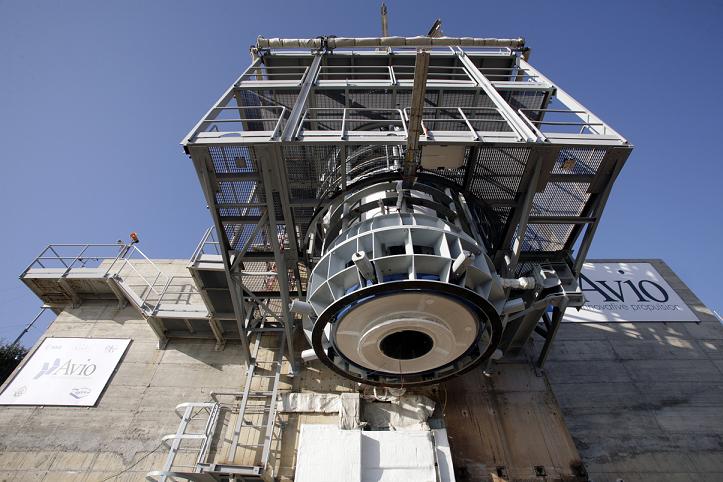
On October 24, 2008, the Zefiro 9 rocket engine passed the first qualification test. There is one additional firing test left for the engine. The Vega launcher’s qualification flight is scheduled to take place by the end of 2009.


Credits: Avio SpA (Italy)


ESA is responsible for the qualification of the launch service and also for sustaining the qualification status during the exploitation phase. Ariane Space will be responsible for Vega’s commercialization and launch operations. The expected launch rate for Vega will be up to four launches per year.


Please stay tuned on the OrbitalHub frequency. We will keep you posted!


  • Facebook
  • Google
  • Slashdot
  • Reddit
  • Live
  • TwitThis