OrbitalHub

The place where space exploration, science, and engineering meet

Domain is for sale. $50,000,000.00 USD. Direct any inquiries to contact@orbitalhub.com.


Credits: NASA


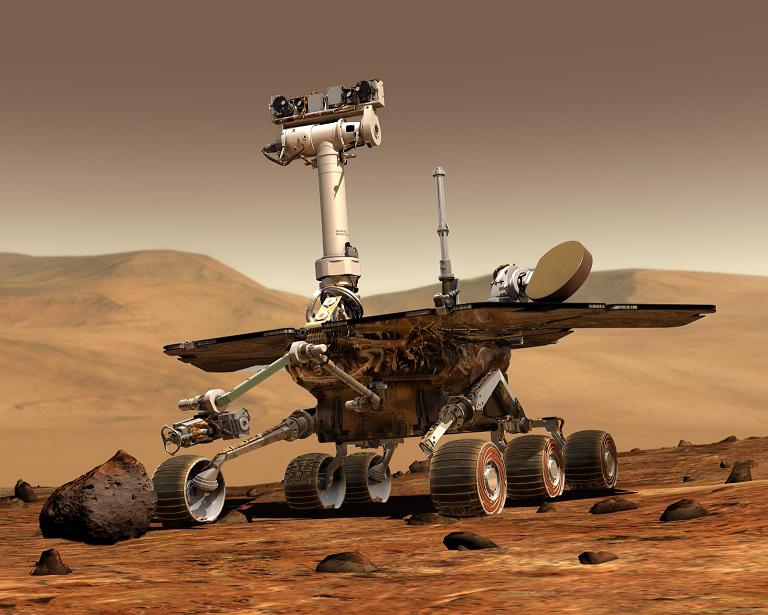
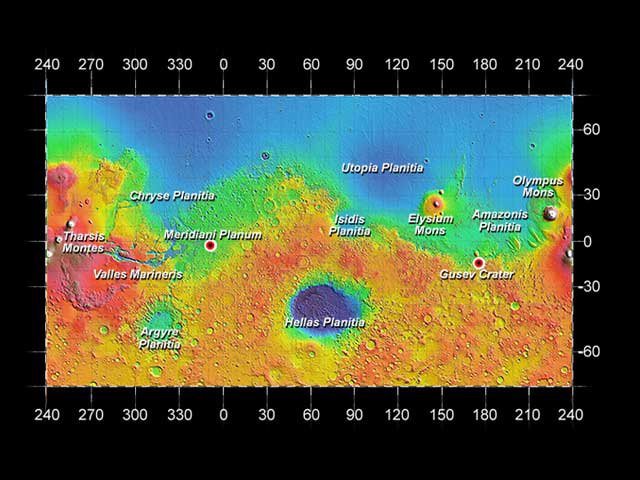
On January 3, 2004, the MER-A rover a.k.a. Spirit landed on Mars at the Gusev Crater. The second rover, MER-B a.k.a. Opportunity, followed twenty-one days later and landed at the Meridiani Planum.


They were both designed to operate for three months on the surface of Mars. Five years later, they are still operational and NASA has planned new missions for them.


Considering the harsh conditions on Mars, NASA’s twin rovers have accomplished remarkable things: they have returned a quarter-million images, driven more than thirteen miles, climbed a mountain, descended into impact craters, and survived dust storms. Using the Mars Odyssey orbiter as a communication relay, the rovers have sent more than 36 GB of scientific data back to Earth.


“These rovers are incredibly resilient considering the extreme environment the hardware experiences every day,” said John Callas, JPL project manager for Spirit and Opportunity. “We realize that a major rover component on either vehicle could fail at any time and end a mission with no advance notice, but on the other hand, we could accomplish the equivalent duration of four more prime missions on each rover in the year ahead.”
 

Credits: NASA


Digging into the MER mission archive, one detail caught my eye. The rovers carry plaques commemorating the crews of Columbia and Challenger, and some of the landmarks surrounding the landing sites of the rovers are dedicated to the astronauts of Apollo 1, Columbia, and Challenger.


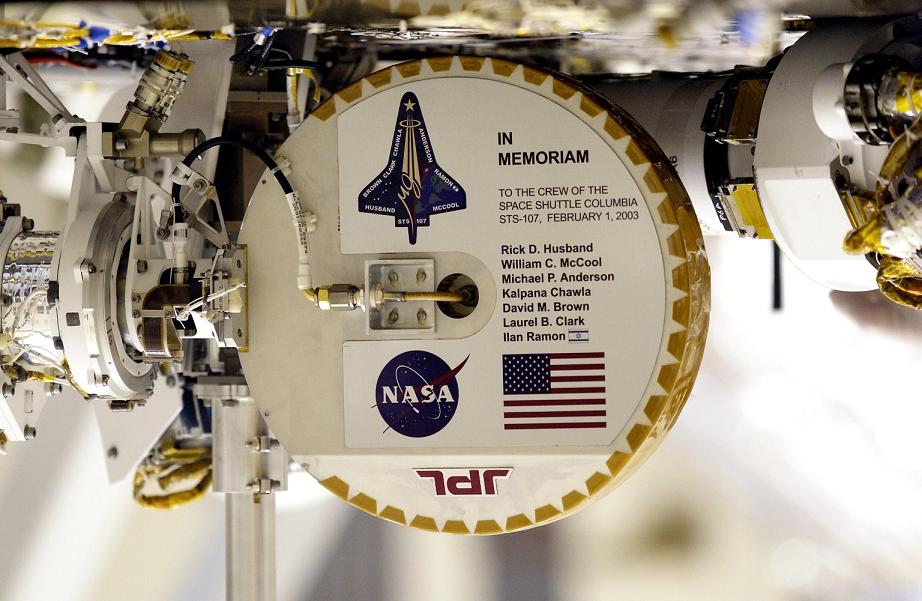
Spirit is carrying a plaque commemorating the STS-107 Space Shuttle Columbia crew, which has been mounted on the high-gain antenna of the rover.


The names of the STS-107 crew are inscribed on the plaque: Rick D. Husband, William C. McCool, Michael P. Anderson, Kalpana Chawla, David M. Brown, Laurel B. Clark, and Ilan Ramon. Their names are now looking over the Martian landscapes.


To further honor their memory, the landing site of the MER Spirit is called the Columbia Memorial Station.
 

Credits: NASA


Three of the hills surrounding the Columbia Memorial Station are dedicated to the Apollo 1 crew: Gus Grissom, Ed White, and Roger Chafee. Grissom Hill is located 7.5 km to the southwest of Columbia Memorial Station, White Hill is 11.2 km northwest of the landing site, and Chafee Hill is located 14.3 km south-southwest of the landing site.


The area where Opportunity landed in the Meridiani Planum is called Challenger Memorial Station, in memory of the last crew of the Space Shuttle Challenger: Francis R. Scobee, Michael J. Smith, Judith A. Resnik, Ellison S. Onizuka, Ronald E. McNair, Gregory B. Jarvis, and Sharon Christa McAuliffe. I remember that Sharon Christa McAuliffe was NASA’s first teacher in space.


“The journeys have been motivated by science, but have led to something else important,” said Steve Squyres of Cornell University, in Ithaca, N.Y. Squyres is principal investigator for the rover science instruments. “This has turned into humanity’s first overland expedition on another planet. When people look back on this period of Mars exploration decades from now, Spirit and Opportunity may be considered most significant not for the science they accomplished, but for the first time we truly went exploring across the surface of Mars.”


  • Facebook
  • Google
  • Slashdot
  • Reddit
  • Live
  • TwitThis


Credits: SpaceX


NASA has awarded two International Space Station (ISS) Commercial Resupply Services (CRS) contracts to Space Exploration Technologies (SpaceX) and Orbital Sciences Corporation (Orbital).


NASA has ordered eight flights valued at about $1.9 billion from Orbital and twelve flights valued at about $1.6 billion from SpaceX.


The maximum potential value of each contract is roughly $3.1 billion. Based on known requirements, the value of both contracts combined is projected at $3.5 billion.


Credits: Orbital


The awarded contracts are fixed-price indefinite delivery, indefinite quantity contracts. They will begin January 1, 2009, and are effective through December 31, 2016. SpaceX and Orbital each will have to deliver a minimum of twenty metric tons of cargo to the space station, and they will also have to deliver non-standard services in support of the cargo resupply, including analysis and special tasks as the government deems necessary.


SpaceX will service the ISS with its Falcon9/Dragon system.


“The SpaceX team is honored to have been selected by NASA as the winner of the Cargo Resupply Services contract,” said Elon Musk, CEO and CTO, SpaceX. “This is a tremendous responsibility, given the swiftly approaching retirement of the Space Shuttle and the significant future needs of the Space Station. This also demonstrates the success of the NASA COTS program, which has opened a new era for NASA in US Commercial spaceflight.”


Orbital will employ the Taurus IITM medium-lift launch vehicle and the CygnusTM maneuvering space vehicle.


“We are very appreciative of the trust NASA has placed with us to provide commercial cargo transportation services to and from the International Space Station, beginning with our demonstration flight scheduled in late 2010,” said Mr. David W. Thompson, Orbital’s Chairman and Chief Executive Officer. “The CRS program will serve as a showcase for the types of commercial services U.S. space companies can offer NASA, allowing the space agency to devote a greater proportion of its resources for the challenges of human spaceflight, deep space exploration and scientific investigations of our planet and the universe in which we live.”


Both Orbital and SpaceX have issued press releases with more details about the CRS contracts.


  • Facebook
  • Google
  • Slashdot
  • Reddit
  • Live
  • TwitThis


Credits: SpaceX


Another critical milestone has been reached by SpaceX with the arrival of Falcon 9 hardware at Cape Canaveral.


After the full mission-length firing test of the Falcon 9 first stage engines and the firing test of the Dragon maneuvering thruster, the arrival of the Falcon 9 first stage fuel tank fulfills SpaceX’s commitment to having Falcon 9 hardware at Cape Canaveral by year-end.


“Christmas has arrived a few days early for our team at the Cape,” said Brian Mosdell, Director of Florida Launch Operations for SpaceX. “The packages measure extra large this year, and they will keep everyone busy in the coming weeks.”


All of the Falcon 9 elements and the ground support hardware have already left the SpaceX manufacturing facility in Hawthorne, California. The hardware will make its way to the launch site at Cape Canaveral over the next two weeks. The Falcon 9 will then be assembled on horizontal and raised to vertical on the custom built erector.


Credits: SpaceX


There are four Falcon 9 launches scheduled for 2009. Two of these launches are demonstration flights with the Dragon spacecraft as part of the NASA Commercial Orbital Transportation Services (COTS) competition. A total of three flights of the Falcon 9/Dragon launch system will be conducted under the agreement, in order to demonstrate cargo delivery capability to the International Space Station (ISS).


NASA’s agreement with SpaceX can be extended to include demonstrating transport of crew to and from the ISS.


“2008 has been a year of rapid progress for SpaceX,” said Elon Musk, CEO and CTO of SpaceX. “The delivery of the Falcon 9 to the Cape is a major milestone in designing and deploying the most reliable, cost-efficient fleet of launch vehicles in the world. I applaud our SpaceX team who has worked 24/7 to make this happen.”


SpaceX has made available a video of Elon Musk giving a tour of the SpaceX Falcon 9 launch site at Space Launch Complex 40, Cape Canaveral AFS, Florida.


  • Facebook
  • Google
  • Slashdot
  • Reddit
  • Live
  • TwitThis


Credits: NASA


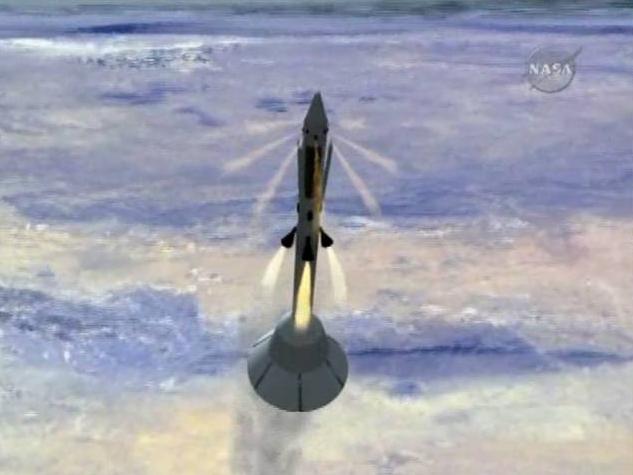
One of the crucial requirements for a man-rated launch system is a reliable Launch Abort System (LAS). LAS is basically a top-mounted rocket connected to a crew module and it is used to separate the crew module from the rest of the launch vehicle in case of emergency.


An emergency can be anything from an explosion of the launch vehicle on the launch pad to a failed separation of the lower stage during flight.


In the case of the Orion Module, several designs were considered for the LAS: the Multiple External Service Module Abort Motor concept, the Crew Module Strap On Motors concept, and the In-Line Tandem Tractor (Tower) concept. The latter concept was incorporated in the Ares I/Orion design.


The Tandem Tractor (Tower) design of the LAS has three motors: an Attitude Control Motor (eight nozzles), a Jettison Motor (four aft nozzles), and the Abort Motor (four exposed flow nozzles). These motors will make possible the separation of the module and the control of the flight after the separation from the launch vehicle. An important component of the LAS is the Boost Protective Cover (BPC), which protects the crew module from the exhaust of the motors.


Credits: NASA


The LAS is designed to perform on the launch pad as well as during the first 300,000 feet after the launch. There are three possible scenarios for the abort procedure: on the launch pad, on the mid-altitude flight segment (up to an altitude of 150,000 feet), and on the high-altitude flight segment (from 150,000 feet to 300,000 feet, where the LAS is jettisoned on a nominal flight). Tests will have to be performed to cover these scenarios: on the launch pad as well in flight.


NASA has made available animations of the test flights planned for the LAS. One is the animation of the Orion Module LAS pad abort flight test. The second presents the Orion Module LAS ascent abort flight test.


Credits: NASA


Currently, the Launch Abort System of the Orion Module is under development.


The first full-scale test fire of the motor that powers the LAS was completed on November 20, 2008. This was the first time a LAS test has been conducted since the 1960s, when the LAS for the Apollo Program was tested.


  • Facebook
  • Google
  • Slashdot
  • Reddit
  • Live
  • TwitThis


Credits: JAXA


If measures are not taken to address the effects of the greenhouse gases produced by our civilization, extreme climate changes will occur: droughts, heat waves, and floods.


Understanding the behavior of greenhouse gases is critical for developing effective measures to fight climate change.


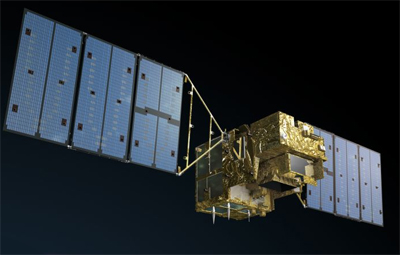
The Greenhouse Gases Observing Satellite (GOSAT) is the first satellite to observe greenhouse gases from space. The main contributors behind GOSAT are the Japan Aerospace Exploration Agency (JAXA), the National Institute for Environmental Studies (NIES), and the Ministry of Environment (MOE). The chosen nickname for GOSAT is IBUKI, which means breath or puff.


The data collected by the GOSAT satellite will help us make better estimates as to how different areas on Earth contribute to global warming through the emission of greenhouse gases. The data will also help us understand the behavior of the greenhouse gases by combining global observation data collected on orbit with data collected on the ground, and it will also help us improve simulation models.


Credits: JAXA


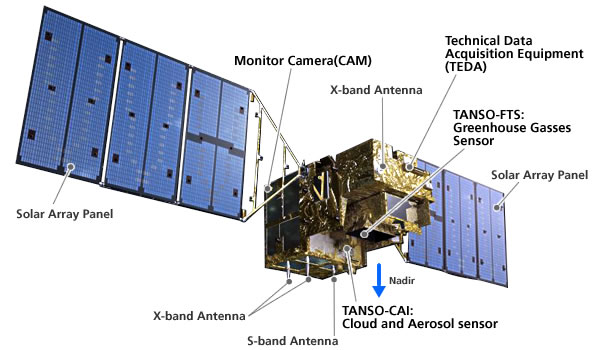
The observation instrument onboard GOSAT is called the Thermal And Near-infrared Sensor for carbon Observation (TANSO).


There are two sensors that collect data for the instrument: a Fourier Transform Spectrometer (FTS) and a Cloud Aerosol Imager (CAI).


The sensors will observe the infrared light from the Earth’s surface and will return measurements that can be used to calculate the abundance of carbon dioxide (CO2) and methane (CH4).


The operational orbit will allow GOSAT to circle the Earth in roughly 100 minutes and to return above the same Earth coordinates every three days. One thing to mention here is that the observations can be done only on cloud-free areas, meaning that on average only ten percent of the total number of measurements can be used for calculating the abundance of CO2 and CH4. However, the number of measurement points surpasses the current number of ground measuring points (under 200) and areas that have never been monitored will be covered by GOSAT observations.


Credits: JAXA / MHI


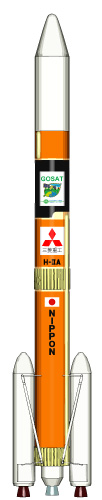
A Mitsubishi H-IIA launch vehicle will inject GOSAT into its predetermined orbit: a sun-synchronous sub-recurrent orbit at a perigee altitude of 667 km, apogee altitude of 683 km, and an inclination of 98 degrees. It will be the fifteenth flight of an H-IIA. The model used for this launch, H2A202, has two solid rocket boosters.


Besides GOSAT, which is the main payload, the payload includes several piggyback payloads. In the case of an excessive launch capability, it is common practice to include in the payload small satellites that are made by private companies or universities.


Seven micro-satellites, six selected through public tender and one JAXA satellite, will be launched by the H-IIA launch vehicle with Ibuki: KAGAYAKI / SORUN CORPORATION (debris detection and Aurora electric current observation mission), STARS / Kagawa University (tether space robot demonstration), KKS-1 / Tokyo Metropolitan College of Industrial Technology (demonstration of the micro cluster and three axis attitude control functions), PRISM / The University of Tokyo (earth image acquisition by using an expandable refracting telescope), SOHLA-1 / ASTRO TECHNOLOGY SOHLA (measurements of thunder and lightning), SPRITE-SAT / Tohoku University (observations of the sprite phenomenon and gamma radiation of the Earth’s origin), and Small Demonstration Satellite-1 (SDS-1) / JAXA (on-orbit verification of the space wire demonstration).


For more details on the additional payload for the GOSAT/Ibuki mission, you can check out the piggyback payload web page on the JAXA web site. Some of the links on the page require knowledge of Japanese or hands-on experience with the Google translation tool.


The launch date for GOSAT/Ibuki has been set. The H-IIA Launch Vehicle No.15 will liftoff sometime between 12:54 and 1:16 PM on January 21, 2009.


Check out the GOSAT / IBUKI program page on the JAXA web site for more information.


  • Facebook
  • Google
  • Slashdot
  • Reddit
  • Live
  • TwitThis


Credits: SpaceX


The nine Merlin engines that power the first stage of the Falcon 9 launcher have been successfully tested. At the McGregor Test Facility in Texas, a full mission-length firing test of the first stage of the launcher was conducted on November 22, 2008. The engines, fired for 178 seconds, consumed over half a million pounds of propellant.


During the last eighteen seconds of the test, two of the engines were shut down in order to test the ability of the first stage to complete a mission in the event of an engine being lost during flight.


According to SpaceX CEO, Elon Musk, the first liftoff of a Falcon 9 launcher from Cape Canaveral will occur in 2009.


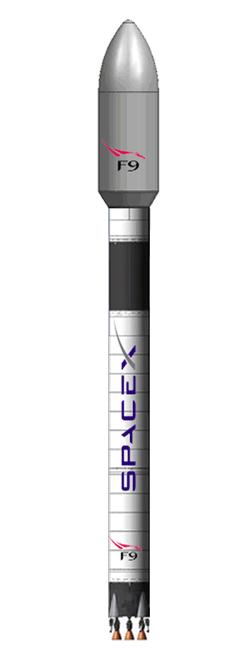
Falcon 9 is a two-stage launch vehicle. It is powered by liquid oxygen and rocket grade kerosene. Nine Merlin engines power the first stage of the launcher. The second stage of the Falcon 9 launcher is powered by one Merlin engine.


Falcon 9 has a length of 54.9 m, a diameter of 3.6 m, and can have a mass of 333,400 kg for a low Earth orbit (LEO) mission, and 332,800 kg for a geosynchronous transfer orbit (GTO) mission. It can inject 12,500 kg payloads into LEO (200 km) and 4,640 kg payloads into GTO (185×35,788 km). SpaceX will charge $36.75M for a LEO mission, and $46.75M for a trans-lunar injection (TLI) mission. For GTO missions, the price ranges from $36.75M to $57.75M.


For more details about the Falcon 9 launcher, you can visit the Falcon 9 overview web page on the SpaceX web site.


Check out the video with the 3 minute test of the Merlin engines on the SpaceX web site.


  • Facebook
  • Google
  • Slashdot
  • Reddit
  • Live
  • TwitThis