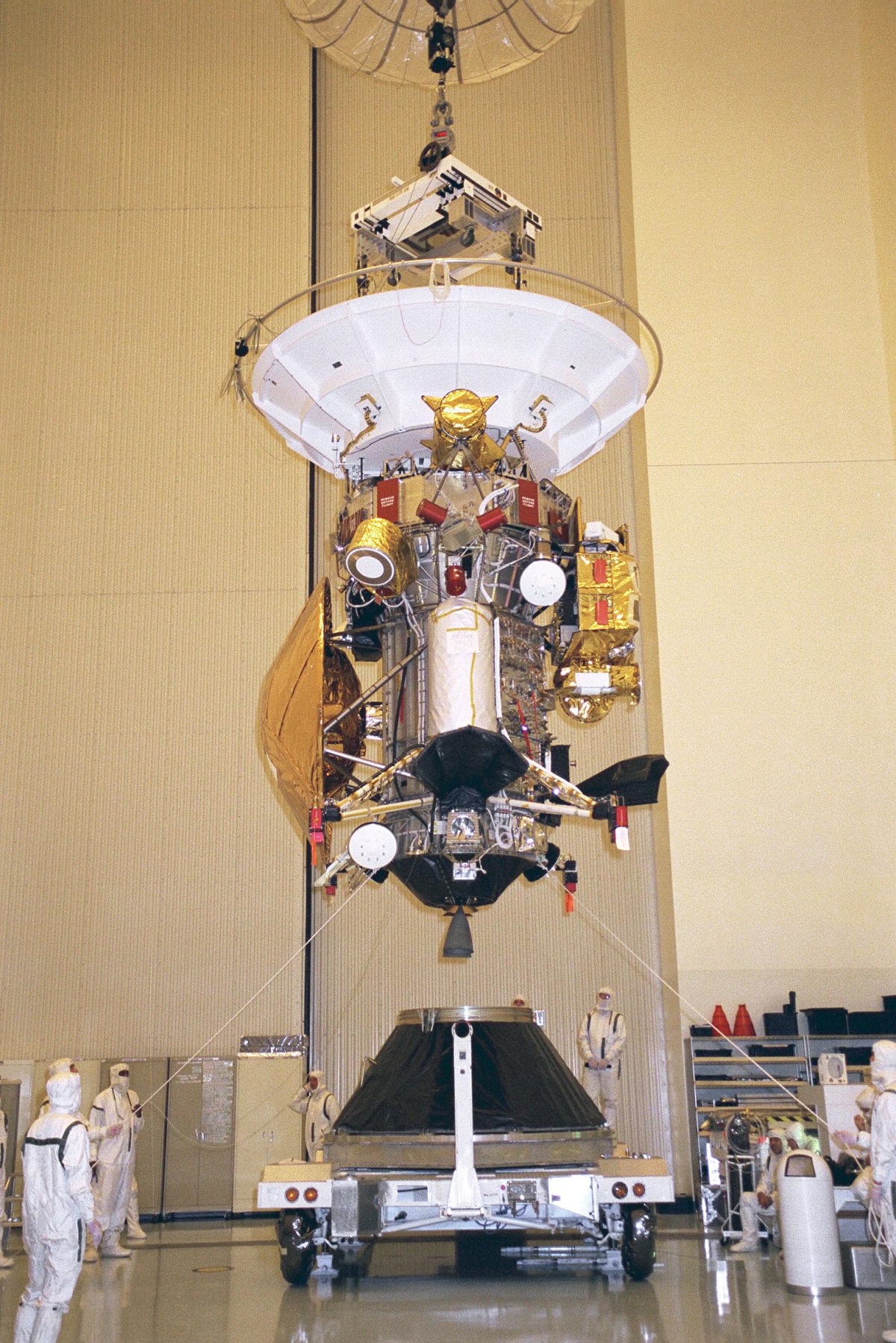
“July 22, 1997. Flight mechanics from NASA’s Jet Propulsion Laboratory (JPL) in Pasadena, Calif., lower the Cassini spacecraft onto its launch vehicle adapter in KSC’s Payload Hazardous Servicing Facility. The adapter will later be mated to a Titan IV/Centaur expendable launch vehicle that will lift Cassini into space. Scheduled for launch in October, the Cassini mission, a joint US-European four-year orbital surveillance of Saturn’s atmosphere and magnetosphere, its rings, and its moons, seeks insight into the origins and evolution of the early solar system. It will take seven years for the spacecraft to reach Saturn. JPL is managing the Cassini project for NASA.”
“After almost 20 years in space, NASA’s Cassini spacecraft begins the final chapter of its remarkable story of exploration: its Grand Finale. Between April and September 2017, Cassini will undertake a daring set of orbits that is, in many ways, like a whole new mission. Following a final close flyby of Saturn’s moon Titan, Cassini will leap over the planet’s icy rings and begin a series of 22 weekly dives between the planet and the rings.
No other mission has ever explored this unique region. What we learn from these final orbits will help to improve our understanding of how giant planets – and planetary systems everywhere – form and evolve.
On the final orbit, Cassini will plunge into Saturn’s atmosphere, sending back new and unique science to the very end. After losing contact with Earth, the spacecraft will burn up like a meteor, becoming part of the planet itself.
Cassini’s Grand Finale is about so much more than the spacecraft’s final dive into Saturn. That dramatic event is the capstone of six months of daring exploration and scientific discovery. (And those six months are the thrilling final chapter in a historic 20-year journey.)”
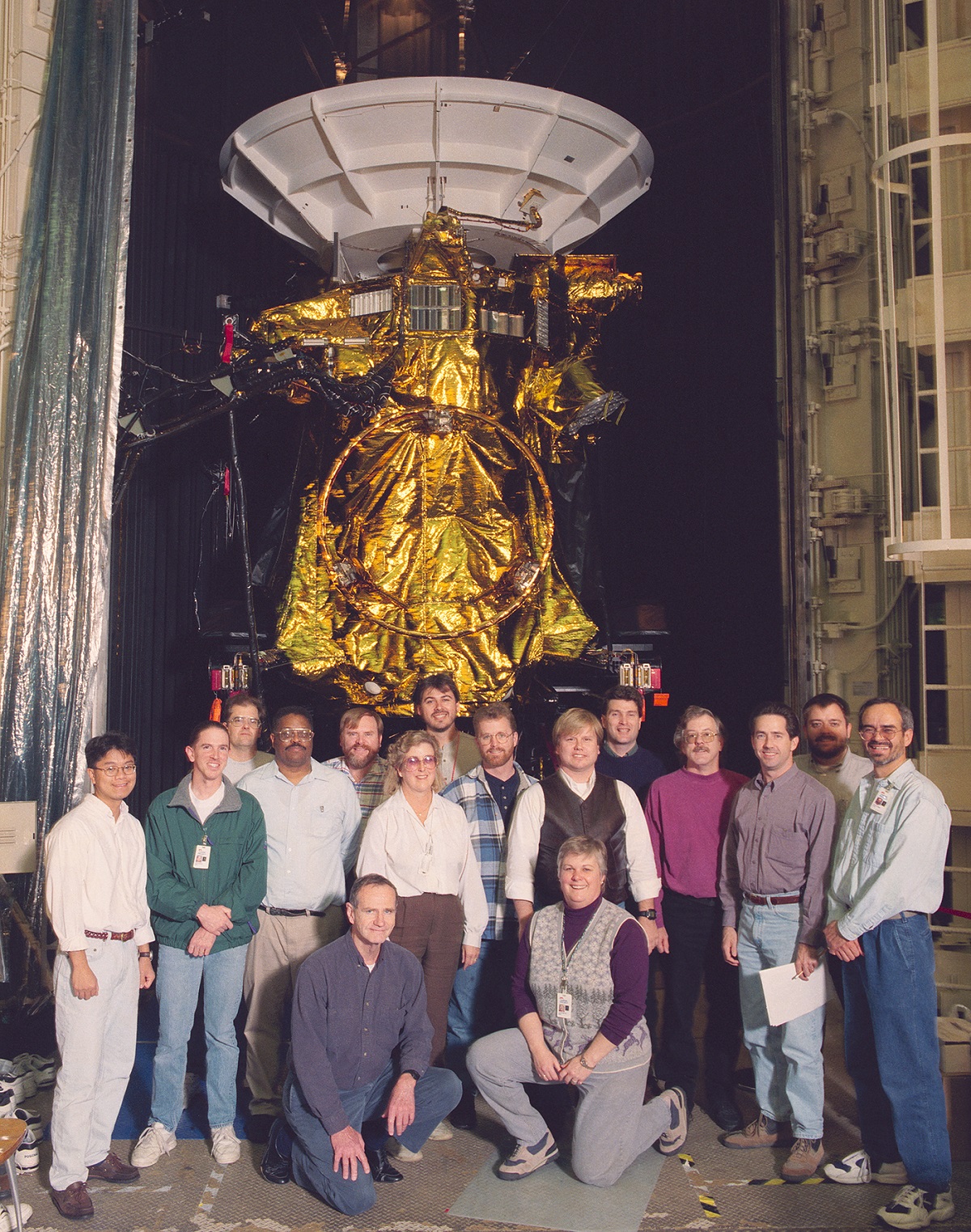
“February 21, 1997. Julie Webster, Cassini’s manager of spacecraft operations (kneeling, right), and the rest of the mission’s assembly, test and launch operations (ATLO) team pose with the spacecraft outside the Jet Propulsion Laboratory’s Space Simulator.”
“After almost 20 years in space, NASA’s Cassini spacecraft begins the final chapter of its remarkable story of exploration: its Grand Finale. Between April and September 2017, Cassini will undertake a daring set of orbits that is, in many ways, like a whole new mission. Following a final close flyby of Saturn’s moon Titan, Cassini will leap over the planet’s icy rings and begin a series of 22 weekly dives between the planet and the rings.
No other mission has ever explored this unique region. What we learn from these final orbits will help to improve our understanding of how giant planets – and planetary systems everywhere – form and evolve.
On the final orbit, Cassini will plunge into Saturn’s atmosphere, sending back new and unique science to the very end. After losing contact with Earth, the spacecraft will burn up like a meteor, becoming part of the planet itself.
Cassini’s Grand Finale is about so much more than the spacecraft’s final dive into Saturn. That dramatic event is the capstone of six months of daring exploration and scientific discovery. (And those six months are the thrilling final chapter in a historic 20-year journey.)”
Image credit: NASA / Jet Propulsion Laboratory – Caltech / Bob Brown
“Mars Reconnaissance Orbiter (MRO) is a multipurpose spacecraft designed to conduct reconnaissance and exploration of Mars from orbit. The US$720 million spacecraft was built by Lockheed Martin under the supervision of the Jet Propulsion Laboratory (JPL). The mission is managed by the California Institute of Technology, at the JPL, in La Cañada Flintridge, California, for the NASA Science Mission Directorate, Washington, D.C. It was launched August 12, 2005, and attained Martian orbit on March 10, 2006. In November 2006, after five months of aerobraking, it entered its final science orbit and began its primary science phase. As MRO entered orbit, it joined five other active spacecraft that were either in orbit or on the planet’s surface: Mars Global Surveyor, Mars Express, 2001 Mars Odyssey, and the two Mars Exploration Rovers (Spirit and Opportunity); at the time, this set a record for the most operational spacecraft in the immediate vicinity of Mars. Mars Global Surveyor and the Spirit rover have since ceased to function; the remainder remain operational as of March 2016.
MRO contains a host of scientific instruments such as cameras, spectrometers, and radar, which are used to analyze the landforms, stratigraphy, minerals, and ice of Mars. It paves the way for future spacecraft by monitoring Mars’ daily weather and surface conditions, studying potential landing sites, and hosting a new telecommunications system. MRO’s telecommunications system will transfer more data back to Earth than all previous interplanetary missions combined, and MRO will serve as a highly capable relay satellite for future missions.[…]
On September 29, 2006 (sol 402), MRO took its first high resolution image from its science orbit. This image is said to resolve items as small as 90 cm (3 feet) in diameter. On October 6, NASA released detailed pictures from the MRO of Victoria crater along with the Opportunity rover on the rim above it. In November, problems began to surface in the operation of two MRO spacecraft instruments. A stepping mechanism in the Mars Climate Sounder (MCS) skipped on multiple occasions resulting in a field of view that is slightly out of position. By December normal operations of the instrument was suspended, although a mitigation strategy allows the instrument to continue making most of its intended observations. Also, an increase in noise and resulting bad pixels has been observed in several CCDs of the High Resolution Imaging Science Experiment (HiRISE). Operation of this camera with a longer warm-up time has alleviated the issue. However, the cause is still unknown and may return.
HiRISE continues to return images that have enabled discoveries regarding the geology of Mars. Foremost among these is the announcement of banded terrain observations indicating the presence and action of liquid carbon dioxide (CO2) or water on the surface of Mars in its recent geological past. HiRISE was able to photograph the Phoenix lander during its parachuted descent to Vastitas Borealis on May 25, 2008 (sol 990).
The orbiter continued to experience recurring problems in 2009, including four spontaneous resets, culminating in a four-month shut-down of the spacecraft from August to December. While engineers have not determined the cause of the recurrent resets, they have created new software to help troubleshoot the problem should it recur.
On March 3, 2010, the Mars Reconnaissance Orbiter passed another significant milestone, having transmitted over 100 terabits of data back to Earth, which was more than all other interplanetary probes sent from Earth combined.
On August 6, 2012 (sol 2483), the orbiter passed over Gale crater, the landing site of the Mars Science Laboratory mission, during its EDL phase. It captured an image via the HiRISE camera of the Curiosity rover descending with its backshell and supersonic parachute.
NASA reported that the Mars Reconnaissance Orbiter, as well as the Mars Odyssey Orbiter and MAVEN orbiter had a chance to study the Comet Siding Spring flyby on October 19, 2014.
On July 29, 2015, the Mars Reconnaissance Orbiter was placed into a new orbit to provide communications support during the arrival of the InSight Mars lander mission on September 28, 2016. The maneuver’s engine burn lasted for 75 seconds.”
“Researchers at NASA’s Jet Propulsion Laboratory are developing the Buoyant Rover for Under-Ice Exploration, a technology that could one day explore oceans under the ice layers of planetary bodies. The prototype was tested in arctic lakes near Barrow, Alaska.”
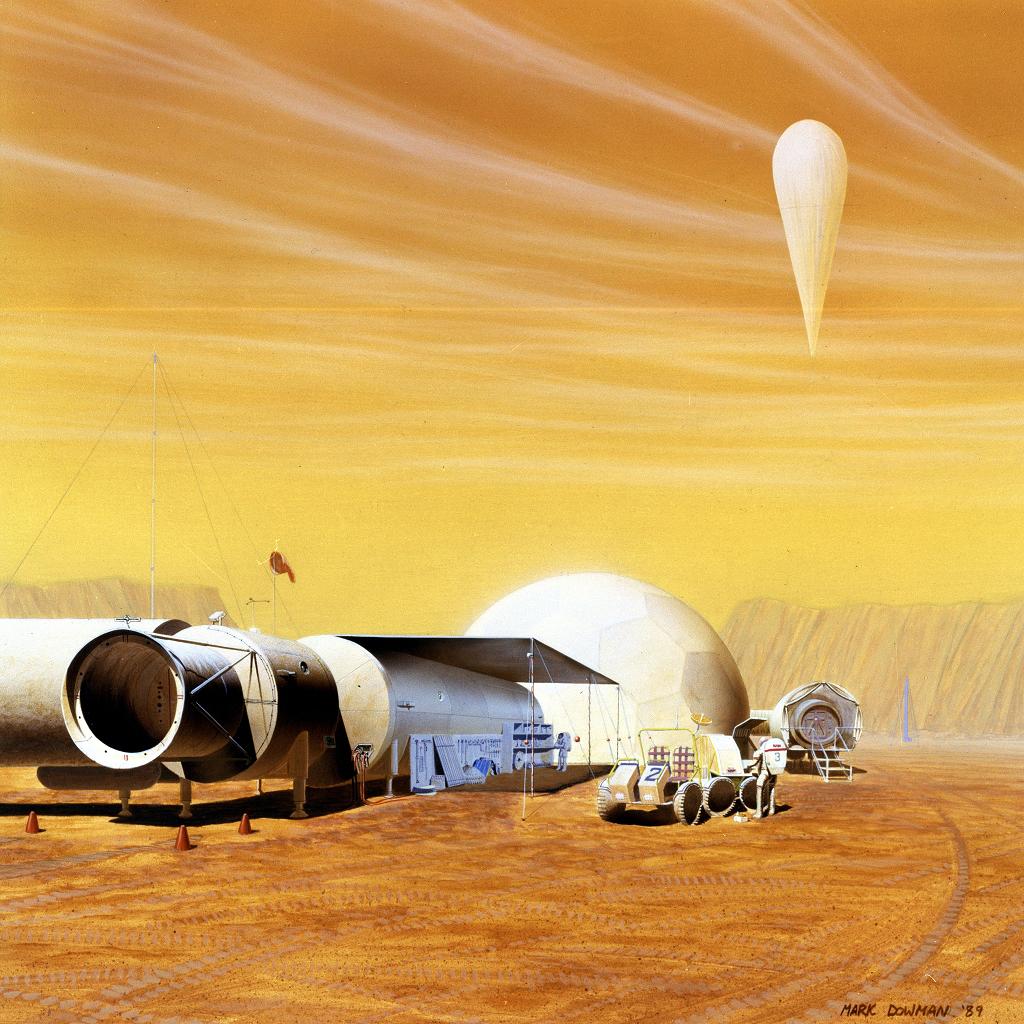
Airships are making a big comeback now as the energy consumption for all modes of transportation is being re-analyzed. Missions with special requirements like surveillance and reconnaissance missions and transportation of heavy payloads to remote outposts are the main driver for the reinvention of the airship.
But Earth is not the only place where airships can be deployed. There are a number of destinations in the solar system that would make a perfect environment for deployment and operation of airships, like Mars, Venus, and Titan – Saturn’s largest moon.
The presence of an atmosphere makes possible the use of vehicles that can fly within atmosphere for planetary exploration. Also, planetary exploration with low-powered vehicles like airships really makes sense considering the fact that energy is always at a premium.
So far, the only extraterrestrial deployment of an airship was performed during the Vega mission to Venus, in 1984. Two balloons were released and they floated 54 km above the planet’s surface for nearly two days.
Lighter-Than-Air (LTA) AERial ROBOTS (AEROBOTS) would present some advantages over their Heavier-Than-Air (HTA) siblings and the traditional planetary scouts, the exploration rovers: they would have long-duration mission and long-distance capabilities, they would not have to deal with obstacle avoidance problems, and they have low-power consumption. However, the environment in which the airship will operate will impose some restrictions on the capabilities of the airship (consider things like atmospheric composition and density, temperature, and the amount of solar radiation available). More on the planetary environments in the solar system and airship evaluations for each one of them can be found here.
NASA has funded a number of projects for solar system exploration that make use of aerobots. The Jet Propulsion Laboratory’s Planetary Aerobot Program is developing balloons to support scientific payloads in the atmosphere of other planets in our solar system. You can find more details about JPL’s Planetary Aerobot Program here.
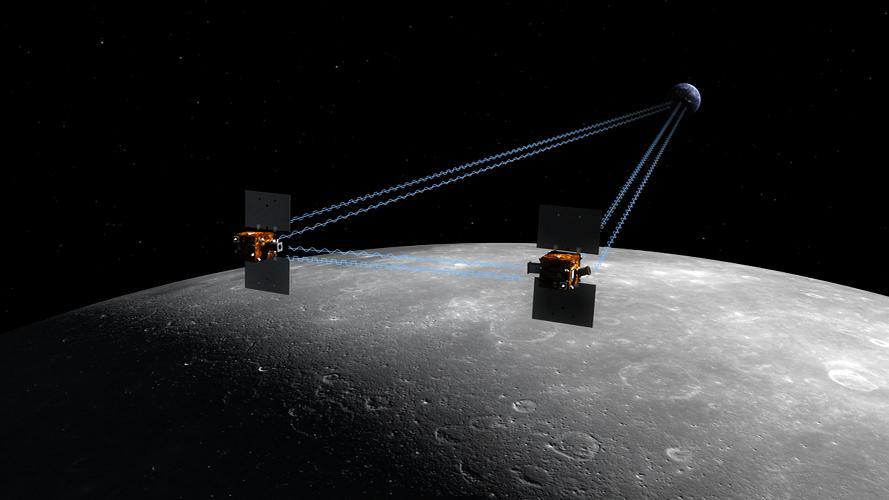
The Gravity Recovery And Interior Laboratory (GRAIL) is a mission that will measure the lunar gravity field in unprecedented detail. The twin spacecraft will orbit the Moon in tandem and collect scientific data for several months.
The GRAIL mission will cost $375 million and launch in 2011 as part of NASA’s Discovery Program. The window for the launch is 26 days long and opens on September 8, 2011.
After a dual launch aboard a Delta II 2920-10, the spacecraft will spend three to four months cruising on a low-energy trans-lunar trajectory. The two spacecraft will orbit the moon on 50 km, near-circular polar orbits, with a spacecraft separation of 175 – 225 km. The science phase of the mission will take 90 days, and it will be followed by a 12-month science data analysis.
The technique used by GRAIL for collecting scientific data was also used for the Gravity Recovery And Climate Experiment (GRACE) mission, launched in 2002. Small changes in the distance that separates the two spacecraft are translated in variations of the lunar gravity field.
The GRAIL spacecraft are based on the Lockheed Martin XSS-11 bus. The XSS-11 (Experimental Small Satellite 11) is the result of research done at Lockheed Martin Space Systems in the field of agile and affordable micro-satellites. Interesting to mention here is that there were speculations that XSS-11 could also be used as the base for the development of a kinetic anti-satellite weapon (ASAT).
The spacecraft is a rectangular composite structure. Two non-articulated solar arrays and lithium ion battery provides power. The attitude control system, the power management system, and the telecommunications system are also inherited from the XSS-11 bus.
The payload consists of a Ka-band Lunar Gravity Ranging System (LGRS), which is derived from the instrument carried by the GRACE spacecraft.
The spacecraft flight operations will be conducted from Lockheed Martin’s Denver facility. Science Level 0 and 1 data processing will be done at Jet Propulsion Laboratory (JPL), Level 2 data processing at JPL, the Goddard Space Flight Center (GSFC) and the Massachusetts Institute of Technology (MIT). The final scientific data will be delivered by MIT.
While missions like the Lunar Reconnaissance Orbiter (LRO) will find safe landing sites, locate potential resources, and take measurements of the radiation environment of the lunar surface, GRAIL will explore the moon from crust to core, and determine the moon’s internal structure and evolution.
More information about GRAIL is available on the GRAIL mission page on MIT’s web site.





 Subscribe to blog posts using RSS












