


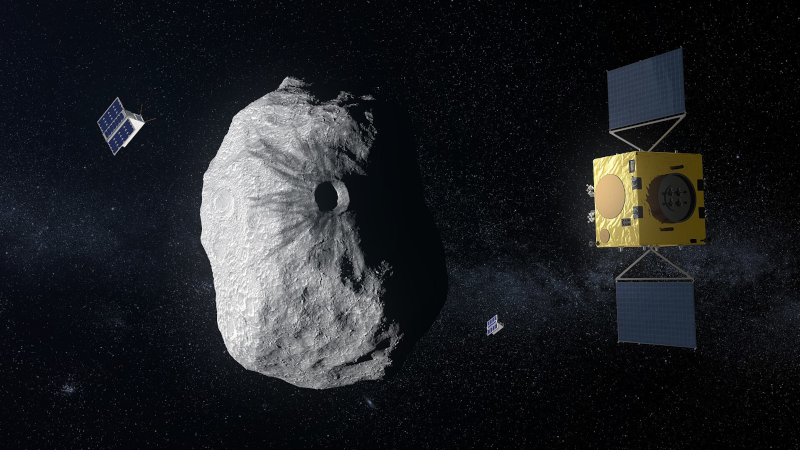
The European Space Agency’s Hera spacecraft is on course for a November 2026 rendezvous with the Didymos binary asteroid system, carrying with it the culmination of humanity’s first attempt to change the orbit of a celestial body. Launched in October 2024 aboard a SpaceX Falcon 9, Hera is now completing the final leg of its 24-month journey, having already executed a critical deep-space maneuver in February-March 2026 that refined its trajectory toward the asteroid pair.
The mission represents the follow-up to NASA’s Double Asteroid Redirection Test, which struck the moonlet Dimorphos in September 2022 at approximately 6.6 kilometers per second. That impact shortened Dimorphos’s orbital period around its parent asteroid Didymos by about 32 minutes, and that seemed dramatic until subsequent research revealed something even more significant: the entire binary system’s orbit around the Sun had actually shifted by more than 10 micrometers per second. For the first time in history, human activity had measurably altered an asteroid’s solar orbit.
Hera’s primary objective is to document what happened. The spacecraft carries three main instruments: an Asteroid Framing Camera that will map the surface in color, a thermal infrared imager to measure temperatures across the moonlet, and a laser altimeter to precisely gauge topography. The spacecraft also carries two briefcase-sized CubeSats named Milani and Juven tas that will deploy once Hera arrives at Didymos. Milani will analyze surface composition using spectroscopy, while Juven tas will attempt a landing on Dimorphos to measure subsurface density using ground-penetrating radar.
When Hera enters orbit around Didymos in late 2026, it will begin mapping the impact crater created by DART. The spacecraft will approach to within a few hundred meters of the asteroid, close enough to produce images with 10-centimeter resolution. This close proximity work represents some of the most demanding navigation in deep space, requiring software that can reconstruct the environment from cameras and sensors in real-time.
The February 2026 trajectory correction burned 123 kilograms of propellant, the largest maneuver of the mission. This burn aligned Hera for the approach phase that will bring it to Didymos in November. Ground controllers at the European Space Operations Centre in Darmstadt monitored the burn, which lasted just under three minutes and changed the spacecraft’s velocity by approximately 180 meters per second.
Data from Hera will inform future planetary defense strategies. The kinetic impactor technique demonstrated by DART works, but questions remain about exactly how efficiently momentum transfers from an impact to an asteroid. The density and porosity of the target affect outcomes significantly. If an asteroid is rubble-pile in structure, held together by its own gravity, impact energy spreads differently than if it were solid rock. Hera will answer these questions.
When a spacecraft collides with an asteroid, the resulting deflection depends on several factors described by the momentum equation p = mv, where momentum equals mass times velocity. The spacecraft carries momentum equal to its mass multiplied by its impact velocity. But the asteroid also receives momentum from ejected material accelerated away from the impact site. This “bonus” momentum from ejecta can substantially exceed the spacecraft’s incoming momentum, sometimes doubling or even tripling the effective deflection.
The efficiency is measured by beta, a factor indicating how much more effective the impact is than the spacecraft alone. DART achieved a beta of approximately 2.5, meaning the deflection was 2.5 times what the spacecraft’s momentum alone would predict. Hera will measure beta more precisely, enabling accurate predictions for real threat scenarios.
The challenge for future missions is timing. A deflection works best when performed years in advance, as even a small velocity change accumulates over multiple orbits. The earlier the intervention, the less delta-v is required. For an asteroid discovered decades before potential impact, a gentle push could suffice where a late intervention might require unprecedented velocities.



 Subscribe to blog posts using RSS












