


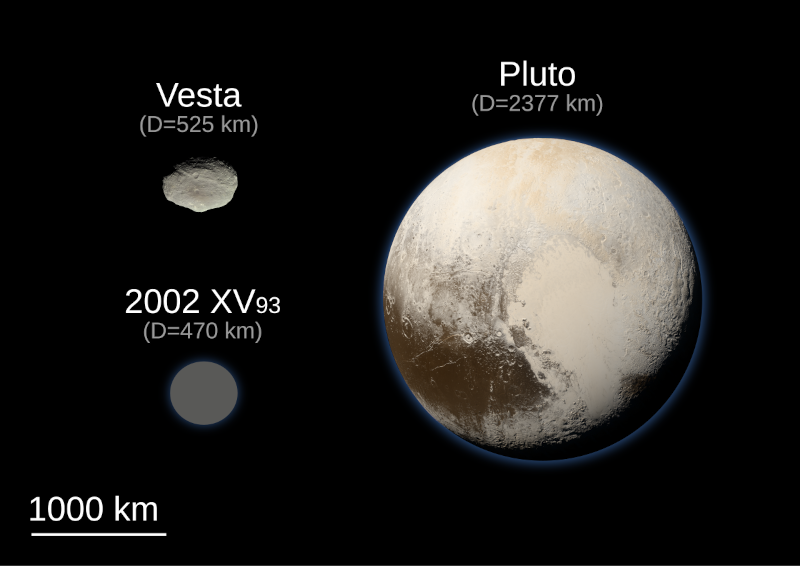
For decades, the assumption among planetary scientists was straightforward: small bodies in the outer solar system are too cold, too low in gravity, and too distant from the Sun to hold onto any significant atmosphere. Pluto had been known to have one since the 1980s, but Pluto is large — roughly 2,400 kilometers in diameter, large enough to retain a thin nitrogen atmosphere through a combination of low temperature and sufficient surface gravity. The same was assumed to be true for Eris and Makemake, the other dwarf planets in the Kuiper Belt. But small trans-Neptunian objects, the hundreds of thousands of bodies that orbit beyond Neptune, were expected to lack atmospheres entirely.
On May 4, 2026, a team led by Ko Arimatsu at the National Astronomical Observatory of Japan published a paper in Nature Astronomy reporting the detection of an atmosphere on the trans-Neptunian object (612533) 2002 XV93. The discovery changes that assumption.
2002 XV93 is a plutino — a class of trans-Neptunian objects that orbit in a 3:2 resonance with Neptune, completing two orbits for every three that Neptune makes. It is roughly 500 kilometers in diameter, about one-fifth the size of Pluto, and at the time of the observation it was approximately 5.5 billion kilometers from Earth. The detection method was a stellar occultation: the team observed the asteroid passing in front of a distant star, measuring how the starlight dimmed as 2002 XV93 moved across the line of sight. In an ordinary occultation by an airless body, the starlight drops abruptly and recovers in the same way. In this case, the dimming was gradual, stretching over roughly 1.5 seconds as the star passed through the atmosphere, its light refracted by gas surrounding the small body.
The surface pressure was estimated at 100 to 200 nanobars — roughly 100 times less than Pluto’s atmosphere, and 50 to 100 million times less than Earth’s sea-level pressure. At temperatures of 40 to 50 kelvin, nitrogen and methane ices on the surface could be in a state of slow sublimation, releasing gas into a thin envelope around the body. But the pressure measurement raises an immediate question: at 500 kilometers across, 2002 XV93 should not be able to hold onto an atmosphere for long. Its surface gravity is too weak to retain gas against the thermal escape processes that drain atmospheres into space. An atmosphere at this pressure should dissipate within roughly a thousand years.
Two possible explanations have been proposed. The first is cryovolcanism — ice eruptions on the surface that continuously replenish gas lost to space, maintaining a steady-state atmosphere through ongoing geological activity. The second is a recent impact event that cracked the interior and released volatiles that are currently slowly escaping. JWST observations have found no detectable surface gases, adding a layer of mystery to the finding. The team acknowledges that the atmosphere may be transient, a short-lived phenomenon that will not persist on astronomical timescales.
The scientific significance is not limited to 2002 XV93 itself. The detection demonstrates that small TNOs can retain atmospheres under conditions that models had suggested were prohibitive. If cryovolcanism is the mechanism, it implies that these distant worlds are more geologically active than previously believed. Other dwarf planets and large TNOs may harbor similar transient atmospheres that have simply not been observed yet. The finding redefines the boundary between airless and atmosphere-bearing bodies in the outer solar system.
The discovery also showcases the power of stellar occultation surveys, which can detect atmospheric signatures that would be invisible to direct telescopic observation. Arimatsu’s team used observations from multiple Japanese sites, including telescopes operated by amateur astronomers, to triangulate the geometry and measure the pressure gradient. The approach demonstrates that targeted occultation surveys can characterize the atmospheres of small bodies at distances where direct sensing is impractical.
The condition for a body to retain an atmosphere against thermal escape is determined by the ratio of gravitational binding energy to the thermal energy of gas molecules. For Earth-temperature conditions, hydrogen and helium escape readily because their molecules move at velocities that approach or exceed the body’s escape velocity. At 40 to 50 kelvin, however, the average molecular velocity is much lower, and only light gases like hydrogen and helium are prone to rapid escape. Nitrogen and methane, being heavier molecules, have lower average velocities at the same temperature, making them more readily retained.
The escape velocity from 2002 XV93 is roughly 0.2 kilometers per second — tiny compared to Earth’s 11.2 kilometers per second. At 50 kelvin, the mean thermal velocity of nitrogen molecules is about 0.14 kilometers per second, which is a substantial fraction of the escape velocity. This means that nitrogen molecules at the top of the atmosphere are not strongly bound, and a continuous supply mechanism is required to maintain the observed pressure. The Jean’s escape parameter, which quantifies the fraction of molecules with velocities exceeding escape velocity, is close to unity for this body — a marginal condition that explains why the atmosphere is so thin.
The discovery of an atmosphere on 2002 XV93 adds a new dimension to the taxonomy of trans-Neptunian objects. Where they were once categorized by size, orbital class, and surface color, the possibility of atmospheric activity introduces a geologically active category that was previously unknown beyond the realm of the gas and ice giants. The outer solar system is more complicated, and more interesting, than the textbooks suggested.
 Subscribe to our RSS feed









There are no comments.
Add A Comment