


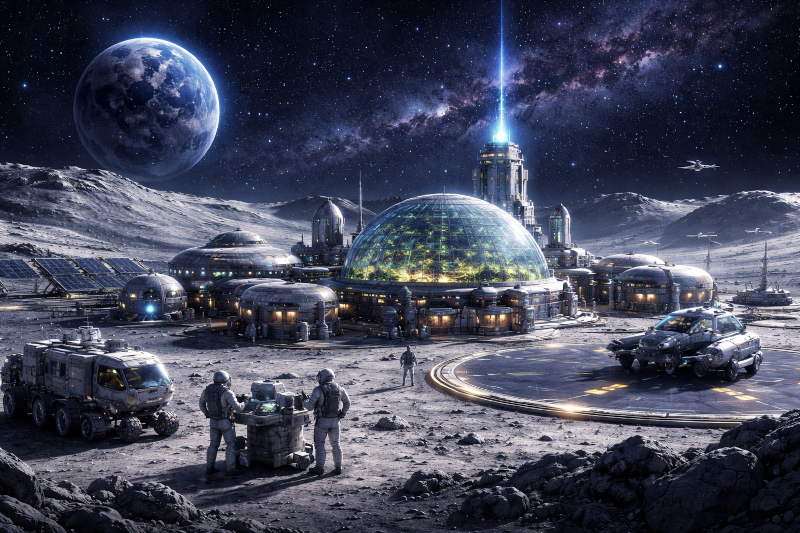
NASA announced a fundamental shift in its lunar architecture on March 24, 2026, halting development of the lunar Gateway in favor of building a permanent base on the Moon’s surface. The decision marks the most significant restructuring of the Artemis program since its inception, redirecting billions of dollars and years of engineering work toward a different vision of sustained human presence beyond Earth orbit.
During an event at NASA Headquarters titled “Ignition,” agency officials outlined plans to spend $20 billion over seven years developing a lunar base at the Moon’s south pole. Program executive Carlos Garcia-Galan described the approach as “building humanity’s first deep space outpost,” emphasizing that surface operations take priority over orbital infrastructure that had been in development for nearly a decade.
The lunar base will proceed in three phases. Phase 1, spanning 2026 to 2028, focuses on establishing reliable access to the lunar surface through increased landing missions via the Commercial Lunar Payload Services program. This phase prioritizes developing enabling technologies and gathering “ground truth” data about potential base locations near permanently shadowed craters where water ice deposits may exist. Phase 2, from 2029 through 2031, begins constructing the actual base infrastructure including communications, navigation, power systems, and supporting two crewed missions per year. Phase 3, beginning in 2032, enables what Garcia-Galan described as “long distance and long duration human exploration” with routine logistics deliveries and the first uncrewed cargo return missions from the lunar surface.
The financial commitment breaks down to approximately $10 billion each for Phases 1 and 2, with Phase 3 requiring an additional $10 billion or more extending through at least 2036. The funding represents a substantial reallocation from the Gateway program, which had received $2.6 billion in a budget reconciliation bill passed last July that defined the facility in law as “an outpost in orbit around the Moon.”
Gateway development will pause in its current form, though NASA will work to repurpose systems already under development, including the Power and Propulsion Element and the Habitation and Logistics Outpost, for use in the lunar base or other programs. Administrator Jared Isaacman stated that shifting workforce priorities to the surface “does not preclude revisiting the orbital outpost in the future,” leaving the door open for a potential Gateway return if circumstances change.
The decision reflects a fundamental reevaluation of what infrastructure actually enables human exploration. When NASA began developing the Gateway several years ago, the orbital facility was intended to support crewed landings at the lunar south pole, providing a staging point for descents to the surface. However, agency officials concluded that while the Gateway remains “relevant for future exploration goals, it is not required to accomplish our primary objectives” of establishing sustained surface operations.
The lunar base will incorporate new capabilities beyond existing programs. One example is MoonFall, a drone designed to hop between locations on the lunar surface, building on the heritage of Ingenuity, the small helicopter that operated on Mars. “We’re going to take everything that we learned from Ingenuity’s systems, the avionics, all of that, to build this,” Garcia-Galan noted.
The Lunar Terrain Vehicle program will also see significant changes. NASA concluded that the current approach would not deliver a crew-capable rover until 2030, which was deemed too slow. The agency is instead issuing a draft request for proposals for simplified rovers that could be developed more quickly but upgraded later as requirements evolve.
Any shift from the Gateway to a lunar base requires congressional approval, as current law defines the Gateway project in specific terms. NASA officials acknowledged this constraint but emphasized the urgency of the decision, arguing that the current trajectory would not achieve the agency’s stated goal of sustained human presence on the Moon.
Building a permanent base on the Moon presents engineering challenges fundamentally different from developing orbital infrastructure. The lunar surface experiences extreme temperature variations, with temperatures swinging from approximately 127 degrees Celsius during daylight to minus 173 degrees Celsius at night in equatorial regions. At the south pole, where NASA plans to locate the base, temperatures remain more stable in permanently shadowed regions but present other challenges related to lighting and access to water ice.
Power generation on the lunar surface relies primarily on solar energy, though the south pole location provides unique advantages. Within certain craters, sunlight never directly illuminates the surface, but rim regions receive nearly continuous illumination during the lunar day. This enables solar panels to generate power during approximately 80% of each Earth month, with the remaining period requiring stored energy from batteries or alternative sources.
Life support systems for a lunar base must recycle resources far more efficiently than the International Space Station, which receives regular resupply missions. NASA’s experience with the Environmental Control and Life Support System on the ISS has informed designs for closed-loop systems that recover water from atmospheric humidity, urine processing, and carbon dioxide removal using molecular sieves and regenerative systems.
Communications with Earth from the lunar surface involves a one-way light time of approximately 1.3 seconds, enabling near-real-time voice and data communication but requiring different protocols than ISS operations. Relay satellites in lunar orbit or at Earth-Sun Lagrange points could provide additional connectivity options and redundancy.
The regolith, the layer of loose material covering the lunar surface, poses both challenges and opportunities. Its abrasive properties require careful consideration for equipment operation, but it also contains resources that could support future in-situ resource utilization, including oxygen extracted from silicon oxide and metals from iron oxide. NASA plans to investigate these possibilities during Phase 1 as part of the base site characterization effort.


 Subscribe to our RSS feed













There are no comments.
Add A Comment