


The James Webb Space Telescope continues to transform our understanding of galactic structure and evolution, with researchers announcing multiple significant discoveries in early 2026. New observations have revealed both stunning visual details of nearby spiral galaxies and unexpected findings about galactic architecture in the early universe.
A team of researchers using Webb data announced the discovery of a barred spiral galaxy existing a remarkably short time after the Big Bang, challenging existing models of galactic formation and evolution. The galaxy, informally designated Alaknanda, shows structural maturity typically associated with galaxies billions of years older. The discovery suggests that physical processes driving galaxy formation, including gas accretion, disk settling, and spiral density wave development, may operate more efficiently than current theoretical models predict.
Dr. Amanda Garfield, an astrophysicist at the University of Pittsburgh and lead author of the study, noted that finding such a well-organized spiral disk at this epoch was unexpected. The bar structure, a linear feature extending from galactic centers that helps funnel material inward, was thought to require substantial time to develop through gravitational interactions and dynamical evolution.
The observations indicate that the universe was capable of producing structurally mature galaxies much earlier than previously believed. This finding has prompted astrophysicists to reconsider the initial conditions and feedback mechanisms involved in galaxy formation, potentially requiring revisions to cosmological simulations that model the evolution of cosmic structure.
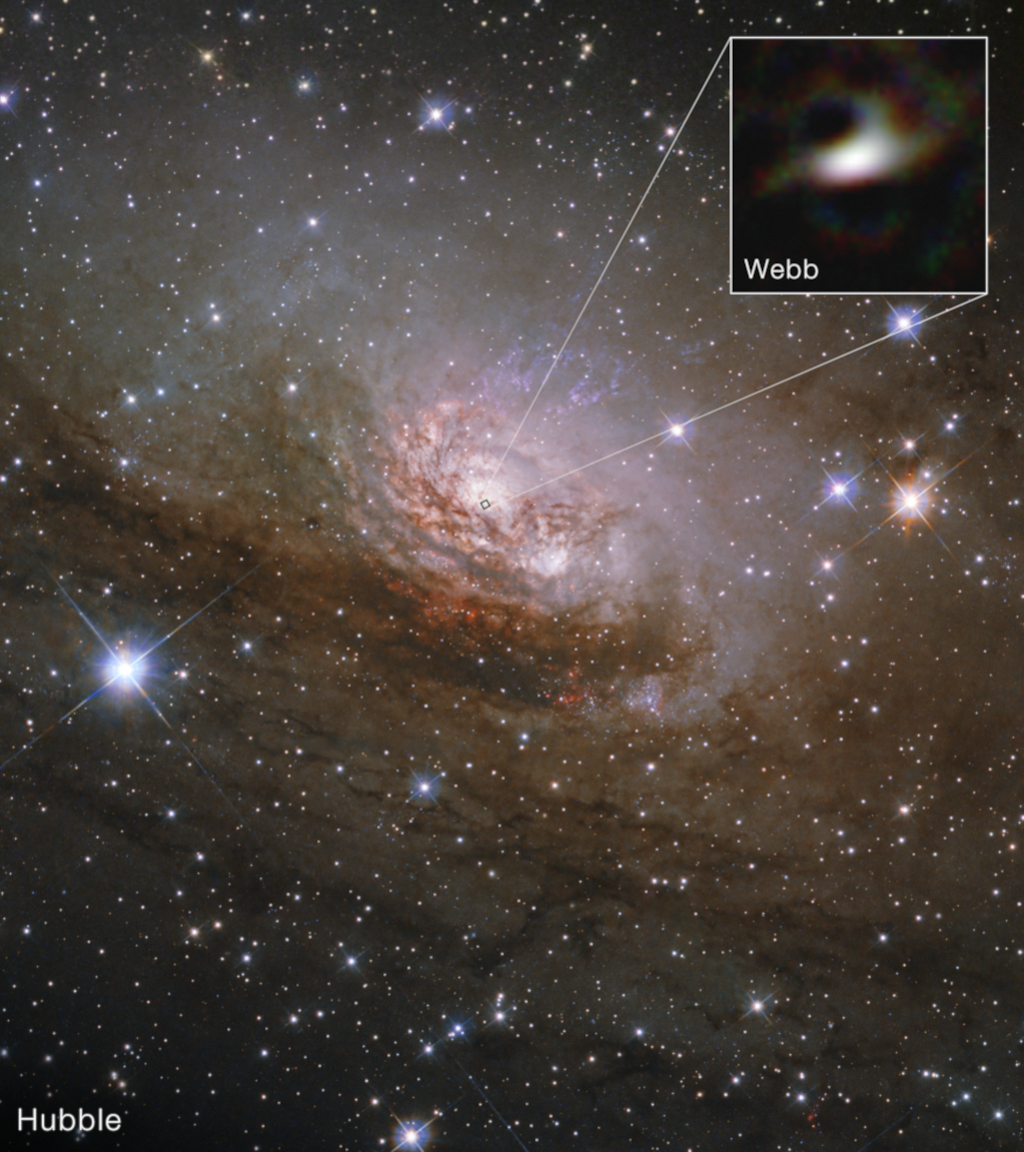
In separate observations, Webb captured a spectacular new image of the Circinus Galaxy, located approximately 14 million light-years from Earth in the constellation Circinus. The composite visualization combines data from both the Hubble Space Telescope and the James Webb Space Telescope, revealing details invisible to previous observatories. Webb’s infrared capabilities penetrate the thick dust clouds that obscure the galactic center in optical images, exposing the glowing inner regions of the active galactic nucleus.
The Circinus Galaxy represents a Seyfert galaxy, a class of active galaxies characterized by extremely luminous cores powered by accretion onto a supermassive black hole. Webb’s mid-infrared observations reveal the structure of the torus-shaped dust cloud surrounding the central engine, providing new data about the physical conditions in these energetic galactic regions.
The telescope’s high-resolution imaging also continues to yield detailed views of stellar nurseries within spiral arms. The intricate networks of dusty filaments and hot young star clusters, previously obscured by interstellar dust, are now visible in unprecedented detail. These observations help astronomers understand the cycle of star formation and the ways that massive stars influence their galactic environments through radiation pressure, stellar winds, and supernova explosions.
The 19 nearby spiral galaxies observed as part of Webb’s PHANGS (Physics at High Angular Resolution in Nearby Galaxies) program have provided a statistical sample for studying the relationship between galactic structure and star formation. The combination of near-infrared and mid-infrared imaging allows researchers to simultaneously observe both the older stellar populations in galactic cores and the youngest stellar objects embedded in dust clouds along spiral arms.
Webb’s capabilities have fundamentally changed the field of extragalactic astronomy in the years since its launch. The observatory’s large mirror and sensitive infrared instruments enable observations that were previously impossible, opening new windows into galactic dynamics, black hole physics, and the early universe. Researchers around the world continue to analyze the torrent of data flowing from the telescope, with each discovery raising new questions about the nature of cosmic structure and evolution.
 Subscribe to our RSS feed









There are no comments.
Add A Comment