


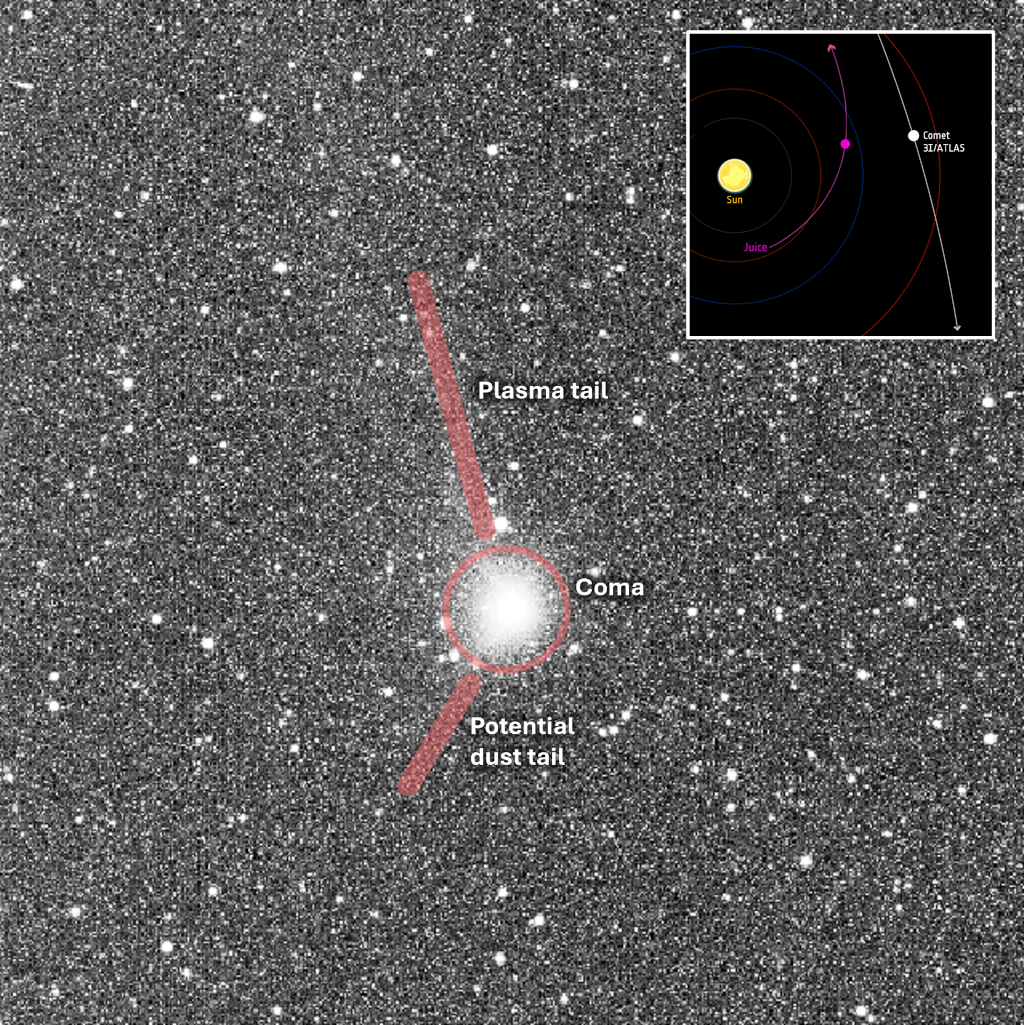
The European Space Agency’s Jupiter Icy Moons Explorer, known as JUICE, has achieved an unexpected milestone in its journey toward the Jovian system by capturing the first detailed images of interstellar comet 3I/ATLAS. The spacecraft, currently en route to study Jupiter and its ocean-bearing moons, turned its instruments toward the visitor from beyond our solar system in late February 2026, producing remarkable imagery that reveals the comet’s structure in unprecedented detail.
Comet 3I/ATLAS represents only the third confirmed interstellar object ever detected in our solar system, following the discoveries of 1I/’Oumuamua in 2017 and 2I/Borisov in 2019. While those objects provided valuable glimpses into planetary formation processes elsewhere in the galaxy, 3I/ATLAS offered something unique: an approach to the inner solar system that allowed multiple spacecraft and ground-based observatories to observe it simultaneously. JUICE’s position and instrumentation made it particularly well-suited for this unexpected observation opportunity.
The images captured by JUICE’s science camera show the comet’s nucleus surrounded by a luminous coma, the glowing envelope of gas and dust that forms when solar radiation heats the icy body. A distinct tail extends away from the Sun, consisting of particles pushed outward by solar radiation pressure. The spacecraft observed the comet at a distance of approximately 50 million kilometers, close enough to resolve features that ground-based telescopes could only glimpse indirectly.
The JUICE mission was designed primarily for planetary science, with its ten scientific instruments optimized for studying Jupiter’s atmosphere, magnetosphere, and the subsurface oceans suspected to exist beneath the icy crusts of Ganymede, Callisto, and Europa. The spacecraft launched from French Guiana in April 2023 and has been performing a complex trajectory that includes multiple gravity assists, including an unprecedented double Earth-Moon flyby in August 2024. The encounter with 3I/ATLAS represents a bonus observation that demonstrates the versatility of the spacecraft’s instrumentation.
Interstellar comets provide scientists with a rare opportunity to study material from other planetary systems without the need for interstellar travel. The composition of such objects, preserved since their formation around another star, carries chemical fingerprints that may inform our understanding of how planets form and evolve throughout the galaxy. 3I/ATLAS exhibited characteristics consistent with comets originating from distant, cool stellar environments, with activity levels suggesting the release of water vapor, carbon dioxide, and other volatiles as it approached the Sun.
The JUICE observations were not without technical challenges. The spacecraft’s medium-gain antenna had to be used for data transmission rather than the high-gain antenna, reducing the data rate due to the spacecraft’s orientation relative to the Sun and Earth. Despite these constraints, the mission team successfully retrieved images that have already contributed to scientists’ understanding of cometary activity mechanisms.
Beyond the immediate scientific value, the JUICE observations highlight the importance of spacecraft flexibility and the potential for serendipitous discoveries in space exploration. Planetary missions often encounter unexpected targets or phenomena that fall outside their primary objectives but represent valuable science opportunities. TheJUICE team’s ability to reorient the spacecraft and repurpose its instruments on short notice reflects both the spacecraft’s robust design and the team’s scientific adaptability.
As 3I/ATLAS continues its journey back toward interstellar space, observations from JUICE will be supplemented by other missions and facilities. The Juno spacecraft orbiting Jupiter may observe the comet during its close approach to the giant planet in March 2026, though fuel constraints and operational priorities complicate any potential redirection. Each new observation adds to our growing picture of these interstellar travelers and what they can teach us about the cosmos beyond our own solar system.


 Subscribe to our RSS feed













There are no comments.
Add A Comment