
OrbitalHub

The place where space exploration, science, and engineering meet

Domain is for sale. $50,000,000.00 USD. Direct any inquiries to contact@orbitalhub.com.

Archive for 2017

April 14, 2017

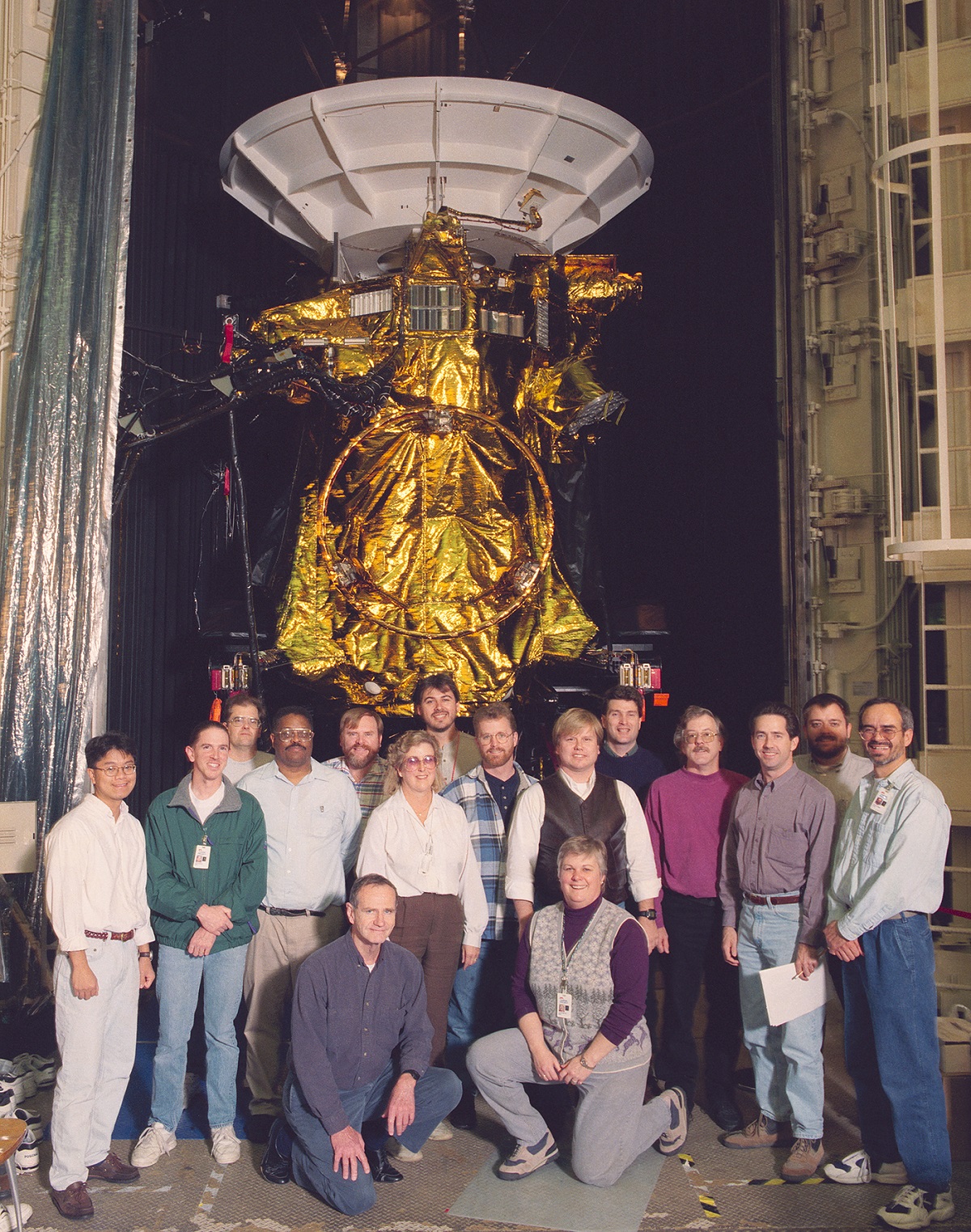
Cassini Assembly, Test and Launch Team

Posted by


NASA dixit:

“February 21, 1997. Julie Webster, Cassini’s manager of spacecraft operations (kneeling, right), and the rest of the mission’s assembly, test and launch operations (ATLO) team pose with the spacecraft outside the Jet Propulsion Laboratory’s Space Simulator.”

“After almost 20 years in space, NASA’s Cassini spacecraft begins the final chapter of its remarkable story of exploration: its Grand Finale. Between April and September 2017, Cassini will undertake a daring set of orbits that is, in many ways, like a whole new mission. Following a final close flyby of Saturn’s moon Titan, Cassini will leap over the planet’s icy rings and begin a series of 22 weekly dives between the planet and the rings.

No other mission has ever explored this unique region. What we learn from these final orbits will help to improve our understanding of how giant planets – and planetary systems everywhere – form and evolve.

On the final orbit, Cassini will plunge into Saturn’s atmosphere, sending back new and unique science to the very end. After losing contact with Earth, the spacecraft will burn up like a meteor, becoming part of the planet itself.

Cassini’s Grand Finale is about so much more than the spacecraft’s final dive into Saturn. That dramatic event is the capstone of six months of daring exploration and scientific discovery. (And those six months are the thrilling final chapter in a historic 20-year journey.)”

Image credit: NASA / Jet Propulsion Laboratory – Caltech / Bob Brown


  • Facebook
  • Google
  • Slashdot
  • Reddit
  • Live
  • TwitThis
April 9, 2017

Thomas Pesquet’s Unedited Spacewalk

Posted by


ESA dixit:

“This unedited video without sound lasts over five hours and shows almost all of ESA astronaut Thomas Pesquet’s spacewalk outside the International Space Station.

NASA astronaut Shane Kimbrough and Thomas left the International Space Station airlock 24 March 2017 on their second spacewalk together. Thomas and Shane worked separately throughout their sortie.

Thomas was tasked to inspected the Station’s cooling system for leaks. He took photos and videos as he patted and prodded the cooling pipes to see if any coolant leaked out. This video starts when he turns on the camera used to record cooling system inspection for analysis by ground control.

Thomas’ second task was to maintain the multipurpose robotic hand Dextre – he had the laborious job of applying lubricant. After setting up a foot restraint to allow him to work with both hands, NASA astronaut Peggy Whitson moved Dextre into position using the controls inside the Station.

The video ends with Thomas returning to the Quest airlock – the spacewalk lasted six hours and 34 minutes in total with time spent in the airlock included.

Thomas is spending six months on the International Space Station as part of his Proxima mission. During Proxima, Thomas will perform around 50 scientific experiments for ESA and France’s space agency CNES as well as take part in many research activities for the other Station partners.

The mission is part of ESA’s vision to use Earth-orbiting spacecraft as a place to live and work for the benefit of European society while using the experience to prepare for future voyages of exploration further into the Solar System.”

Video credit: ESA


  • Facebook
  • Google
  • Slashdot
  • Reddit
  • Live
  • TwitThis
April 4, 2017

Cassini’s Grand Finale

Posted by


NASA dixit:

“After almost 20 years in space, NASA’s Cassini spacecraft begins the final chapter of its remarkable story of exploration: its Grand Finale. Between April and September 2017, Cassini will undertake a daring set of orbits that is, in many ways, like a whole new mission. Following a final close flyby of Saturn’s moon Titan, Cassini will leap over the planet’s icy rings and begin a series of 22 weekly dives between the planet and the rings.

No other mission has ever explored this unique region. What we learn from these final orbits will help to improve our understanding of how giant planets – and planetary systems everywhere – form and evolve.

On the final orbit, Cassini will plunge into Saturn’s atmosphere, sending back new and unique science to the very end. After losing contact with Earth, the spacecraft will burn up like a meteor, becoming part of the planet itself.

Cassini’s Grand Finale is about so much more than the spacecraft’s final dive into Saturn. That dramatic event is the capstone of six months of daring exploration and scientific discovery. (And those six months are the thrilling final chapter in a historic 20-year journey.)

At times, the spacecraft will skirt the very inner edge of the rings; at other times, it will skim the outer edges of the atmosphere. While the mission team is confident the risks are well understood, there could still be surprises. It’s the kind of bold adventure that could only be undertaken at the end of the mission.

Cassini’s final images will have been sent to Earth several hours before its final plunge, but even as the spacecraft makes its fateful dive into the planet’s atmosphere, it will be sending home new data in real time. Key measurements will come from its mass spectrometer, which will sample Saturn’s atmosphere, telling us about its composition until contact is lost.

While it’s always sad when a mission comes to an end, Cassini’s finale plunge is a truly spectacular end for one of the most scientifically rich voyages yet undertaken in our solar system. From its launch in 1997 to the unique Grand Finale science of 2017, the Cassini-Huygens mission has racked up a remarkable list of achievements. “

Video credit: NASA Jet Propulsion Laboratory


  • Facebook
  • Google
  • Slashdot
  • Reddit
  • Live
  • TwitThis
April 3, 2017

SDO Year 7

Posted by


NASA dixit:

“The Solar Dynamics Observatory (SDO) has now captured nearly seven years worth of ultra-high resolution solar footage. This time lapse shows that full run from two of SDO’s instruments. The large orange sun is visible light captured by HMI. The smaller golden sun is extreme ultraviolet light from AIA and reveals some of the suns atmosphere, the corona. Both appear at one frame every 12 hours. SDO’s nearly unbroken run is now long enough to watch the rise and fall of the current solar cycle. The graph of solar activity shows the sunspot number, a measurement based on the number of individual spots and the number of sunspot groups. In this case, the line represents a smoothed 26-day average to more clearly show the overall trend.”

Video credit: NASA’s Goddard Space Flight Center/Scott Wiessinger


  • Facebook
  • Google
  • Slashdot
  • Reddit
  • Live
  • TwitThis
March 30, 2017

Sentinel-2B

Posted by


ESA dixit:

“Each of the SENTINEL-2 satellites weighs approximately 1.2 tonnes, and is designed to be compatible with small launchers like VEGA and ROCKOT. The satellite lifespan is 7.25 years, which includes a 3 month in-orbit commissioning phase. Batteries and propellants have been provided to accommodate 12 years of operations, including end of life de-orbiting manoeuvres.

Two identical SENTINEL-2 satellites will operate simultaneously, phased at 180° to each other, in a sun-synchronous orbit at a mean altitude of 786 km. The position of each SENTINEL-2 satellite in its orbit will be measured by a dual-frequency Global Navigation Satellite System (GNSS) receiver. Orbital accuracy will be maintained by a dedicated propulsion system.

The SENTINEL-2 satellite system is being developed by an industrial consortium led by Astrium GmbH (Germany). Astrium SAS (France) is responsible for the MultiSpectral Instrument (MSI).

The MSI works passively, by collecting sunlight reflected from the Earth. New data is acquired at the instrument as the satellite moves along its orbital path. The incoming light beam is split at a filter and focused onto two separate focal plane assemblies within the instrument; one for Visible and Near-Infra-Red (VNIR) bands and one for Short Wave Infra-Red (SWIR) bands . The spectral separation of each band into individual wavelengths is accomplished by stripe filters mounted on top of the detectors.”

Video credit: ESA


  • Facebook
  • Google
  • Slashdot
  • Reddit
  • Live
  • TwitThis


NASA dixit:

“The U.S. commercial SpaceX Dragon cargo craft was released from the International Space Station’s Canadarm2 robotic arm in the early hours of March 19, after spending more than three weeks at the orbital outpost. During that time, the crew onboard transferred onto the station several tons of supplies and scientific investigations delivered by Dragon. Expedition 50 crew members Thomas Pesquet of ESA (European Space Agency) and Commander Shane Kimbrough of NASA bid farewell to Dragon as the resupply craft moved to a safe distance away from the complex for its deorbit engine firing and a parachute-assisted splashdown in the Pacific. Dragon is returning critical science experiments for investigators back on the Earth.”

Video credit: NASA


  • Facebook
  • Google
  • Slashdot
  • Reddit
  • Live
  • TwitThis





