


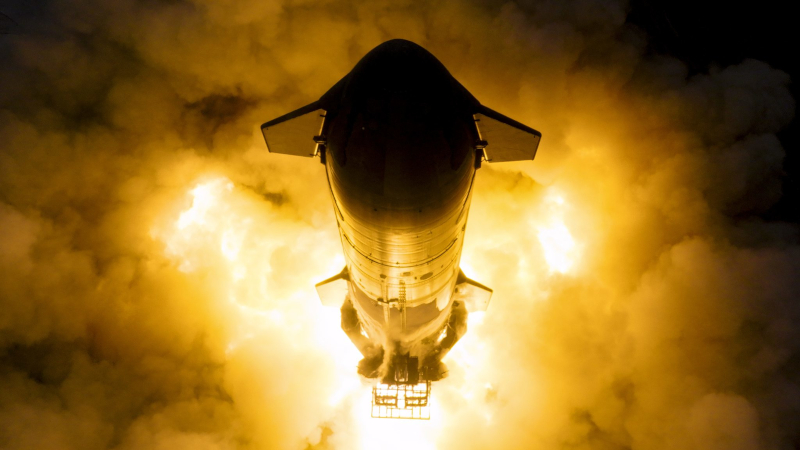
The next integrated test of Starship is positioned as a configuration transition rather than a routine increment. Flight 12, targeting early to mid-May 2026 from Starbase Orbital Launch Pad 2, is the first mission planned to use Version 3 (Block 3) hardware. The flight stack—Super Heavy Booster 19 and Starship Ship 39—incorporates design changes intended to improve propulsion performance, structural efficiency, and overall system reliability.
Pre-flight validation has centered on static fire testing. On April 15, 2026, Booster 19 executed a full-duration ignition of all 33 engines at the McGregor test facility. This was the first complete integrated test of the updated propulsion configuration using Raptor 3 engines. The preceding day, Ship 39 conducted a static fire of its six engines, including vacuum-optimized variants. These tests are designed to verify ignition sequencing, thrust vector control response, propellant flow stability, and structural load handling prior to flight.
The propulsion system is the primary area of change in Version 3. The Raptor engine operates on a full-flow staged combustion cycle using liquid methane and liquid oxygen. In this cycle, both propellants are fully gasified in separate preburners before entering the main combustion chamber. This approach allows for high chamber pressures and improved efficiency relative to simpler cycles, but it requires precise control of turbomachinery and flow balance. The Raptor 3 iteration focuses on simplification and integration. External plumbing has been reduced, and thermal management features are incorporated more directly into the engine structure. The intent is to decrease part count, reduce mass, and improve manufacturability while maintaining or increasing performance.
For Booster 19, the use of 33 engines introduces additional system-level considerations. Engine-out capability, thrust balancing, and control authority must be validated under conditions where all engines are firing simultaneously. The static fire provides data on pressure stability across the propellant manifolds, synchronization of ignition timing, and the response of the thrust vector control system. Structural loads transmitted through the thrust puck and into the booster’s primary structure are measured and compared against design predictions.
Ship 39’s propulsion configuration includes both sea-level and vacuum-optimized engines. The vacuum engines use larger expansion ratio nozzles to increase exhaust velocity in low-pressure environments. This improves specific impulse, which is a measure of propulsion efficiency. The trade-off is that these nozzles are not suitable for operation at sea level due to flow separation risks. The combined configuration allows the vehicle to operate efficiently across ascent and in-space phases. Static fire testing of Ship 39 validates ignition reliability, mixture ratio control, and thermal behavior of the extended nozzles.
Beyond propulsion, Version 3 hardware reflects iterative changes in structure and systems integration. Starship’s primary structure is composed of stainless steel, chosen for its strength at cryogenic temperatures and its ability to tolerate high thermal loads during reentry. Modifications in weld patterns, ring structures, and internal tank geometry are aimed at improving load distribution and reducing mass. These changes must be validated through both ground testing and flight data, as structural margins are closely tied to vehicle performance and reusability goals.
Propellant management is another area of focus. The vehicles use subcooled liquid methane and liquid oxygen, which require careful handling to maintain density and prevent cavitation in turbopumps. Tank pressurization systems must ensure consistent flow to the engines while accommodating changes in acceleration and orientation during flight. Static fire tests provide an opportunity to observe these systems under controlled conditions, including the behavior of autogenous pressurization, where gaseous propellants are used to maintain tank pressure.
The planned flight profile for Flight 12 remains suborbital, consistent with previous integrated tests. This allows the program to evaluate ascent performance, stage separation, and initial reentry behavior without committing to a full orbital insertion. Data collected during ascent will include engine performance metrics, structural loads, and aerodynamic response. Stage separation dynamics are of particular interest, as they involve complex interactions between the booster and upper stage, including plume effects and transient forces.
Reentry testing focuses on thermal protection and guidance. Starship uses a combination of passive and active systems to manage heat loads. The vehicle’s geometry distributes heating across the windward surface, while thermal protection tiles provide insulation. Guidance algorithms control the vehicle’s orientation to maintain a stable descent profile, balancing drag and lift to manage deceleration. Flight 12 is expected to provide additional data on tile performance, attachment reliability, and thermal gradients across the structure.
The integration of these systems reflects a broader engineering approach centered on rapid iteration. Design changes are implemented, tested, and refined in successive vehicles. Static fire campaigns serve as gate checks, confirming that major subsystems perform as expected before flight. The transition to Version 3 hardware indicates that the program has reached a stage where incremental improvements are being consolidated into a more mature configuration.
From a systems engineering perspective, Flight 12 is a validation of integration rather than a demonstration of isolated components. Propulsion, structure, guidance, and thermal systems must operate together under dynamic conditions. The objective is to reduce uncertainty in how these systems interact, providing data that informs future design decisions and operational procedures.
The significance of this flight lies in its role as a configuration baseline. If Version 3 hardware performs as intended, it establishes a reference point for subsequent vehicles, supporting the program’s goal of achieving full reusability. This includes rapid turnaround between flights, consistent performance across missions, and the ability to scale production.
Starship Flight 12 represents a transition to a more integrated and refined vehicle configuration. The static fire tests of Booster 19 and Ship 39 have validated key aspects of the propulsion system and supporting infrastructure. The upcoming flight will extend this validation into operational conditions, providing data on ascent, separation, and reentry. The outcome will determine the effectiveness of the Version 3 design changes and their contribution to the overall development of the launch system.


 Subscribe to our RSS feed













There are no comments.
Add A Comment