


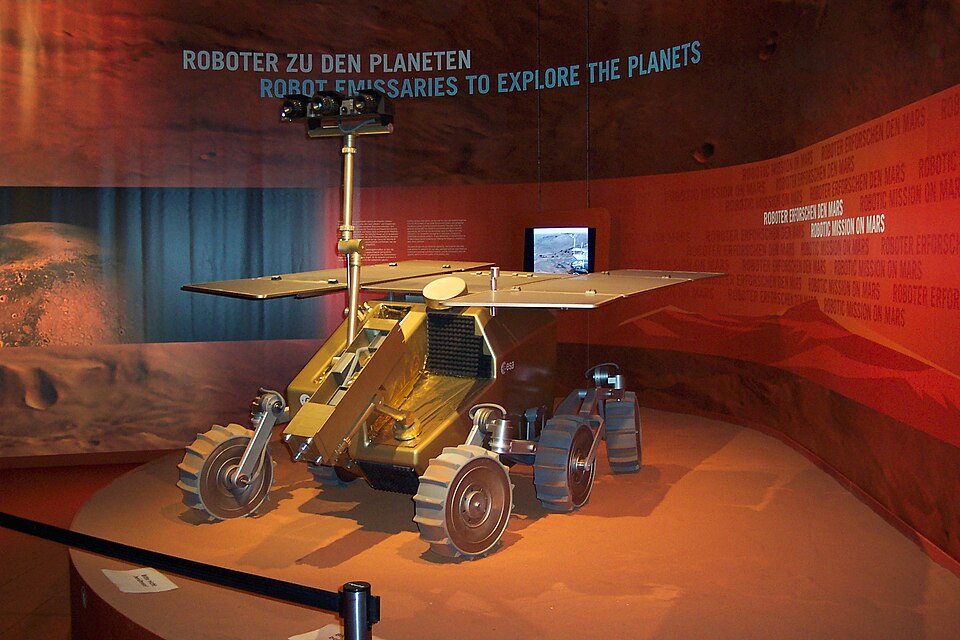
After more than a decade of delays, geopolitical shifts, and mission redesigns, ESA’s Rosalind Franklin rover finally has a confirmed launch provider. NASA announced on April 16, 2026, that SpaceX’s Falcon Heavy will launch the European Mars rover from Kennedy Space Center’s Launch Complex 39A in late 2028, with arrival on the Red Planet expected around late 2030. The contract, worth approximately $176 million through NASA’s Launch Services program, marks SpaceX’s first interplanetary mission to Mars and the culmination of an arduous journey for Europe’s first Mars rover.
The mission’s history reads like a geopolitical drama spanning multiple continents and two decades. Originally conceived in 2001 as part of ESA’s Aurora Programme, the rover was designed to search for biosignatures of past or present life on Mars through the most ambitious subsurface drilling attempt ever attempted on another world. The original plan called for a Russian-provided launch vehicle and landing platform through a partnership with Roscosmos, the Russian space agency. That partnership dissolved following Russia’s invasion of Ukraine in 2022, when ESA member states voted to suspend cooperation with Russia.
The rover’s scientific payload centers on a 2-meter drilling system, nearly double the depth achieved by any previous Mars rover. NASA’s Perseverance, for comparison, drills to 7 centimeters, while the Soviet-era Lunokhod rovers never attempted subsurface sampling on another world. The drill retrieves core samples that have been shielded from the harsh Martian surface radiation and oxidation that destroys organic compounds near the top layer of regolith. Once collected, the samples enter the Analytical Laboratory Drawer, where nine instruments including the Panoramic Camera and mass spectrometer characterize the composition.
The landing site, Oxia Planum, was selected after years of debate among planetary scientists. This region shows evidence of ancient clay mineral formation, which requires liquid water to create. Clay minerals serve as excellent preservers of organic compounds, as they can trap and shield complex molecules from degradation. The choice reflects the mission’s core hypothesis: if life ever arose on Mars, the chemical traces would be most likely to survive in protected subsurface environments.
NASA’s role extends beyond launch services. The agency is providing radioisotope heater units, tiny devices that use the decay heat of plutonium-238 to keep electronics warm during the frigid Martian nights. Without these units, the rover would not survive the temperature swings that plunge to minus 100 degrees Celsius. The Trump administration’s FY2027 budget proposed cutting approximately $100 million from NASA’s ROSA program that funds these contributions, but NASA proceeded with the SpaceX contract regardless, signaling continued commitment to international science partnerships despite broader budget pressures.
The selection of Falcon Heavy from Launch Complex 39A places the mission alongside NASA’s own heavy-lift ambitions. LC-39A has hosted Apollo missions, space shuttles, and Falcon Heavy launches including the historic Tesla Roadster flight in 2018. The capacity to lift approximately 3.5 tonnes to trans-Mars injection provides the delta-v needed for the eight-month journey. The backup launch windows in 2030 avoid the Mars dust storm season that historically has disrupted landing operations.
Drilling into bedrock on Mars presents challenges that exceed any previous subsurface expedition. The 2-meter drill must operate in temperatures ranging from minus 80 degrees to plus 20 degrees Celsius, with the mechanical systems enduring thermal cycling that weakens metals through repeated expansion and contraction. The drill string uses a percussive mechanism similar to rotary hammers, powered by electric motors that must produce sufficient torque while drawing minimal current from the solar panels.
The sample retrieval mechanism seals the cores in containers that maintain the terrestrial context of each sample. On Earth, contamination from drilling fluids and equipment can obscure the scientific signal, so the rover’s sample handling system was designed to minimize terrestrial organic contact. Each core breaks into fragments that fit into the analytical instruments, where the mass spectrometer detects organic compounds through vaporization and ion separation.
Solar power at Mars delivers approximately 40 percent of the energy available at Earth, requiring the largest solar array ever deployed on a planetary rover. The 1,200-watt-hour daily capacity must power movement, drilling operations, instrument analysis, and communications while maintaining survival systems through the Martian night. During dust storms, the array may produce only a fraction of rated power, limiting operations until conditions improve.
 Subscribe to our RSS feed









There are no comments.
Add A Comment