OrbitalHub

The place where space exploration, science, and engineering meet

Domain is for sale. $50,000,000.00 USD. Direct any inquiries to contact@orbitalhub.com.

Archive for 2017

August 20, 2017

TDRS-M Launch

Posted by


NASA dixit:

“On Friday, August 18, NASA launched the third in a series of three advanced, Tracking and Data Relay Satellites, known as TDRS-M, from Cape Canaveral Air Force Station, in Florida. This latest addition to the fleet will augment a space communications network that provides the critical path for high data-rate communication to a host of spacecraft including the International Space Station and its resupply vehicles, the Hubble Space Telescope and many of NASA’s Earth-observing fleet spacecraft.”

Video credit: NASA


  • Facebook
  • Google
  • Slashdot
  • Reddit
  • Live
  • TwitThis
August 17, 2017

Scenic Shock

Posted by


NASA dixit:

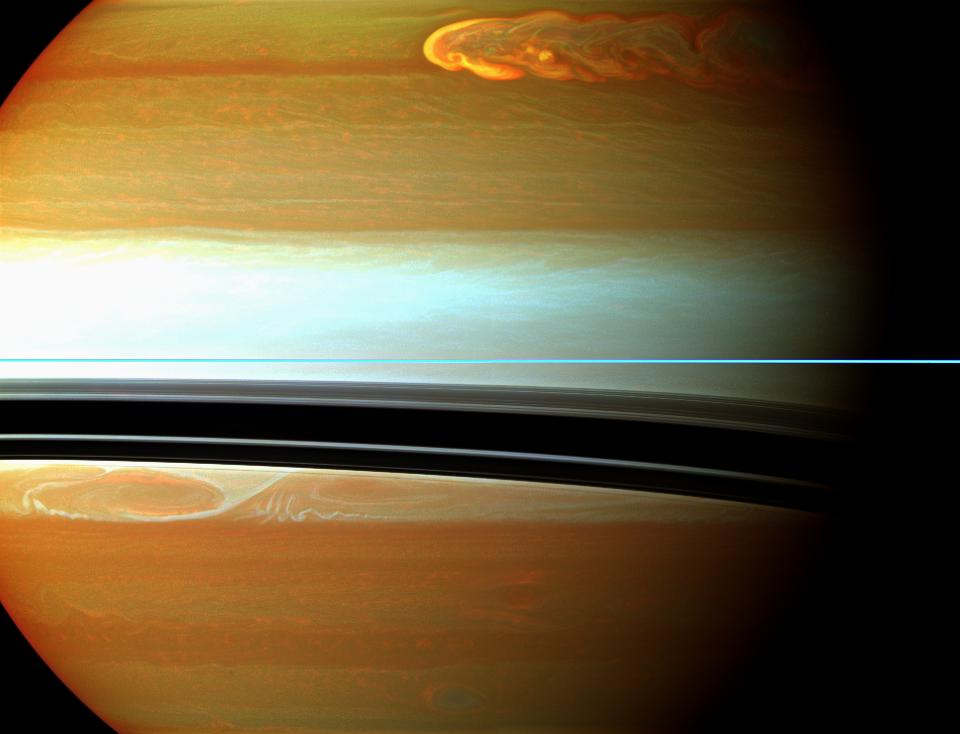
“January 11, 2011. Saturn’s northern storm marches through the planet’s atmosphere in the top right of this false-color mosaic from NASA’s Cassini spacecraft. Saturn’s atmosphere and its rings are shown here in a false-color composite made from 12 images taken in near-infrared light through filters that are sensitive to varying degrees of methane absorption. Red and orange colors in this view indicate clouds that are deep in the atmosphere. Yellow and green colors, most noticeable along the top edge of the view, indicate intermediate clouds. White and blue indicate high clouds and haze. The rings appear as a thin horizontal line of bright blue because they are outside of the atmosphere and not affected by methane absorption.

This view looks toward the northern, sunlit side of the rings from just above the ring plane. The images were taken with the Cassini spacecraft wide-angle camera using a combination of spectral filters sensitive to wavelengths of near-infrared light. The images filtered at 890 nanometers are projected as blue. The images filtered at 728 nanometers are projected as green, and images filtered at 752 nanometers are projected as red.

The images were taken over about 50 minutes, at a distance of approximately 569,000 miles (915,000 kilometers) from Saturn and at a sun-Saturn-spacecraft, or phase, angle of 45 degrees. The images were re-projected to the same viewing geometry, so that scale in this final mosaic is 63 miles (102 kilometers) per pixel.”

“After almost 20 years in space, NASA’s Cassini spacecraft begins the final chapter of its remarkable story of exploration: its Grand Finale. Between April and September 2017, Cassini will undertake a daring set of orbits that is, in many ways, like a whole new mission. Following a final close flyby of Saturn’s moon Titan, Cassini will leap over the planet’s icy rings and begin a series of 22 weekly dives between the planet and the rings.

No other mission has ever explored this unique region. What we learn from these final orbits will help to improve our understanding of how giant planets – and planetary systems everywhere – form and evolve.

On the final orbit, Cassini will plunge into Saturn’s atmosphere, sending back new and unique science to the very end. After losing contact with Earth, the spacecraft will burn up like a meteor, becoming part of the planet itself.

Cassini’s Grand Finale is about so much more than the spacecraft’s final dive into Saturn. That dramatic event is the capstone of six months of daring exploration and scientific discovery. And those six months are the thrilling final chapter in a historic 20-year journey.”

Image credit: NASA

 

  • Facebook
  • Google
  • Slashdot
  • Reddit
  • Live
  • TwitThis
August 17, 2017

SDO Watches a Sunspot Turn Toward Earth

Posted by


NASA dixit:

“An active region on the sun — an area of intense and complex magnetic fields — has rotated into view on the sun and seems to be growing rather quickly in this video captured by NASA’s Solar Dynamics Observatory between July 5-11, 2017. Such sunspots are a common occurrence on the sun, but are less frequent as we head toward solar minimum, which is the period of low solar activity during its regular approximately 11-year cycle. This sunspot is the first to appear after the sun was spotless for two days, and it is the only sunspot group at this moment. Like freckles on the face of the sun, they appear to be small features, but size is relative: The dark core of this sunspot is actually larger than Earth.”

Video credit: NASA


  • Facebook
  • Google
  • Slashdot
  • Reddit
  • Live
  • TwitThis


NASA dixit:

“The SpaceX Falcon 9 rocket launched from the Kennedy Space Center, Florida, on August 14, sent an unpiloted Dragon cargo vehicle on a delivery run to the International Space Station. Loaded with more than three tons of supplies and scientific investigations, the Dragon is scheduled to arrive at the station on August 16 where it will be captured by Expedition 52 crewmembers Jack Fischer of NASA and Paolo Nespoli of the European Space Agency operating the station’s Canadarm2 robotic arm. Dragon will spend about a month attached to the Earth-facing port of the Harmony module.”

Video credit: NASA


  • Facebook
  • Google
  • Slashdot
  • Reddit
  • Live
  • TwitThis
August 15, 2017

Encroaching Shadow

Posted by


NASA dixit:

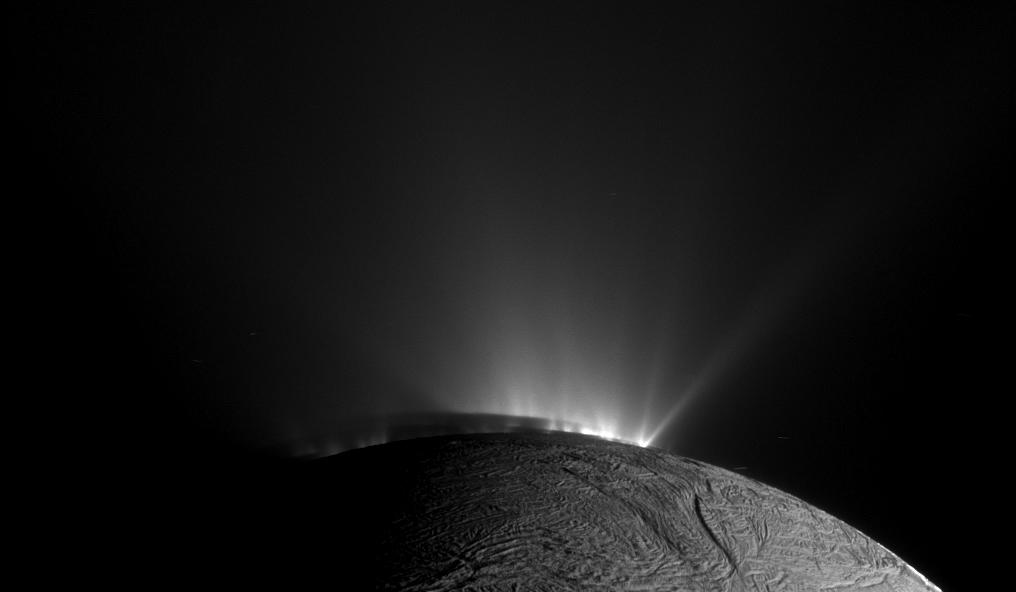
“November 30, 2010. This Cassini narrow-angle camera image — one of those acquired in the survey conducted by the Cassini imaging science team of the geyser basin at the south pole of Enceladus — was taken as Cassini was looking across the moon’s south pole. At the time, the spacecraft was essentially in the moon’s equatorial plane. The image scale is 1280 feet (390 meters) per pixel and the sun-Enceladus-spacecraft, or phase, angle is 162.5 degrees. The image was taken through the clear filter of the narrow angle camera, 1.4 years after southern autumnal equinox. The shadow of the body of Enceladus on the lower portions of the jets is clearly seen.

Post-equinox images like this, clearly showing the different projected locations of the intersection between the shadow and the curtain of jets from each fracture, were useful for scientists in checking the triangulated positions of the geysers.”

“After almost 20 years in space, NASA’s Cassini spacecraft begins the final chapter of its remarkable story of exploration: its Grand Finale. Between April and September 2017, Cassini will undertake a daring set of orbits that is, in many ways, like a whole new mission. Following a final close flyby of Saturn’s moon Titan, Cassini will leap over the planet’s icy rings and begin a series of 22 weekly dives between the planet and the rings.

No other mission has ever explored this unique region. What we learn from these final orbits will help to improve our understanding of how giant planets – and planetary systems everywhere – form and evolve.

On the final orbit, Cassini will plunge into Saturn’s atmosphere, sending back new and unique science to the very end. After losing contact with Earth, the spacecraft will burn up like a meteor, becoming part of the planet itself.

Cassini’s Grand Finale is about so much more than the spacecraft’s final dive into Saturn. That dramatic event is the capstone of six months of daring exploration and scientific discovery. And those six months are the thrilling final chapter in a historic 20-year journey.”

Image credit: NASA


  • Facebook
  • Google
  • Slashdot
  • Reddit
  • Live
  • TwitThis
August 15, 2017

SpaceX CRS-12 Launch

Posted by


NASA dixit:

“A SpaceX Falcon 9 rocket launched from NASA’s Kennedy Space Center in Florida Aug. 14, sending an unpiloted Dragon cargo spacecraft on a delivery run to the International Space Station. Loaded with more than three tons of supplies and scientific investigations, the Dragon is scheduled to arrive at the station Aug. 16 where it will be captured by Expedition 52 crewmembers Jack Fischer of NASA and Paolo Nespoli of ESA (European Space Agency) operating the station’s Canadarm2 robotic arm. Dragon will spend about a month attached to the Earth-facing port of the Harmony module.”

Video credit: NASA


  • Facebook
  • Google
  • Slashdot
  • Reddit
  • Live
  • TwitThis