OrbitalHub

The place where space exploration, science, and engineering meet

Domain is for sale. $50,000,000.00 USD. Direct any inquiries to contact@orbitalhub.com.

August 2, 2017

Five Years of Curiosity Driving on Mars

Posted by


Wikipedia dixit:

“Curiosity comprised 23 percent of the mass of the 3,893 kg (8,583 lb) Mars Science Laboratory (MSL) spacecraft, which had the sole mission of delivering the rover safely across space from Earth to a soft landing on the surface of Mars. The remaining mass of the MSL craft was discarded in the process of carrying out this task. Curiosity has a mass of 899 kg (1,982 lb) including 80 kg (180 lb) of scientific instruments. The rover is 2.9 m (9.5 ft) long by 2.7 m (8.9 ft) wide by 2.2 m (7.2 ft) in height.

Curiosity is powered by a radioisotope thermoelectric generator (RTG), like the successful Viking 1 and Viking 2 Mars landers in 1976. Radioisotope power systems (RPSs) are generators that produce electricity from the decay of radioactive isotopes, such as plutonium-238, which is a non-fissile isotope of plutonium. Heat given off by the decay of this isotope is converted into electric voltage by thermocouples, providing constant power during all seasons and through the day and night. Waste heat can be used via pipes to warm systems, freeing electrical power for the operation of the vehicle and instruments. Curiosity’s RTG is fueled by 4.8 kg (11 lb) of plutonium-238 dioxide supplied by the U.S. Department of Energy.

Curiosity is powered by a Multi-Mission Radioisotope Thermoelectric Generator (MMRTG), designed and built by Rocketdyne and Teledyne Energy Systems under contract to the U.S. Department of Energy, and assembled and tested by the Idaho National Laboratory. Based on legacy RTG technology, it represents a more flexible and compact development step, and is designed to produce 125 watts of electrical power from about 2,000 watts of thermal power at the start of the mission. The MMRTG produces less power over time as its plutonium fuel decays: at its minimum lifetime of 14 years, electrical power output is down to 100 watts. The power source will generate 9 MJ (2.5 kWh) each day, much more than the solar panels of the Mars Exploration Rovers, which can generate about 2.1 MJ (0.58 kWh) each day. The electrical output from the MMRTG charges two rechargeable lithium-ion batteries. This enables the power subsystem to meet peak power demands of rover activities when the demand temporarily exceeds the generator’s steady output level. Each battery has a capacity of about 42 ampere-hours.

The temperatures at the landing site can vary from −127 to 40 °C (−197 to 104 °F); therefore, the thermal system will warm the rover for most of the Martian year. The thermal system will do so in several ways: passively, through the dissipation to internal components; by electrical heaters strategically placed on key components; and by using the rover heat rejection system (HRS). It uses fluid pumped through 60 m (200 ft) of tubing in the rover body so that sensitive components are kept at optimal temperatures. The fluid loop serves the additional purpose of rejecting heat when the rover has become too warm, and it can also gather waste heat from the power source by pumping fluid through two heat exchangers that are mounted alongside the RTG. The HRS also has the ability to cool components if necessary.

The two identical on-board rover computers, called Rover Computer Element (RCE) contain radiation hardened memory to tolerate the extreme radiation from space and to safeguard against power-off cycles. The computers run the VxWorks real-time operating system (RTOS). Each computer’s memory includes 256 kB of EEPROM, 256 MB of DRAM, and 2 GB of flash memory. For comparison, the Mars Exploration Rovers used 3 MB of EEPROM, 128 MB of DRAM, and 256 MB of flash memory.

The RCE computers use the RAD750 CPU, which is a successor to the RAD6000 CPU of the Mars Exploration Rovers. The RAD750 CPU, a radiation-hardened version of the PowerPC 750, can execute up to 400 MIPS, while the RAD6000 CPU is capable of up to only 35 MIPS. Of the two on-board computers, one is configured as backup and will take over in the event of problems with the main computer. On February 28, 2013, NASA was forced to switch to the backup computer due to an issue with the then active computer’s flash memory, which resulted in the computer continuously rebooting in a loop. The backup computer was turned on in safe mode and subsequently returned to active status on March 4. The same issue happened in late March, resuming full operations on March 25, 2013.

The rover has an Inertial Measurement Unit (IMU) that provides 3-axis information on its position, which is used in rover navigation. The rover’s computers are constantly self-monitoring to keep the rover operational, such as by regulating the rover’s temperature. Activities such as taking pictures, driving, and operating the instruments are performed in a command sequence that is sent from the flight team to the rover. The rover installed its full surface operations software after the landing because its computers did not have sufficient main memory available during flight. The new software essentially replaced the flight software.

Curiosity is equipped with significant telecommunication redundancy by several means – an X band transmitter and receiver that can communicate directly with Earth, and a UHF Electra-Lite software-defined radio for communicating with Mars orbiters. Communication with orbiters is expected to be the main path for data return to Earth, since the orbiters have both more power and larger antennas than the lander allowing for faster transmission speeds. Telecommunication includes a small deep space transponder on the descent stage and a solid-state power amplifier on the rover for X band. The rover also has two UHF radios, the signals of which the 2001 Mars Odyssey satellite is capable of relaying back to Earth. An average of 14 minutes, 6 seconds will be required for signals to travel between Earth and Mars. Curiosity can communicate with Earth directly at speeds up to 32 kbit/s, but the bulk of the data transfer should be relayed through the Mars Reconnaissance Orbiter and Odyssey orbiter. Data transfer speeds between Curiosity and each orbiter may reach 2000 kbit/s and 256 kbit/s, respectively, but each orbiter is able to communicate with Curiosity for only about eight minutes per day (0.56% of the time). Communication from and to Curiosity relies on internationally agreed space data communications protocols as defined by the Consultative Committee for Space Data Systems.

JPL is the central data distribution hub where selected data products are provided to remote science operations sites as needed. JPL is also the central hub for the uplink process, though participants are distributed at their respective home institutions. At landing, telemetry was monitored by three orbiters, depending on their dynamic location: the 2001 Mars Odyssey, Mars Reconnaissance Orbiter and ESA’s Mars Express satellite.

Curiosity is equipped with six 50 cm (20 in) diameter wheels in a rocker-bogie suspension. The suspension system also served as landing gear for the vehicle, unlike its smaller predecessors. Each wheel has cleats and is independently actuated and geared, providing for climbing in soft sand and scrambling over rocks. Each front and rear wheel can be independently steered, allowing the vehicle to turn in place as well as execute arcing turns. Each wheel has a pattern that helps it maintain traction but also leaves patterned tracks in the sandy surface of Mars. That pattern is used by on-board cameras to estimate the distance traveled. The pattern itself is Morse code for “JPL” (·— ·–· ·-··). The rover is capable of climbing sand dunes with slopes up to 12.5°. Based on the center of mass, the vehicle can withstand a tilt of at least 50° in any direction without overturning, but automatic sensors will limit the rover from exceeding 30° tilts. After two years of use, the wheels are visibly worn with punctures and tears.

Curiosity can roll over obstacles approaching 65 cm (26 in) in height, and it has a ground clearance of 60 cm (24 in). Based on variables including power levels, terrain difficulty, slippage and visibility, the maximum terrain-traverse speed is estimated to be 200 m (660 ft) per day by automatic navigation. The rover landed about 10 km (6.2 mi) from the base of Mount Sharp, (officially named Aeolis Mons) and it is expected to traverse a minimum of 19 km (12 mi) during its primary two-year mission. It can travel up to 90 metres (300 ft) per hour but average speed is about 30 metres (98 ft) per hour.”

Video credit: NASA Jet Propulsion Laboratory
 

July 30, 2017

Before Saturn’s Limb

Posted by


NASA dixit:

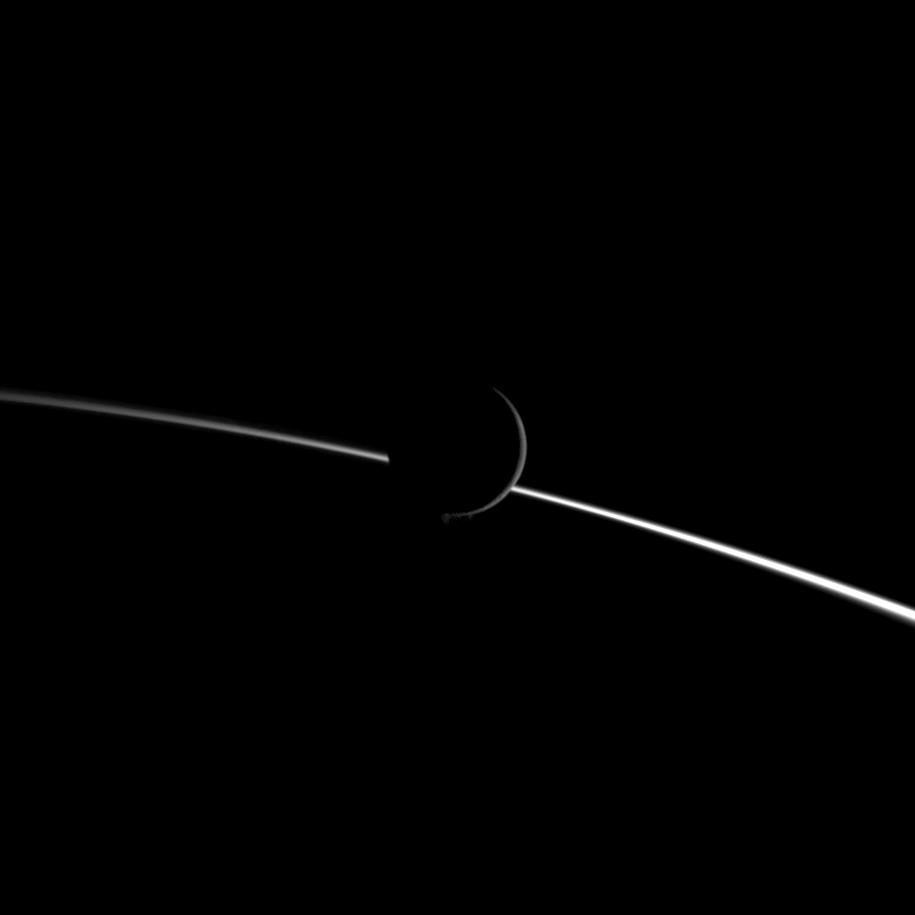
“August 13, 2010. Jets of water ice particles spew from Saturn’s moon Enceladus in this image obtained by NASA’s Cassini spacecraft. A crescent of the moon appears dimly illuminated in front of the bright limb of Saturn. This view looks toward the night side of Saturn, which occupies the lower half of the image. Enceladus, in the center of the image, is closer to the spacecraft than the planet is in this view. Sunlight scatters through the planet’s atmosphere and forms the bright diagonal line running from the left to right of the image. Lit terrain seen on Enceladus (504 kilometers, 313 miles across) is on the leading hemisphere of the moon. North on Enceladus is up. The jets erupting from the south polar region appear faint here, but can be seen at the bottom of the crescent of the moon.

The image was taken in visible light with the Cassini spacecraft wide-angle camera. The view was acquired at a distance of approximately 61,000 kilometers (38,000 miles) from Enceladus and at a sun-Enceladus-spacecraft, or phase, angle of 155 degrees. Image scale is 4 kilometers (2 miles) per pixel.”

“After almost 20 years in space, NASA’s Cassini spacecraft begins the final chapter of its remarkable story of exploration: its Grand Finale. Between April and September 2017, Cassini will undertake a daring set of orbits that is, in many ways, like a whole new mission. Following a final close flyby of Saturn’s moon Titan, Cassini will leap over the planet’s icy rings and begin a series of 22 weekly dives between the planet and the rings.

No other mission has ever explored this unique region. What we learn from these final orbits will help to improve our understanding of how giant planets – and planetary systems everywhere – form and evolve.

On the final orbit, Cassini will plunge into Saturn’s atmosphere, sending back new and unique science to the very end. After losing contact with Earth, the spacecraft will burn up like a meteor, becoming part of the planet itself.

Cassini’s Grand Finale is about so much more than the spacecraft’s final dive into Saturn. That dramatic event is the capstone of six months of daring exploration and scientific discovery. And those six months are the thrilling final chapter in a historic 20-year journey.”

Image credit: NASA


July 30, 2017

Soyuz MS-05 Launch and Docking

Posted by


NASA dixit:

“After launching earlier in the day in their Soyuz MS-05 spacecraft from the Baikonur Cosmodrome in Kazakhstan, Expedition 52-53 Soyuz Commander Sergey Ryazanskiy of Roscosmos and Flight Engineers Randy Bresnik of NASA and Paolo Nespoli of the European Space Agency arrived at the International Space Station on July 28.”

Video credit: NASA/Roscosmos


Wikipedia dixit:

“The Landsat program is the longest-running enterprise for acquisition of satellite imagery of Earth. On July 23, 1972 the Earth Resources Technology Satellite was launched. This was eventually renamed to Landsat. The most recent, Landsat 8, was launched on February 11, 2013. The instruments on the Landsat satellites have acquired millions of images. The images, archived in the United States and at Landsat receiving stations around the world, are a unique resource for global change research and applications in agriculture, cartography, geology, forestry, regional planning, surveillance and education, and can be viewed through the U.S. Geological Survey (USGS) ‘EarthExplorer’ website. Landsat 7 data has eight spectral bands with spatial resolutions ranging from 15 to 60 meters; the temporal resolution is 16 days. Landsat images are usually divided into scenes for easy downloading. Each Landsat scene is about 115 miles long and 115 miles wide (or 100 nautical miles long and 100 nautical miles wide, or 185 kilometers long and 185 kilometers wide).

[…] Landsat missions 1 through 5 carried the Landsat Multispectral Scanner (MSS), while missions 4 and 5 used the Landsat Thematic Mapper (TM) scanner. The Multispectral Scanner had a 230 mm (9 in) fused silica dinner-plate mirror epoxy bonded to three invar tangent bars mounted to base of a Ni/Au brazed Invar frame in a Serrurier truss that was arranged with four “Hobbs-Links” (conceived by Dr. Gregg Hobbs), crossing at mid-truss. This construct ensured the secondary mirror would simply oscillate about the primary optic axis to maintain focus despite vibration inherent from the 360 mm (14 in) beryllium scan mirror. This engineering solution allowed the United States to develop LANDSAT at least five years ahead of the French SPOT, which first used CCD arrays to stare without need for a scanner. However, LANDSAT data prices climbed from $250 per computer compatible data tape and $10 for black-and-white print to $4,400 for data tape and $2,700 for black-and-white print by 1984, making SPOT data a much more affordable option for satellite imaging data. This was a direct result of the commercialization efforts begun under the Carter administration, though finally completed under the Reagan administration.

The MSS FPA, or Focal Plane Array consisted of 24 square optical fibers extruded down to 0.005 mm (0.0002 in) square fiber tips in a 4×6 array to be scanned across the Nimbus spacecraft path in a ±6 degree scan as the satellite was in a 1.5 hour polar orbit, hence it was launched from Vandenberg Air Force Base. The fiber optic bundle was embedded in a fiber optic plate to be terminated at a relay optic device that transmitted fiber end signal on into six photodiodes and 18 photomultiplier tubes that were arrayed across a 7.6 mm (0.30 in) thick aluminum tool plate, with sensor weight balanced vs the 230 mm telescope on opposite side. This main plate was assembled on a frame, then attached to the silver-loaded magnesium housing with helicoil fasteners.

Key to the success of the multi spectral scanner was the scan monitor mounted on the underbelly of the magnesium housing. It consisted of a diode light source and a sensor mounted at the ends of four flat mirrors that were tilted so that it took 14 bounces for a beam to reflect the length of the three mirrors from source to sender. The beam struck the beryllium scan mirror seven times as it reflected seven times off the flat mirrors. The beam only sensed three positions, being both ends of scan and the mid scan, but by interpolating between these positions that was all that was required to determine where the multi spectral scanner was pointed. Using the scan monitor information the scanning data could be calibrated to display correctly on a map.”

Video credit: NASA Goddard


July 22, 2017

Propeller from Unlit Side

Posted by


NASA dixit:

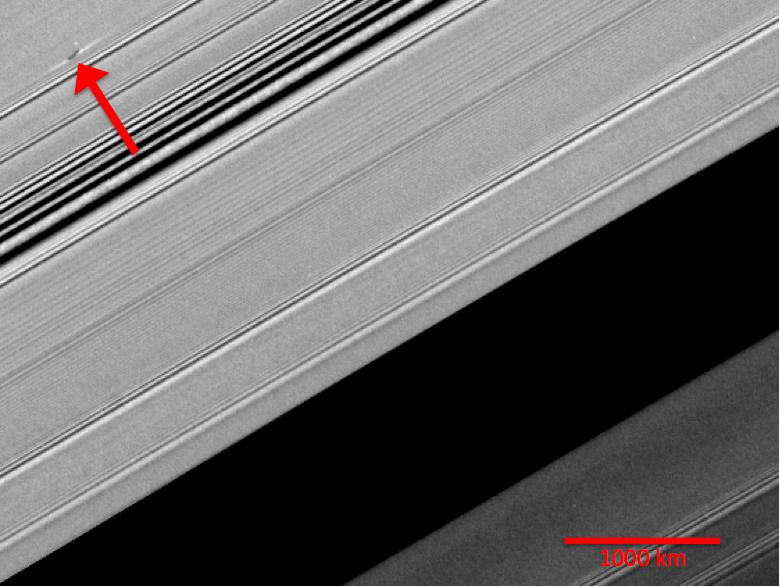
“August 19, 2008. A propeller-shaped structure created by an unseen moon appears dark in this image obtained by NASA’s Cassini spacecraft of the unilluminated side of Saturn’s rings. The propeller is marked with a red arrow in the top left of the annotated version of the image. The Encke Gap of Saturn’s A ring is in the lower right of the image. The A ring is the outermost of Saturn’s main rings. The moon, likely about a kilometer (half a mile) across, can’t be seen at this resolution. However, it is larger than other “propeller” moons and has cleared ring material from the bright (because they are less opaque) wing-like regions to its left and right in this image. Disturbed ring material close to the moon blocks more sunlight and appears like a dark airplane propeller.

Several density waves are visible in the ring, particularly in the upper left. A spiral density wave is a spiral-shaped accumulation of particles that tightly winds many times around the planet. It is the result of gravitational tugs by individual moons whose orbits are in resonance with the particles’ orbits at a specific distance from Saturn. A propeller’s appearance changes with viewing geometry, and this image shows the way a propeller looks when viewed from the unilluminated side of the rings. The dark structure at the center of this propeller corresponds to the bright structure seen in Sunlit Propeller, which was imaged from the sunlit side of the rings.

This image is part of a growing catalogue of “propeller” moons that, despite being too small to be seen, enhance their visibility by creating larger disturbances in the surrounding fabric of Saturn’s rings. Cassini scientists now have tracked several of these individual propeller moons embedded in Saturn’s disk over several years.

These images are important because they represent the first time scientists have been able to track the orbits of objects in space that are embedded in a disk of material. Continued monitoring of these objects may lead to direct observations of the interaction between a disk of material and embedded moons. Such interactions help scientists understand fundamental principles of how solar systems formed from disks of matter. Indeed, Cassini scientists have seen changes in the orbits of these moons, although they don’t yet know exactly what causes these changes.

Imaging scientists nicknamed the propeller shown here “Santos-Dumont” after the early Brazilian-French aviator Alberto Santos-Dumont. The propeller structure is 5 kilometers (3 miles) in the radial dimension (the dimension moving outward from Saturn which is far out of frame to the lower right of this image). It is 65 kilometers (40 miles) in the azimuthal (longitudinal) dimension. Scale in the original image was about 2 kilometers (1 mile) per pixel. The image has been rotated and contrast-enhanced to aid visibility. The cropped inset of the propeller included here was magnified by a factor of four.

This view looks toward the northern, unilluminated side of the rings from about 45 degrees above the ring plane. The image was taken in visible light with the Cassini spacecraft narrow-angle camera. The view was acquired at a distance of approximately 310,000 kilometers (193,000 miles) from Saturn and at a sun-Saturn-spacecraft, or phase, angle of 121 degrees.”

“After almost 20 years in space, NASA’s Cassini spacecraft begins the final chapter of its remarkable story of exploration: its Grand Finale. Between April and September 2017, Cassini will undertake a daring set of orbits that is, in many ways, like a whole new mission. Following a final close flyby of Saturn’s moon Titan, Cassini will leap over the planet’s icy rings and begin a series of 22 weekly dives between the planet and the rings.

No other mission has ever explored this unique region. What we learn from these final orbits will help to improve our understanding of how giant planets – and planetary systems everywhere – form and evolve.

On the final orbit, Cassini will plunge into Saturn’s atmosphere, sending back new and unique science to the very end. After losing contact with Earth, the spacecraft will burn up like a meteor, becoming part of the planet itself.

Cassini’s Grand Finale is about so much more than the spacecraft’s final dive into Saturn. That dramatic event is the capstone of six months of daring exploration and scientific discovery. And those six months are the thrilling final chapter in a historic 20-year journey.”

Image credit: NASA


July 22, 2017

Solar Eclipse

Posted by


Wikipedia dixit:

“As seen from the Earth, a solar eclipse is a type of eclipse that occurs when the Moon passes between the Sun and Earth, and the Moon fully or partially blocks (“occults”) the Sun. This can happen only at new moon when the Sun and the Moon are in conjunction as seen from Earth in an alignment referred to as syzygy. In a total eclipse, the disk of the Sun is fully obscured by the Moon. In partial and annular eclipses, only part of the Sun is obscured.

If the Moon were in a perfectly circular orbit, a little closer to the Earth, and in the same orbital plane, there would be total solar eclipses every month. However, the Moon’s orbit is inclined (tilted) at more than 5 degrees to the Earth’s orbit around the Sun (see ecliptic), so its shadow at new moon usually misses Earth. Earth’s orbit is called the ecliptic plane as the Moon’s orbit must cross this plane in order for an eclipse (both solar as well as lunar) to occur. In addition, the Moon’s actual orbit is elliptical, often taking it far enough away from Earth that its apparent size is not large enough to block the Sun totally. The orbital planes cross each other at a line of nodes resulting in at least two, and up to five, solar eclipses occurring each year; no more than two of which can be total eclipses. However, total solar eclipses are rare at any particular location because totality exists only along a narrow path on the Earth’s surface traced by the Moon’s shadow or umbra.

An eclipse is a natural phenomenon. Nevertheless, in some ancient and modern cultures, solar eclipses have been attributed to supernatural causes or regarded as bad omens. A total solar eclipse can be frightening to people who are unaware of its astronomical explanation, as the Sun seems to disappear during the day and the sky darkens in a matter of minutes.

Since looking directly at the Sun can lead to permanent eye damage or blindness, special eye protection or indirect viewing techniques are used when viewing a solar eclipse. It is technically safe to view only the total phase of a total solar eclipse with the unaided eye and without protection; however, this is a dangerous practice, as most people are not trained to recognize the phases of an eclipse, which can span over two hours while the total phase can only last a maximum of 7.5 minutes for any one location. People referred to as eclipse chasers or umbraphiles will travel to remote locations to observe or witness predicted central solar eclipses.”

Video credit: NASA Goddard