


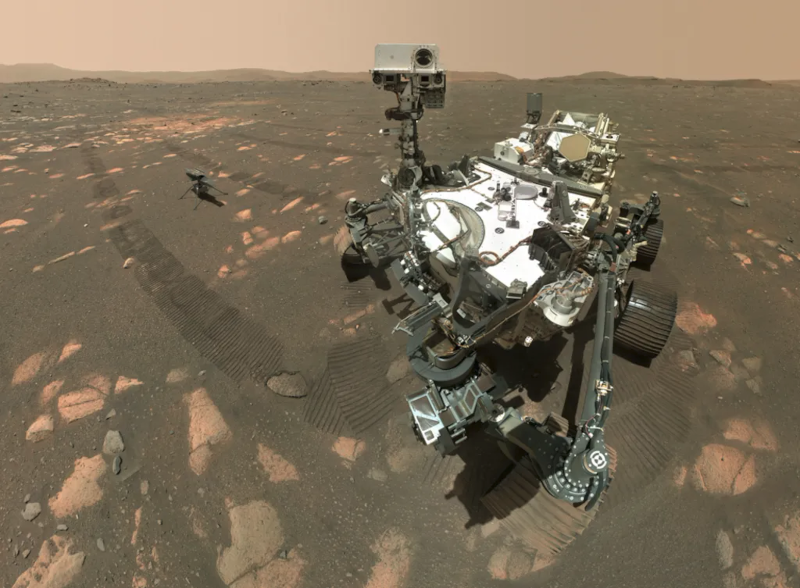
NASA’s Perseverance rover has entered a new era of autonomous exploration on Mars, with a system debuted in February 2026 that gives the vehicle GPS-like self-localization capabilities without requiring input from Earth. The Mars Global Localization system, first used in operations on February 2 and again on February 16, represents a fundamental shift in how the rover navigates the Martian surface, enabling longer drives with greater precision than ever before.
The system works by comparing navigation camera panoramas to stored orbital maps from the Mars Reconnaissance Orbiter. This matching process takes approximately two minutes and achieves positioning accuracy of 10 inches (25 centimeters), a dramatic improvement over previous visual odometry methods that accumulated errors potentially exceeding 100 feet over long drives. Previously, uncertainty about the rover’s precise position limited how far controllers would allow it to drive in a single sol, or Martian day.
The Mars Global Localization algorithm runs on hardware repurposed from the Ingenuity helicopter’s base station. This processor, roughly 100 times faster than the rover’s main computers and based on technology from the mid-2010s smartphone era, proved adequate for the computationally intensive matching process. The algorithm includes sanity checks to ensure reliability, preventing the rover from accepting obviously incorrect position estimates.
This development builds on earlier autonomy milestones. In December 2025, Perseverance completed its first fully AI-planned drives, with ground-based generative AI analyzing HiRISE orbital images and elevation data to generate safe waypoint paths. The rover drove 689 feet on December 8 and 807 feet on December 10, autonomously following routes that avoided boulders, sand ripples, bedrock, and outcrops identified by the AI system.
The combination of AI planning and autonomous localization has pushed the rover’s independence to approximately 90 percent of its travels without human input. This represents a fundamental shift in mission operations, where controllers no longer need to micromanage every aspect of each drive. The rover can receive high-level objectives and execute them with minimal oversight, dramatically increasing scientific productivity.
Perseverance continues its exploration of Jezero Crater, having traveled over 30 kilometers since landing on February 18, 2021. The vehicle has collected 24 rock and regolith samples, along with one air sample, for potential future return to Earth. Notably, the “Sapphire Canyon” sample collected from the Cheyava Falls rock in 2024 shows potential biosignatures that were validated in a September 2025 Nature paper, making it one of the most significant samples collected during the mission.
The autonomy advances have particular importance for future Mars missions. With the Mars Sample Return program effectively cancelled by Congress in January 2026, the samples collected by Perseverance will remain on the Martian surface indefinitely unless a new retrieval mission emerges. However, the technologies demonstrated by the rover pave the way for more ambitious autonomous explorers capable of operating independently across greater distances.
Navigating on Mars presents unique challenges absent in terrestrial robotics. The planet lacks any global navigation satellite system, meaning rovers cannot rely on GPS or GLONASS for positioning. Communication delays between Earth and Mars range from 4 to 24 minutes one way, making real-time remote control impossible and requiring the rover to make decisions autonomously.
Previous rovers used visual odometry, comparing successive images to estimate motion between positions. While effective for short distances, this method accumulates error over time as small estimation mistakes compound. After driving hundreds of meters, the rover’s position estimate might be significantly off, requiring ground controllers to carefully verify progress through orbital imagery.
The Mars Global Localization system sidesteps this problem by leveraging the extensive imaging data already collected by orbital missions. The Mars Reconnaissance Orbiter’s HiRISE camera has captured high-resolution images covering much of the Martian surface, creating a detailed map against which the rover can compare its own images. This approach works similarly to how facial recognition systems match images against databases.
The computational requirements for real-time image matching are substantial, requiring significant processing power to compare feature-rich navcam panoramas against large orbital map databases. The repurposed Ingenuity processor proved adequate for this task, demonstrating how hardware originally designed for one purpose can find new life in spacecraft applications.


 Subscribe to our RSS feed













There are no comments.
Add A Comment